Last updated: February 26, 2026
Key Takeaways
- Backlinks are votes of confidence from one website to another that signal authority and trustworthiness to search engines
- Quality beats quantity in 2026: One link from a highly authoritative, relevant source outperforms dozens of low-quality links[3]
- Context matters more than ever: Google evaluates links within your entire online presence, including brand mentions, co-citations, and topical authority[3]
- Link placement affects value: Editorial in-content links carry significantly more weight than footer or sidebar links
- Natural link profiles win: Google’s algorithms can detect manipulative link schemes and penalize sites that use them[3]
- No-follow links still provide value through traffic, brand visibility, and natural profile support[3]
- Relevance is critical: Links from topically related sites in your industry carry exponentially more ranking power than random links
- EEAT signals amplify backlink value: Expertise, Experience, Authoritativeness, and Trustworthiness now work together with backlinks as primary ranking drivers[1]
Quick Answer
Backlinks work in SEO by acting as endorsements that transfer authority from one website to another. When a reputable site links to your content, search engines interpret this as a signal that your content is valuable, trustworthy, and worth ranking higher. The quality, relevance, and context of these links matter far more than the total number, with Google’s 2026 algorithms evaluating links within your broader brand presence and topical authority[3].
What Are Backlinks and Why Do They Matter?
Backlinks are hyperlinks from external websites that point to pages on your site. They function as votes of confidence in the eyes of search engines, signaling that your content provides value worth referencing.
Think of backlinks as professional recommendations. When an established industry publication links to your research, it tells Google that experts in your field consider your work credible and useful. This trust signal influences how search engines rank your pages.
Here’s why backlinks remain essential in 2026:
- Authority transfer: Links pass “link equity” or “link juice” from the source site to your site
- Discovery mechanism: Search engine crawlers find new pages by following links between sites
- Ranking factor: Backlinks remain one of Google’s core ranking signals, though quality now matters more than quantity[3]
- Traffic source: Quality backlinks drive referral visitors who are already interested in your topic
- Brand credibility: Links from respected sources build your reputation and industry standing
The relationship between backlinks and rankings isn’t simple math. A single link from a highly authoritative, topically relevant source carries exponentially more value than dozens of links from marginally related or low-quality sites[3]. Understanding how Google’s index differs from backlink indexes helps clarify how search engines process and value these connections.
How Backlinks Work in SEO: The Technical Mechanics
Search engines use backlinks to discover content, evaluate authority, and determine rankings by following links between sites and analyzing the context, source quality, and relevance of each connection.
When a search engine crawler encounters a link, it performs several evaluations:
Link Discovery and Crawling
- Crawlers follow links from known pages to discover new content
- The crawler indexes the destination page if it’s accessible and valuable
- Link relationships get stored in the search engine’s link graph database
- Crawl priority increases for pages with more high-quality backlinks
Authority and Trust Signals
Google’s algorithms analyze multiple factors to determine how much weight a backlink carries:
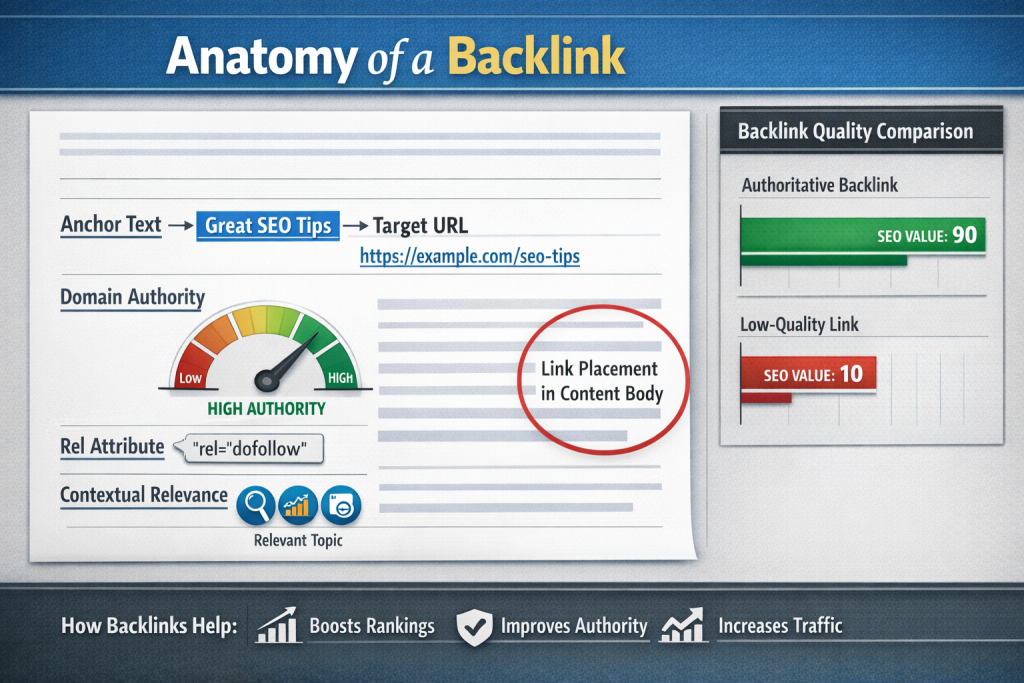
- Source domain authority: Links from established, trusted sites pass more value
- Topical relevance: Links from sites in related industries carry more weight than random links
- Page-level authority: The specific page linking to you matters, not just the domain
- Link placement: Editorial in-content links outperform footer, sidebar, or comment links
- Anchor text: The clickable text provides context about your page’s topic
- Link context: Surrounding content and co-citations affect link interpretation
The Broader Context Evaluation
Google’s algorithms now evaluate links within a comprehensive context of your entire online presence, considering brand mentions, co-citations, entity relationships, and topical authority—not just the link itself[3]. This means your backlink profile works together with your EEAT signals (Expertise, Experience, Authoritativeness, Trustworthiness) to determine rankings[1].
Common mistake: Focusing solely on acquiring links while neglecting brand-building activities like podcasts, interviews, and social proof diminishes the impact of your backlink efforts[1].
What Makes a Backlink Valuable in 2026?
A valuable backlink comes from a relevant, authoritative source, appears naturally within editorial content, and connects to your site because your content genuinely deserves the reference.
Not all backlinks provide equal SEO benefit. Here’s what separates high-value links from low-quality ones:
Quality Indicators
| Factor | High Value | Low Value |
|---|---|---|
| Source relevance | Same industry/topic | Unrelated niche |
| Domain authority | Established, trusted site | New or spammy site |
| Link placement | Editorial in-content | Footer/sidebar |
| Anchor text | Natural, varied | Exact match, repetitive |
| Link context | Surrounded by relevant content | Random insertion |
| Traffic potential | Active, visited page | Dead or low-traffic page |
| Link type | Earned through merit | Paid or exchanged |
Best Backlink Sources in 2026
The most valuable backlinks come from[3]:
- Relevant industry websites: Trade publications, professional associations, and niche authorities in your field
- Trusted news and media sites: Established journalism outlets with editorial standards
- Local authority sources: Educational institutions (.edu) and government sites (.gov) when topically appropriate
- Editorial in-content links: References within the main body of quality articles
- Brand mention links: Links added when publications naturally discuss your company or work
Choose guest post backlinks carefully—success now requires contributing genuinely exceptional content to select, highly relevant publications rather than churning out mediocre posts solely for links[3].
What Diminishes Backlink Value
Avoid these link sources that provide minimal benefit or risk penalties:
- Link farms or private blog networks (PBNs)
- Irrelevant directory submissions
- Comment spam or forum signature links
- Reciprocal link exchanges done at scale
- Paid links without proper disclosure
- Links from penalized or low-quality sites
Edge case: No-follow links (marked with rel=”nofollow”) still provide meaningful SEO benefits by driving traffic, increasing brand visibility, and supporting natural link profiles as part of overall trust signals[3]. Don’t dismiss them entirely.
How Do Search Engines Use Backlinks for Rankings?
Search engines incorporate backlink data into ranking algorithms by measuring the quantity, quality, and relevance of links pointing to each page, then using this as a major signal of content value and authority.
The process involves several algorithmic components:
PageRank and Authority Flow
Google’s foundational PageRank algorithm (still used in evolved form) treats links as votes, with each link passing a portion of the source page’s authority to the destination. Pages with more high-quality backlinks accumulate more authority, which helps them rank higher and pass more value through their own outbound links.
Relevance and Topical Authority
Modern search algorithms don’t just count links—they evaluate topical relationships. A link from a respected marketing blog carries more weight for marketing content than a link from an unrelated cooking site, even if both domains have similar authority metrics.
Google builds entity graphs that map relationships between topics, sites, and concepts. Links that fit naturally within these topical clusters signal genuine relevance.
Trust and Spam Detection
Google’s algorithms have become exceptionally sophisticated at identifying whether a link was earned through merit or obtained through manipulation, with severe penalties for manipulative link schemes[3]. The system analyzes:
- Link velocity: Sudden spikes in backlinks trigger scrutiny
- Pattern recognition: Unnatural link patterns (identical anchor text, same IP ranges) raise red flags
- Source quality: Links from known spam networks get discounted or penalized
- User behavior: If users click links and engage with content, it validates link quality
Integration with EEAT Signals
In 2026, backlinks work most effectively when combined with strong Expertise, Experience, Authoritativeness, and Trustworthiness signals[1]. Search engines look for consistency between your link profile and other brand signals like:
- Third-party reviews and mentions
- Author credentials and bylines
- Social media presence and engagement
- Podcast appearances and interviews
- Industry recognition and awards
Websites written by people with real lived experience increasingly outrank faceless corporate blogs, especially in competitive spaces[1][2]. Your backlinks amplify this personal authority when they come from sources that recognize your genuine expertise.
How Can You Build High-Quality Backlinks?
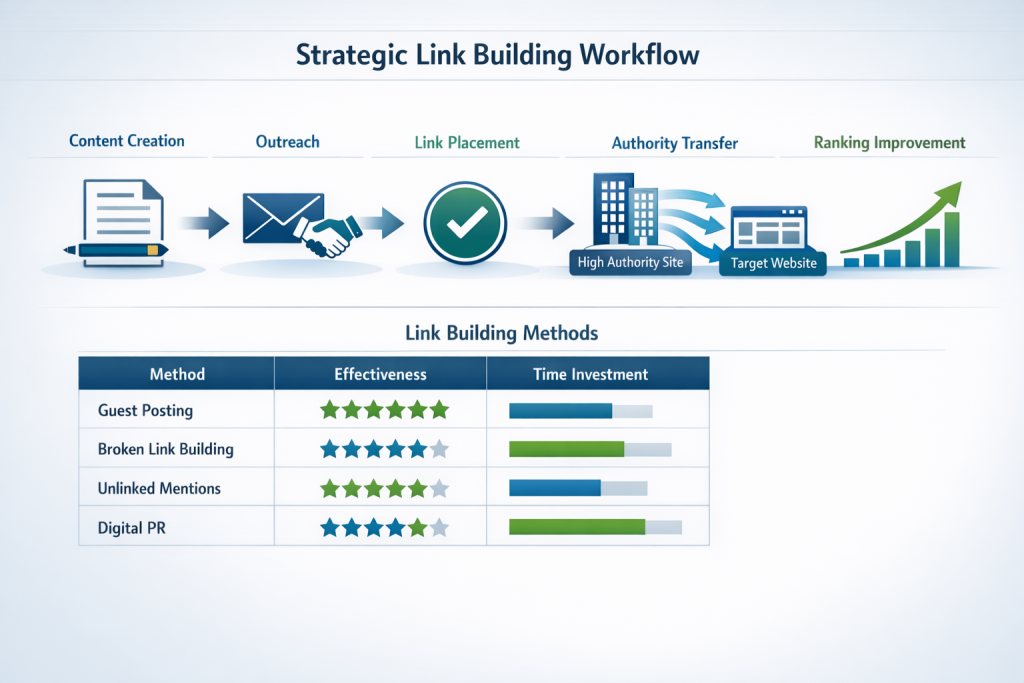
Build high-quality backlinks by creating genuinely valuable content that deserves references, building relationships with industry peers, and strategically promoting your work to relevant audiences who will naturally want to link to it.
Effective link building in 2026 requires a shift from manipulation to merit-based strategies:
Create Link-Worthy Content
Before pursuing links, ensure you have content worth linking to:
- Original research and data: Conduct surveys, analyze trends, or compile industry statistics
- Comprehensive guides: Create the most thorough resource on a specific topic
- Visual assets: Develop infographics, charts, or tools others want to embed
- Expert insights: Share unique perspectives based on real experience
- Case studies: Document real results with specific data and lessons
Strategic Outreach Methods
Unlinked brand mentions offer one of the highest-success link building opportunities, with conversion rates often reaching 30-50% or better[3]. Find existing mentions of your brand without links, then politely request the author add a hyperlink.
Other effective outreach approaches:
- Broken link building: Find broken links on authoritative pages in your niche, then suggest your relevant content as a replacement (focus on high-value opportunities rather than mass targeting)[3]
- Resource page additions: Identify curated resource lists where your content fits naturally
- Digital PR: Create newsworthy content or data that journalists want to cover
- Expert contributions: Offer genuine expertise for roundup posts or expert quotes
Relationship-Based Link Building
When you’re known and respected in your field, people naturally mention your content, reference your work in resources, and invite you to contribute to collaborative projects, generating valuable backlinks through earned merit[3].
Build these relationships by:
- Engaging authentically on social media with industry peers
- Commenting thoughtfully on relevant blogs and publications
- Speaking at industry events and webinars
- Participating in professional communities
- Collaborating on research or content projects
Decision rule: Choose guest posting only if you can contribute genuinely exceptional content to highly relevant publications. The outdated model of churning out mediocre guest posts solely for links is dead and can trigger penalties[3].
Avoid These Link Building Mistakes
- Prioritizing quantity over quality: One strong backlink outperforms dozens of low-quality links[3]
- Ignoring relevance: Links from unrelated sites provide minimal value
- Using manipulative schemes: Google detects and penalizes artificial link patterns
- Neglecting brand building: Links work best when supported by broader EEAT signals[1]
- Forgetting about existing assets: Convert unlinked mentions before pursuing new links
For structured link building campaigns, consider services like multi-tier backlinks that create supporting link layers, but ensure they follow quality and relevance guidelines.
How Long Does It Take for Backlinks to Affect Rankings?
Backlinks typically begin affecting rankings within 4-10 weeks after Google discovers and processes them, though the full impact may take 3-6 months as search engines evaluate link quality, relevance, and integration with other ranking signals.
The timeline varies based on several factors:
Discovery and Indexing Phase (1-4 weeks)
- Google must first crawl the page containing your backlink
- High-authority sites get crawled more frequently (daily or weekly)
- Lower-authority sites may take weeks between crawls
- You can speed discovery by submitting the linking page URL to Google Search Console
Processing and Evaluation (2-6 weeks)
- Google’s algorithms analyze the link’s context, source quality, and relevance
- The link gets integrated into Google’s link graph
- Initial ranking adjustments may occur as the link is processed
- Broader contextual evaluation happens alongside other signals[3]
Full Impact Realization (2-6 months)
- Rankings stabilize as the link’s value is fully incorporated
- The impact becomes clearer as Google observes user behavior signals
- Additional links compound the effect over time
- EEAT signals and brand mentions amplify backlink value[1]
Variables that affect timing:
- Source authority: Links from frequently crawled, high-authority sites impact rankings faster
- Your site’s crawl rate: Established sites see faster updates than new sites
- Competitive landscape: Highly competitive keywords require more time and links to move rankings
- Link quality: High-quality, relevant links show impact sooner than marginal links
- Existing authority: Sites with established authority see faster results from new links
Common mistake: Expecting immediate ranking jumps from a single backlink. SEO works cumulatively, with each quality link contributing to long-term authority growth.
Do No-Follow Links Help SEO?
Yes, no-follow links still provide meaningful SEO benefits in 2026 by driving traffic, increasing brand visibility, supporting natural link profiles, and contributing to overall trust signals, even though they don’t directly pass PageRank.
The rel=”nofollow” attribute tells search engines not to follow a link or pass authority. Despite this technical limitation, no-follow links offer value:
Direct Benefits
- Referral traffic: Visitors click no-follow links just as readily as do-follow links
- Brand exposure: Links from high-traffic sites increase awareness regardless of follow status
- Natural profile balance: A mix of follow and no-follow links appears more organic
- Discovery: Search engines still crawl no-follow links to discover new content
- Indirect signals: Traffic and engagement from no-follow links send positive user signals
Strategic Value
A healthy backlink profile includes both do-follow and no-follow links. Sites with exclusively do-follow links may appear manipulative to search algorithms. No-follow links from sources like:
- Social media platforms
- Wikipedia references
- News site comments
- Forums and community discussions
- Some guest post platforms
…all contribute to a natural, diverse link profile that supports your broader SEO efforts[3].
Edge case: Some high-authority sites (Wikipedia, major news outlets) use no-follow by default, but links from these sources still carry significant value through traffic, credibility, and brand association.
Don’t ignore no-follow opportunities—pursue them when they offer traffic potential or brand visibility benefits.
How Many Backlinks Do You Need to Rank?
The number of backlinks needed varies dramatically based on keyword competition, with low-competition terms potentially ranking with 5-10 quality links, while highly competitive keywords may require hundreds of authoritative backlinks plus strong EEAT signals.
There’s no universal answer because ranking depends on:
Competition Level
- Low competition (long-tail keywords): 5-20 quality backlinks may suffice
- Medium competition (niche industry terms): 20-100 relevant backlinks typically needed
- High competition (broad commercial terms): 100+ authoritative backlinks required, plus strong brand signals
Quality vs. Quantity Trade-off
One link from a highly authoritative, topically relevant source now carries exponentially more value than dozens of links from marginally related or low-quality sites[3]. Focus on acquiring fewer, better links rather than maximizing link count.
Example: A single link from an industry-leading publication might provide more ranking power than 50 links from low-authority blogs.
Other Ranking Factors
Backlinks work alongside multiple ranking signals:
- Content quality: Comprehensive, well-written content ranks better with the same links
- EEAT signals: Expertise, Experience, Authoritativeness, and Trustworthiness now function as primary ranking drivers[1]
- User experience: Page speed, mobile-friendliness, and engagement metrics matter
- Brand reputation: Social proof through podcasts, interviews, and third-party reviews amplifies link value[1]
- Technical SEO: Proper site structure and indexability enable links to work effectively
Competitive Analysis Approach
Instead of targeting a specific link number:
- Analyze top-ranking competitors for your target keyword
- Review their backlink profiles using tools like Ahrefs or SEMrush
- Identify quality benchmarks: Note the authority and relevance of their links
- Aim to match or exceed their quality profile, not just quantity
- Monitor progress and adjust strategy based on ranking movement
Decision rule: If you’re in a competitive niche, invest in comprehensive backlink packages that provide both quantity and quality, but always prioritize relevance and natural placement.
For local businesses, specialized links like Google Map citations can provide targeted value beyond general backlink metrics.
What’s the Difference Between Internal and External Links?
Internal links connect pages within your own website, while external links (backlinks) connect from other websites to yours—both serve different SEO purposes, with internal links helping site structure and navigation while external links build authority and trust signals.
Understanding this distinction helps optimize both link types:
Internal Links
Purpose: Help users navigate your site and distribute PageRank among your pages
- Control: You have complete control over internal linking
- Anchor text: You can optimize anchor text without appearing manipulative
- Site structure: Internal links establish hierarchy and topical relationships
- Crawling: Help search engines discover and index all your pages
- User experience: Guide visitors to related, valuable content
Best practices:
- Link to relevant related content naturally within articles
- Use descriptive anchor text that indicates destination content
- Maintain a logical site structure with important pages closer to homepage
- Ensure every page is reachable within 3-4 clicks from the homepage
External Links (Backlinks)
Purpose: Build authority, trust, and referral traffic from other websites
- Control: Limited—you must earn or request these links
- Authority transfer: Pass link equity from source to destination
- Trust signals: Indicate third-party validation of your content
- Discovery: Help search engines find and evaluate your site
- Ranking impact: Major influence on search engine rankings
Best practices:
- Focus on earning links from relevant, authoritative sources
- Build diverse link profiles with varied anchor text
- Monitor backlink quality and disavow harmful links
- Combine link building with broader brand-building activities[1]
How They Work Together
Both link types contribute to SEO success:
- External links bring authority to your domain
- Internal links distribute that authority strategically across your pages
- Strong internal linking helps new pages benefit from your existing backlink profile
- Quality external links to well-structured sites amplify overall ranking potential
Common mistake: Obsessing over backlinks while neglecting internal linking structure. Optimize both for maximum SEO impact.
How Has Link Building Changed in 2026?
Link building in 2026 prioritizes quality, relevance, and brand-building over quantity, with search engines evaluating links within broader context of EEAT signals, brand mentions, and topical authority rather than treating them as isolated ranking factors.
Several major shifts have transformed link building strategy:
From Quantity to Quality
The days of mass link building are over. Google’s algorithms now evaluate links with unprecedented sophistication, detecting manipulative patterns and rewarding genuinely earned endorsements[3]. Success requires:
- Selective targeting: Focus on fewer, higher-quality link opportunities
- Relevance prioritization: Links from topically related sources carry exponentially more weight
- Merit-based acquisition: Create content that deserves links rather than manipulating placements
Broader Contextual Evaluation
Google no longer evaluates backlinks in isolation. The algorithms now consider your entire online presence, including brand mentions, co-citations, entity relationships, and topical authority[3]. This means:
- Brand building matters: Podcast appearances, interviews, and social media presence amplify link value[1]
- Unlinked mentions count: Brand visibility contributes to authority even without direct links
- Entity recognition: Google understands your brand’s relationships within your industry
- EEAT integration: Links work best when supported by strong expertise and trust signals[1]
Evolution of Specific Tactics
Guest posting: The outdated model of churning out mediocre guest posts solely for links is dead and can trigger penalties. Success now requires contributing genuinely exceptional content to select, highly relevant publications[3].
Broken link building: This classic strategy remains effective but requires strategic refinement—focus on high-value opportunities by targeting broken links on authoritative, topically relevant pages that still receive traffic[3].
Unlinked mentions: Converting existing brand mentions into actual backlinks has become highly efficient, with success rates often reaching 30-50% or better because requesting a link from someone who’s already mentioned you is natural and reasonable[3].
The Rise of Brand Reputation
Brand reputation has become a core ranking and visibility signal, with smaller blogs written by people with real lived experience increasingly outranking faceless corporate blogs, especially in competitive spaces[1][2]. Your backlinks should reflect and reinforce this personal authority.
What Still Works
Despite these changes, certain fundamentals remain constant:
- Quality content: Creating genuinely valuable resources still attracts natural links
- Relationship building: Authentic industry connections generate sustainable link opportunities
- Relevance: Links from related sites in your niche still carry the most weight
- Natural patterns: Organic link acquisition still outperforms manipulative schemes
Link building definitively still works in 2026 and remains a core ranking factor; however, success depends on link quality, relevance, and placement rather than the number of backlinks[3].
For current strategies that align with 2026’s SEO landscape, explore case studies showing real results from quality-focused link building.
FAQ
What is a backlink in simple terms?
A backlink is a link from one website to another. When Website A links to Website B, that’s a backlink for Website B. Think of it as a recommendation or vote of confidence that tells search engines the linked content is valuable.
How do I know if a backlink is good quality?
A quality backlink comes from a relevant, authoritative website in your industry, appears naturally within editorial content (not footer or sidebar), uses natural anchor text, and connects to your site because your content genuinely deserves the reference. Check the source site’s reputation, traffic, and topical relevance.
Can backlinks hurt my SEO?
Yes, backlinks from spammy, penalized, or irrelevant sites can harm your rankings. Google may interpret low-quality link patterns as manipulation attempts and apply penalties. Use Google Search Console to monitor your backlink profile and disavow harmful links when necessary.
How long do backlinks last?
Backlinks last as long as the linking page remains published and accessible. Some links stay active for years, while others disappear when content gets updated or removed. Monitor your backlink profile regularly to track gains and losses.
Should I buy backlinks?
No. Buying backlinks violates Google’s guidelines and risks severe penalties. Focus on earning links through quality content, relationship building, and legitimate outreach. If you use link building services, ensure they follow white-hat practices and earn links naturally.
Do social media links count as backlinks?
Social media links are typically no-follow and don’t directly pass PageRank, but they still provide SEO value through traffic, brand visibility, and natural profile diversity. They also contribute to broader brand signals that search engines consider alongside backlinks[3].
How many backlinks should I build per month?
There’s no ideal number—focus on quality over quantity. Natural link building happens at varying rates. A sudden spike in hundreds of links appears suspicious, while steady acquisition of 5-10 quality links monthly looks organic. Let content value and outreach success determine pace.
What’s the difference between do-follow and no-follow links?
Do-follow links pass PageRank and authority to the destination site, directly influencing rankings. No-follow links include a rel=”nofollow” attribute that tells search engines not to pass authority, but they still provide value through traffic, visibility, and natural profile balance[3].
Can I remove bad backlinks pointing to my site?
You can’t directly remove links from other sites, but you can request removal by contacting site owners or use Google’s Disavow Tool to tell Google to ignore specific harmful links. Focus on building quality links rather than obsessing over every low-quality link.
Do backlinks from .edu and .gov sites rank higher?
Not automatically. While .edu and .gov domains often have high authority and trust, the link’s value depends on relevance and context. A relevant link from a .edu site in your field carries weight, but an irrelevant .edu link provides minimal benefit.
How do I find my competitors’ backlinks?
Use SEO tools like Ahrefs, SEMrush, Moz, or free tools like Google Search Console and Bing Webmaster Tools. Enter your competitor’s domain to see their backlink profile, including source domains, anchor text, and link quality metrics.
What is anchor text and why does it matter?
Anchor text is the clickable text in a hyperlink. It provides context to search engines about the destination page’s topic. Natural, varied anchor text looks organic, while repetitive exact-match anchor text appears manipulative and can trigger penalties.
🔗 Backlink Quality Analyzer
Evaluate the potential SEO value of a backlink based on key quality factors
Recommendations
Conclusion
Understanding how backlinks work in SEO is essential for anyone serious about improving search rankings in 2026. Backlinks remain a core ranking factor, but success now depends entirely on quality, relevance, and context rather than quantity. Search engines evaluate links within your broader brand presence, considering EEAT signals, brand mentions, and topical authority alongside traditional link metrics[1][3].
The most effective approach combines creating genuinely valuable content that deserves links with strategic relationship building and merit-based outreach. Focus on earning links from authoritative, topically relevant sources rather than pursuing manipulative schemes that Google’s sophisticated algorithms can easily detect and penalize[3].
Next Steps
Start improving your backlink profile today:
- Audit your current backlinks using Google Search Console or specialized tools to identify quality gaps
- Create link-worthy content based on original research, comprehensive guides, or unique insights from real experience
- Find and convert unlinked brand mentions for quick wins with 30-50% success rates[3]
- Build genuine industry relationships through social engagement, expert contributions, and collaborative projects
- Monitor competitors’ backlink profiles to identify high-value link opportunities in your niche
- Strengthen EEAT signals through podcasts, interviews, reviews, and social proof to amplify link value[1]
- Focus on relevance by targeting sites in your industry rather than chasing high-authority but unrelated links
Remember that backlinks work best as part of a comprehensive SEO strategy that includes quality content, strong brand signals, and excellent user experience. The sites that win in 2026 combine authoritative backlink profiles with genuine expertise and trustworthiness that both search engines and users can recognize.
For additional guidance on building effective link strategies, explore SEO case studies and expert SEO resources that demonstrate real-world results from quality-focused approaches.
References
[1] Seo Trends 2026 – https://www.marketermilk.com/blog/seo-trends-2026
[2] 2026 Seo Predictions – https://envisionitagency.com/blog/2026-seo-predictions/
[3] Link Building In 2026 What Actually Works – https://www.ingenioushitech.com/blog/link-building-in-2026-what-actually-works