Last updated: February 27, 2026
Understanding backlink examples in SEO helps website owners identify which link building strategies actually move the needle for search rankings. A backlink is simply a link from one website to another, and search engines like Google use these links as votes of confidence to determine which sites deserve higher rankings. This guide breaks down real backlink examples in SEO, showing exactly what works, what doesn’t, and how to replicate successful link building campaigns for your own site.
Key Takeaways
- Dofollow backlinks from authoritative sites pass direct ranking power, while nofollow links still provide referral traffic and brand visibility
- Guest posts on relevant industry blogs remain one of the most reliable ways to earn quality editorial backlinks when you provide unique, valuable content
- Original research and data studies attract natural backlinks because other publishers cite your statistics and findings in their own content
- Podcast appearances offer low-effort, high-reward backlink opportunities through show notes and episode pages
- Unlinked brand mentions represent a goldmine—approximately 77% of brand mentions online lack links, creating easy outreach opportunities
- Competitor backlink analysis reveals exactly where your rivals earn their best links, giving you a roadmap for your own campaigns
- Contextual backlinks embedded within relevant content carry more weight than footer or sidebar links
- Digital PR campaigns work best for established sites with domain authority between 30-50 looking to earn high-authority media links
Quick Answer
Backlink examples in SEO include guest posts on industry blogs, podcast show notes, citations from original research, resource page listings, digital PR mentions in news outlets, and contextual links within relevant content. The most effective backlinks come from high-authority domains in your niche, appear within the main content (not footers or sidebars), and use dofollow attributes to pass ranking power. Successful link building in 2026 focuses on creating linkable assets like data studies, comprehensive guides, and tools that naturally attract editorial links rather than relying on outdated tactics like directory submissions or link exchanges.
What Are Backlink Examples in SEO and Why Do They Matter?
Backlink examples in SEO demonstrate the specific types of links that improve search rankings and drive organic traffic. A backlink occurs when one website links to another, and search engines interpret these links as endorsements that signal trust, authority, and relevance.
Not all backlinks carry equal weight. The value of a backlink depends on several factors:
- Source authority: Links from established, reputable websites with strong domain authority carry more ranking power than links from new or low-quality sites
- Relevance: A backlink from a website in your industry or niche signals topical authority better than random, unrelated links
- Link placement: Editorial links within main content outperform footer, sidebar, or comment section links
- Link attributes: Dofollow links pass ranking power directly, while nofollow links don’t transfer SEO value but still provide referral traffic
Understanding why backlinks are important for SEO helps you prioritize which link building strategies deserve your time and resources. Search engines use backlinks as one of their top ranking signals because links represent genuine endorsements from other content creators.
Common mistake: Many site owners chase quantity over quality, building hundreds of low-value links instead of focusing on a smaller number of high-authority, relevant backlinks. Ten links from authoritative industry publications typically outperform 100 links from random directories or low-quality blogs.
What Types of Backlinks Work Best in 2026?
The most effective backlinks in 2026 come from editorial placements on high-authority, relevant websites where the link appears naturally within valuable content.
Dofollow vs. Nofollow Backlinks
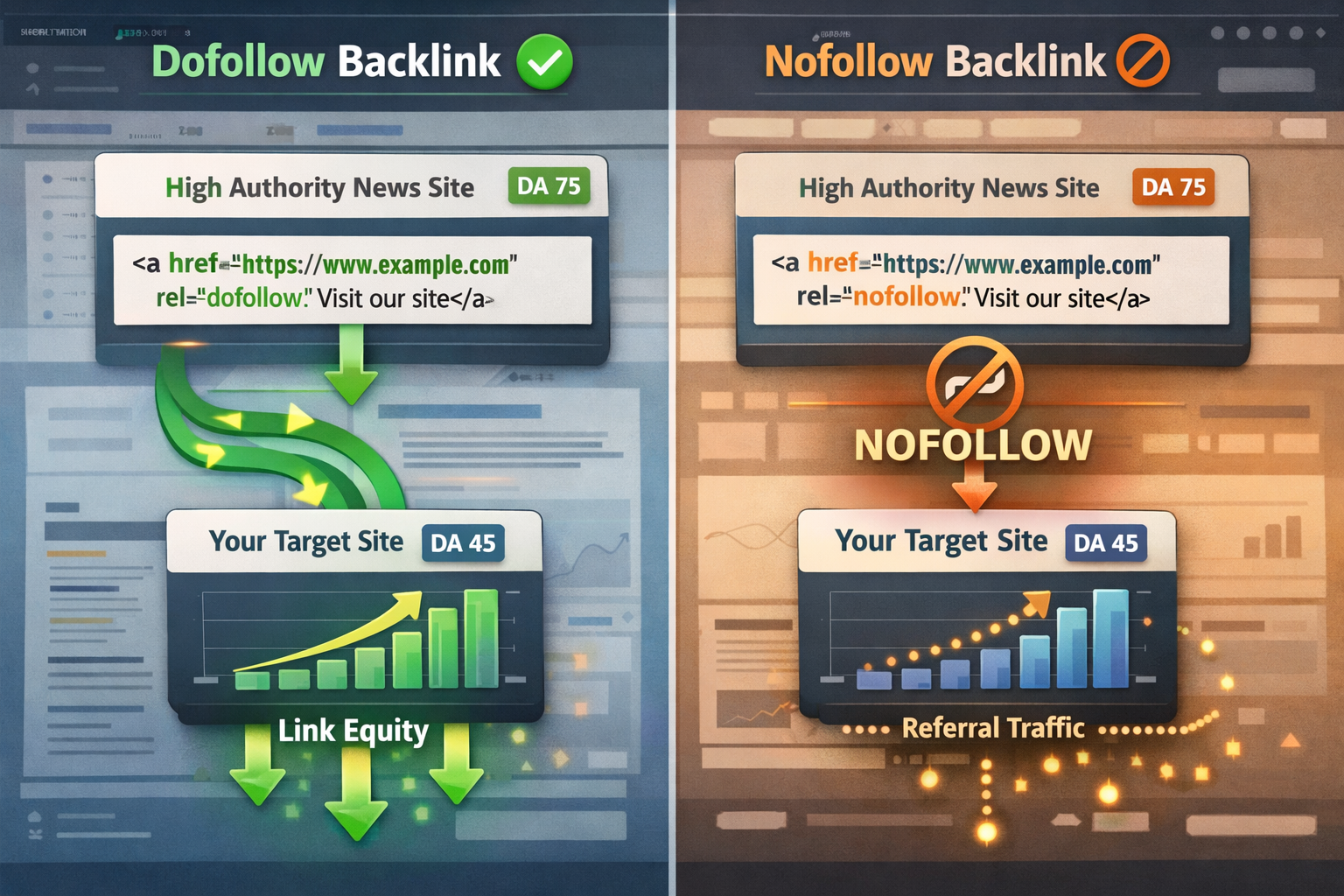
Dofollow backlinks pass SEO value directly from the linking site to your site, contributing to higher search rankings. These links tell search engines to count the link as an endorsement. Industry benchmarks suggest aiming for a 60-70% dofollow ratio in your backlink profile.
Nofollow backlinks include a rel=”nofollow” attribute that instructs search engines not to pass ranking power. While they don’t directly boost rankings, nofollow links still provide referral traffic, brand exposure, and diversify your link profile naturally.
Example HTML code:
- Dofollow:
<a href="https://example.com">anchor text</a> - Nofollow:
<a href="https://example.com" rel="nofollow">anchor text</a>
Learn more about dofollow vs nofollow backlinks explained to understand when each type appears in your link profile.
High-Authority Editorial Links
Links from reputable, established websites with strong domain authority and clean backlink profiles remain the most valuable type. These include:
- News publications: Links from industry news sites, local newspapers, or national media outlets
- Educational institutions: .edu domains from universities and colleges
- Government websites: .gov domains from official government resources
- Industry associations: Professional organizations and trade groups
- Established blogs: Long-running, authoritative blogs in your niche
What is a high authority backlink explains how to identify and earn these valuable links for your site.
Contextual Backlinks
Contextual backlinks appear within the main content of a page, surrounded by relevant text that relates to your topic. These links signal to search engines that your site belongs in its niche, increasing trust scores.
A contextual backlink example: A digital marketing blog publishes an article about content strategy and includes a link to your SEO guide within a paragraph discussing keyword research because your guide provides additional value to their readers.
Non-contextual links appear in footers, sidebars, author bios, or comment sections and carry less weight. For more details, see our guide on what is a contextual backlink.
Choose contextual links when: You want maximum SEO impact from each backlink and can create content valuable enough to earn in-content editorial placements.
Real Backlink Examples in SEO: Guest Posts and Contributed Content
Guest posting involves writing original articles for other websites in your industry, typically with an author bio link or contextual link back to your site. This strategy remains one of the most reliable ways to earn quality editorial backlinks when executed properly.
How Guest Posts Work as Backlinks
A successful guest post backlink example:
- A marketing agency identifies relevant industry blogs by searching “digital marketing + ‘write for us'” or “SEO + ‘contributor guidelines'”
- They pitch a unique topic that fills a content gap on the target site
- The agency writes a comprehensive, original article (not recycled content used elsewhere)
- The published post includes 1-2 contextual links to relevant resources on the agency’s website
- The author bio contains a link to the agency’s homepage or service page
Key success factors:
- Target websites with domain authority similar to or higher than your own
- Pitch topics that align with the host site’s audience and content strategy
- Provide genuinely valuable, well-researched content (not thinly-veiled promotional material)
- Include data, examples, and actionable advice readers can implement
- Build ongoing relationships rather than one-off placements
Finding Guest Post Opportunities
Search operators to find guest posting opportunities:
- “your niche + write for us”
- “your niche + guest post guidelines”
- “your niche + become a contributor”
- “your niche + submit a guest post”
- intitle:”write for us” + “your keyword”
Rather than sending identical pitches to multiple sites, customize each outreach email to reference specific articles on the target site and explain how your proposed topic complements their existing content.
Common mistake: Submitting the same article to multiple websites creates duplicate content issues and damages your reputation with editors. Each guest post should be 100% original content written specifically for that publication.
Backlink Examples in SEO: Original Research and Data Studies
Original research, surveys, and data studies attract natural backlinks because other publishers cite your statistics and findings in their own content. This strategy creates linkable assets that continue earning backlinks long after publication.
Why Original Data Earns Backlinks
When you publish unique data or research findings, other content creators reference your study as a source, creating natural editorial backlinks. AI Overviews and featured snippets frequently cite original studies, increasing visibility and link opportunities.
Real-world example: A SaaS company surveys 1,000 industry professionals about their marketing budgets, publishes the findings in a comprehensive report, and earns 50+ backlinks over six months as marketing blogs, news sites, and industry publications cite their statistics.
Creating Linkable Research Assets
Steps to create research that earns backlinks:
- Identify data gaps in your industry where no recent statistics exist
- Conduct surveys using tools like Google Forms, Typeform, or SurveyMonkey
- Analyze results and identify surprising or newsworthy findings
- Publish findings in multiple formats: blog post, PDF report, infographic, data visualizations
- Promote actively by reaching out to journalists, bloggers, and publications that cover your industry
- Make data accessible with embed codes for graphics and clear citation guidelines
Types of original research that attract links:
- Industry surveys and benchmark reports
- Trend analysis and year-over-year comparisons
- Case studies with specific results and methodologies
- Proprietary data from your customer base or platform
- Experimental studies testing common assumptions
Choose this strategy if you have access to unique data sources, can invest in survey distribution, or possess expertise to analyze existing data in new ways.
Podcast Appearances and Show Notes Backlinks
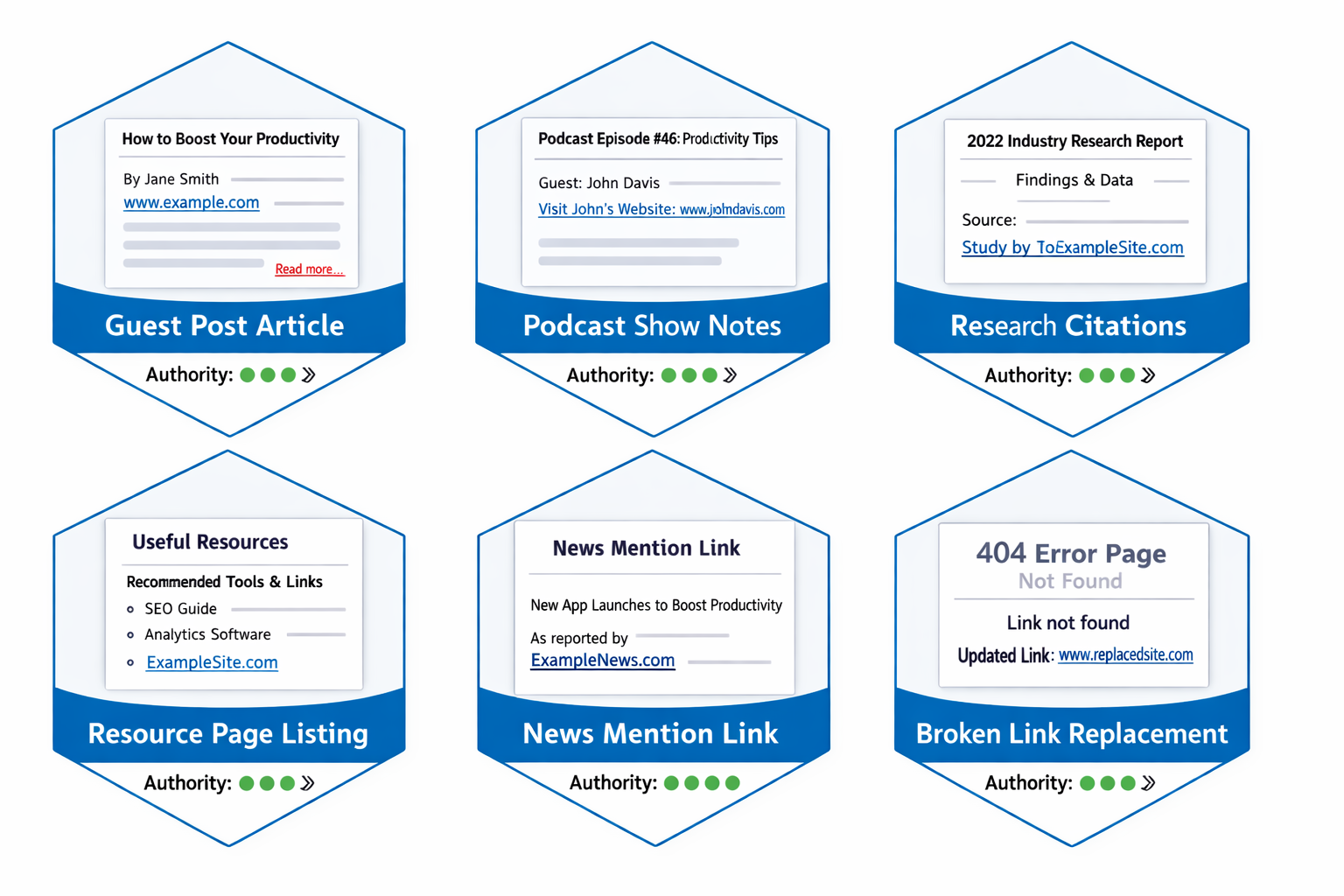
Appearing as a guest on industry-relevant podcasts provides low-effort, high-reward backlink opportunities because podcast hosts almost always link to guest websites and resources in show notes.
How Podcast Backlinks Work
A typical podcast backlink scenario:
- You appear as a guest on an industry podcast discussing your area of expertise
- The podcast episode publishes with show notes on the host’s website
- Show notes include links to your website, specific resources you mentioned, and your social profiles
- The podcast gets syndicated to Apple Podcasts, Spotify, and other platforms with links in episode descriptions
- Listeners visit your site through the links, and search engines count the show notes page as a backlink
Benefits beyond the backlink:
- Brand exposure to the podcast’s existing audience
- Authority building through association with established podcast hosts
- Referral traffic from engaged listeners
- Content you can repurpose (audio clips, quotes, social media posts)
- Relationship building with podcast hosts and their networks
Finding Podcast Opportunities
Search for relevant podcasts:
- “your industry + podcast”
- “your topic + podcast guests”
- Use podcast directories like Apple Podcasts, Spotify, or Podchaser
- Check which podcasts your competitors have appeared on
- Join podcast guest booking platforms
Pitch template elements:
- Brief introduction highlighting your expertise
- 3-5 specific topic ideas relevant to their audience
- Links to previous podcast appearances or speaking experience
- Explanation of unique value you bring to their listeners
This strategy works best if you can speak confidently about your expertise, have interesting stories or case studies to share, and can commit to 30-60 minute recording sessions.
Resource Pages and Directory Listings as Backlink Examples
Resource pages compile useful links, tools, and references for a specific topic or industry. Getting listed on relevant resource pages provides stable, long-term backlinks from authoritative sources.
What Makes a Good Resource Page Backlink
A quality resource page backlink comes from:
- Curated lists maintained by educational institutions, industry associations, or established blogs
- Pages that regularly update their resources (not abandoned pages from years ago)
- Collections focused on your specific niche or industry
- Sites with editorial standards that review submissions before listing
Example: A university library maintains a resource page listing the best digital marketing tools and blogs for students. Your comprehensive SEO guide gets added to their “SEO Resources” section, providing a stable .edu backlink.
Finding Resource Page Opportunities
Search operators to discover resource pages:
- “your keyword + resources”
- “your keyword + useful links”
- “your keyword + helpful sites”
- intitle:”resources” + “your keyword”
- inurl:links + “your keyword”
Review the types of backlinks in SEO to understand where resource page links fit within your overall link building strategy.
Outreach approach: When requesting inclusion on a resource page, explain specifically why your content deserves a spot (unique data, comprehensive coverage, regular updates, etc.) and how it benefits their audience. Point out any outdated or broken links you noticed that need updating.
Choose resource pages when: You have genuinely comprehensive, well-maintained content that stands out as one of the best resources on a topic.
Digital PR and Media Mentions as High-Value Backlinks
Digital PR involves earning media coverage and mentions in news publications, industry blogs, and online magazines through newsworthy stories, expert commentary, and strategic outreach. This strategy works best for established sites with domain authority between 30-50 looking to earn high-authority media links.
How Digital PR Creates Backlinks
Digital PR campaigns generate backlinks when journalists and publishers:
- Cover your company news, product launches, or announcements
- Quote you as an expert source in their articles
- Reference your original research or data in their reporting
- Feature your business in industry roundups or best-of lists
- Link to your resources when covering related topics
Real example: A fintech startup publishes a study on consumer spending habits during economic uncertainty. They pitch the findings to business journalists, resulting in coverage from Forbes, Business Insider, and industry trade publications, each linking back to the original research report.
Digital PR Strategies That Earn Backlinks
Effective digital PR tactics:
- Newsjacking: Comment on trending industry news with expert analysis
- Data-driven stories: Share proprietary data or research findings with journalists
- Expert roundups: Contribute quotes to journalist requests on platforms like HARO (Help A Reporter Out)
- Awards and recognition: Apply for industry awards that generate coverage when won
- Company milestones: Announce significant achievements (funding, customer milestones, partnerships)
- Unique perspectives: Offer contrarian or underreported angles on industry topics
Media outreach best practices:
- Build relationships with journalists before you need coverage
- Personalize pitches to each journalist’s beat and recent articles
- Lead with the newsworthy angle, not your company promotion
- Provide ready-to-use quotes, data, and images
- Follow up once, then move on if no response
This approach requires consistent effort and works best when you have genuine news value, unique expertise, or original data to share.
Competitor Backlink Analysis: Learning from Real Examples
Analyzing where your competitors earn backlinks reveals proven link opportunities and shows exactly which strategies work in your niche. This research-driven approach removes guesswork from link building campaigns.
How to Analyze Competitor Backlinks
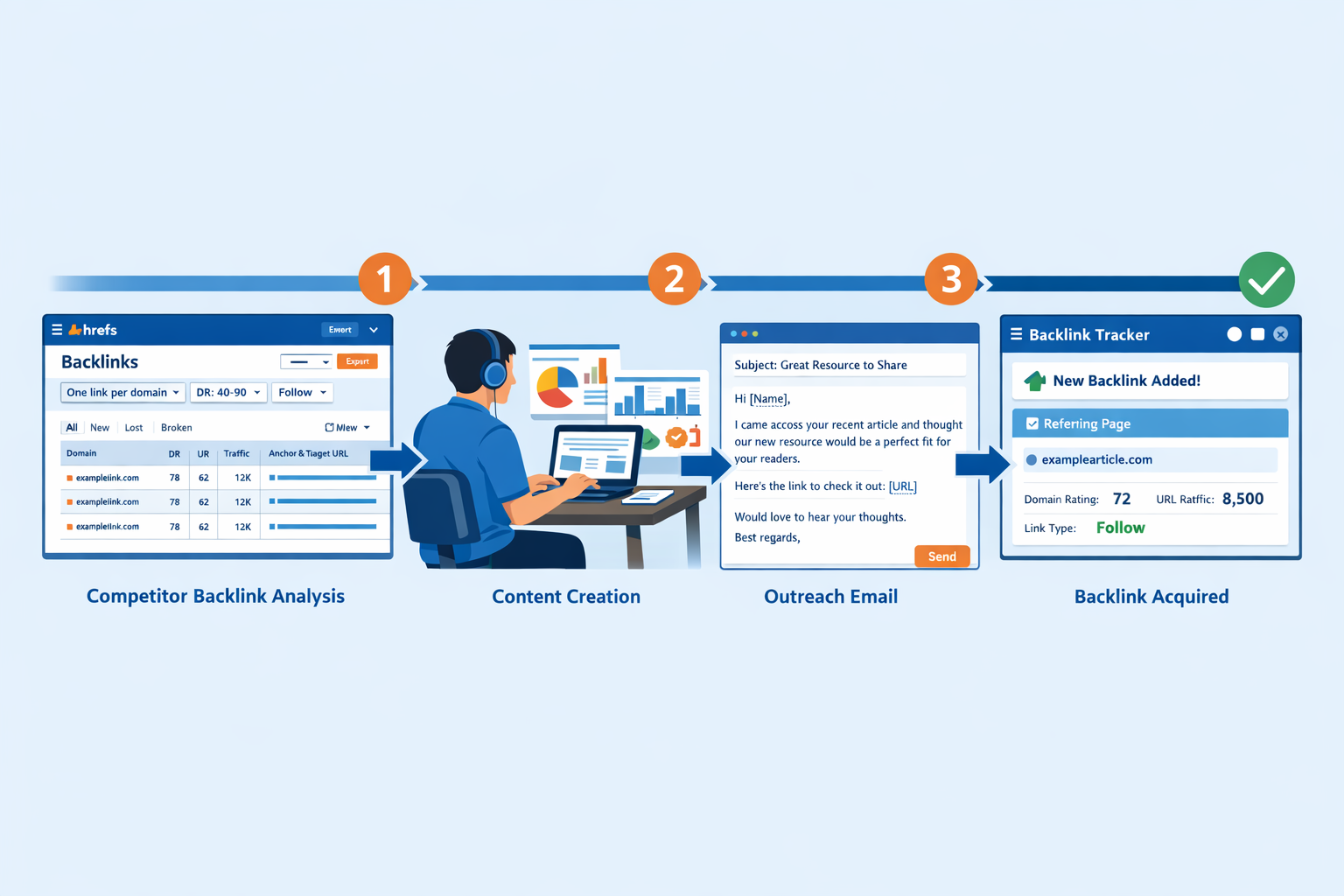
Steps to extract actionable backlink examples from competitors:
- Identify top-ranking competitors for your target keywords (typically the top 10 results)
- Export their backlink profiles using tools like Ahrefs, SEMrush, or Moz
- Filter for quality links: Domain authority 40+, dofollow only, recent links (past 12 months)
- Exclude low-value links: Remove footer links, sidebar links, site-wide links, and obvious spam
- Categorize link types: Sort by guest posts, resource pages, mentions, PR coverage, etc.
- Identify patterns: Look for websites that link to multiple competitors
- Prioritize targets: Focus on sites linking to 2+ competitors but not to you
Turning Analysis into Action
Once you identify where competitors earn backlinks, replicate their success:
- For guest posts: Pitch better, more comprehensive topics to the same publications
- For resource pages: Request inclusion with superior content
- For mentions: Offer updated data, expert quotes, or additional resources to the same journalists
- For broken links: Find broken links on competitor backlink sources and offer your content as a replacement
Analysis framework:
| Link Source Type | Replication Difficulty | Time to Results | Value Potential |
|---|---|---|---|
| Guest posts | Medium | 2-4 weeks | High |
| Resource pages | Low | 1-2 weeks | Medium |
| Digital PR | High | 4-12 weeks | Very High |
| Unlinked mentions | Low | 1 week | Medium |
| Broken link replacement | Medium | 2-4 weeks | Medium-High |
Understanding how Google evaluates backlinks helps you prioritize which competitor links to pursue based on quality signals.
Common mistake: Copying competitor tactics without understanding context. A backlink that works for an established brand with high domain authority might not work for a newer site. Focus on opportunities appropriate for your current authority level.
Unlinked Brand Mentions: Easy Backlink Examples to Claim
Approximately 77% of brand mentions online lack links, creating straightforward opportunities to convert existing mentions into backlinks through simple outreach. This strategy requires minimal effort because the publisher already knows and references your brand.
Finding Unlinked Mentions
Tools and methods to discover unlinked brand mentions:
- Google Alerts: Set up alerts for your brand name, product names, and key team members
- Ahrefs Content Explorer: Search for your brand name and filter for pages without links
- BuzzSumo: Monitor brand mentions across web content and social media
- Brand24 or Mention: Paid monitoring tools that track mentions in real-time
- Manual searches: Use Google search operators like “your brand name” -site:yoursite.com
Converting Mentions to Links
Outreach template for unlinked mentions:
Subject: Quick link request for [Article Title]
Hi [Author Name],
I noticed you mentioned [Your Brand] in your recent article about [Topic]. Thanks for the reference!
I noticed the mention doesn’t currently link to our site. Would you be willing to add a link to [specific relevant page] so readers can learn more?
Here’s the suggested link: [URL]
Thanks for considering, and great article!
[Your Name]
Success factors:
- Reach out quickly while the content is fresh
- Make the request easy (provide the exact URL to link)
- Be polite and appreciative (they already mentioned you favorably)
- Suggest the most relevant page for their context (not always your homepage)
Conversion rates: Unlinked mention outreach typically converts at 20-40% because you’re asking for a small edit to content that already references you positively.
This strategy works best if you have an established brand with regular media coverage, blog mentions, or industry recognition.
Content Alliances and Co-Marketing Backlinks
Content alliances involve partnering with complementary brands to co-create content, with each partner linking to the other’s resources. This approach builds backlinks while expanding audience reach through cross-promotion.
Types of Content Partnerships
Effective co-marketing formats that generate backlinks:
- Linked blog series: Create complementary articles on related topics, each linking to the partner’s content
- Podcast swaps: Appear on each other’s podcasts with show notes links
- Co-authored research: Partner on surveys or studies, both publishing results with mutual links
- Webinar collaborations: Co-host webinars with resources and recordings on both sites
- Case study partnerships: Feature partner success stories with links to their site
- Newsletter cross-promotions: Mention partner resources in newsletters with links
- Resource exchanges: Create tools or guides that reference each other’s complementary resources
Real example: A project management software company partners with a time tracking tool. They co-create a productivity guide, each publishing it on their blog with links to the partner’s tool. Both companies promote the guide to their audiences, generating traffic and backlinks for each other.
Finding Alliance Partners
Ideal content partners:
- Serve the same audience but offer complementary (not competing) solutions
- Have similar domain authority and audience size
- Share compatible brand values and quality standards
- Actively create content and engage their audience
- Have proven track records of successful partnerships
Approach: Instead of cold outreach, build relationships first by engaging with their content, sharing their resources, and providing value before proposing a partnership.
Choose this strategy when you want to build sustainable, long-term backlink relationships while expanding your audience reach beyond traditional link building tactics.
Creating Linkable Assets: Content That Earns Backlinks Naturally
Linkable assets are resources so valuable that other content creators naturally reference and link to them. These assets continue earning backlinks over time without ongoing outreach.
Types of Linkable Assets
High-performing linkable asset formats:
Comprehensive guides and tutorials: In-depth, technical guides that become the definitive resource on a topic. These fill knowledge gaps in your niche and attract links when others reference your instructions.
Original statistics and data: Proprietary data, survey results, or industry benchmarks that publishers cite as sources.
Interactive tools and calculators: Practical tools that solve specific problems (ROI calculators, comparison tools, assessment quizzes).
Infographics and data visualizations: Visual representations of complex information, offered with embed codes for easy sharing.
Templates and downloadable resources: Ready-to-use templates, checklists, or frameworks that save time.
Curated resource lists: Comprehensive collections of the best tools, resources, or references for a specific topic.
Making Assets Link-Worthy
Characteristics of content that earns natural backlinks:
- Uniqueness: Offers information, data, or tools not available elsewhere
- Depth: Covers topics more comprehensively than competing resources
- Utility: Solves real problems or answers important questions
- Credibility: Backed by research, data, or demonstrated expertise
- Accessibility: Easy to understand, use, and reference
- Shareability: Includes embed codes, clear citations, or download options
Promotion strategy: Even the best linkable assets need initial promotion. Share with:
- Industry influencers and thought leaders
- Journalists who cover your topic
- Communities and forums where your audience gathers
- Email subscribers and social media followers
- Websites that previously linked to similar (but inferior) resources
Learn more about how backlinks work in SEO to understand what makes certain content naturally attract links while other content goes unnoticed.
Investment consideration: Creating truly linkable assets requires significant time and resources upfront but generates ongoing returns through accumulated backlinks over months and years.
FAQ
What is a good backlink example?
A good backlink example is an editorial link from a high-authority website in your industry, placed within relevant content with natural anchor text. For instance, a marketing blog linking to your SEO guide within an article about content strategy because your guide provides additional value to their readers.
How many backlinks do I need to rank?
The number varies by keyword competition and industry. Focus on quality over quantity—10 high-authority, relevant backlinks typically outperform 100 low-quality links. Analyze top-ranking competitors for your target keywords to see their backlink counts as benchmarks.
What’s the difference between dofollow and nofollow backlinks?
Dofollow backlinks pass SEO ranking power from the linking site to your site, while nofollow backlinks include a rel=”nofollow” attribute that tells search engines not to count the link for rankings. Both types provide value through referral traffic and brand exposure.
Are guest post backlinks still effective in 2026?
Yes, guest posts remain effective when you target relevant, authoritative sites and provide genuinely valuable, original content. Avoid low-quality guest posting networks and focus on building relationships with reputable publications in your niche.
How do I find backlink opportunities?
Analyze competitor backlink profiles, search for resource pages in your industry, monitor unlinked brand mentions, join industry associations, contribute expert quotes to journalists, and create linkable assets like original research that naturally attracts links.
What makes a backlink high-quality?
High-quality backlinks come from authoritative domains with strong reputations, appear within relevant content in your niche, use natural anchor text, are placed editorially (not paid or exchanged), and appear in the main content rather than footers or sidebars.
Can I buy backlinks?
Buying backlinks violates Google’s guidelines and risks penalties that can severely damage your search rankings. Focus on earning links through valuable content, relationships, and legitimate outreach rather than purchasing links.
How long does it take to see results from backlinks?
Most sites see ranking improvements 4-12 weeks after earning quality backlinks, though timing varies based on site authority, competition, and how frequently search engines crawl your site. Backlink impact accumulates over time as you build a stronger profile.
What is a toxic backlink?
Toxic backlinks come from spammy, low-quality, or penalized websites and can harm your search rankings. These include links from link farms, adult sites, gambling sites (if unrelated to your business), or sites with manipulative link schemes.
Should I disavow bad backlinks?
Disavow backlinks only if you have a manual penalty from Google or a significant number of clearly toxic links. Most sites don’t need to disavow links because Google ignores low-quality links automatically. Focus effort on earning good links rather than removing bad ones.
How do I track my backlinks?
Use SEO tools like Ahrefs, SEMrush, Moz, or Google Search Console to monitor your backlink profile. Track metrics including total backlinks, referring domains, domain authority of linking sites, anchor text distribution, and new vs. lost links over time.
What’s the best backlink strategy for new websites?
New websites should focus on creating exceptional content, claiming unlinked mentions, getting listed on relevant resource pages, contributing guest posts to established blogs, and building relationships within their industry before pursuing advanced strategies like digital PR.
Conclusion
Backlink examples in SEO demonstrate that successful link building in 2026 focuses on earning editorial placements through valuable content, strategic relationships, and genuine expertise rather than manipulative tactics. The most effective backlinks come from guest posts on relevant industry blogs, original research that other publishers cite, podcast appearances with show notes links, digital PR coverage in authoritative media, and unlinked brand mentions converted through simple outreach.
Quality consistently outperforms quantity in link building. A handful of high-authority, contextually relevant backlinks from established sites in your niche provide more ranking power than hundreds of low-quality directory links or comment spam. Focus your efforts on creating linkable assets like comprehensive guides, original data studies, and practical tools that naturally attract editorial links over time.
Actionable next steps:
- Audit your current backlink profile using tools like Ahrefs or Google Search Console to understand your baseline
- Analyze competitor backlinks to identify proven link opportunities in your niche
- Create one linkable asset this month (original research, comprehensive guide, or useful tool)
- Set up brand monitoring to find and convert unlinked mentions into backlinks
- Identify 5-10 guest posting targets and craft personalized pitches with unique topic ideas
- Build relationships with industry podcasters, journalists, and bloggers before you need links
Remember that link building is a long-term strategy. The backlinks you earn this month may take weeks to impact rankings, but they contribute to accumulated authority that compounds over time. Start with strategies matching your current resources and authority level, then expand to more advanced tactics as your site grows.
For more insights on building an effective backlink strategy, explore our related guides on Google Index vs Backlink Index to understand how search engines discover and process your links.
References
[1] 2026 Backlink Strategies For Small Biz Growth – https://www.e-marketingassociates.com/blog/2026-backlink-strategies-for-small-biz-growth
[2] The Ultimate Guide To Backlink Strategy In 2026 – https://www.chainreaction.ae/blog/the-ultimate-guide-to-backlink-strategy-in-2026/
[3] Definitive Guide Link Building 2026 – https://almcorp.com/blog/definitive-guide-link-building-2026/
[5] Seo Best Practices – https://svitla.com/blog/seo-best-practices/
Tags
backlink examples, SEO backlinks, link building strategies, guest posting, digital PR, dofollow backlinks, contextual links, competitor analysis, linkable assets, original research, podcast backlinks, unlinked mentions