Last updated: April 10, 2026
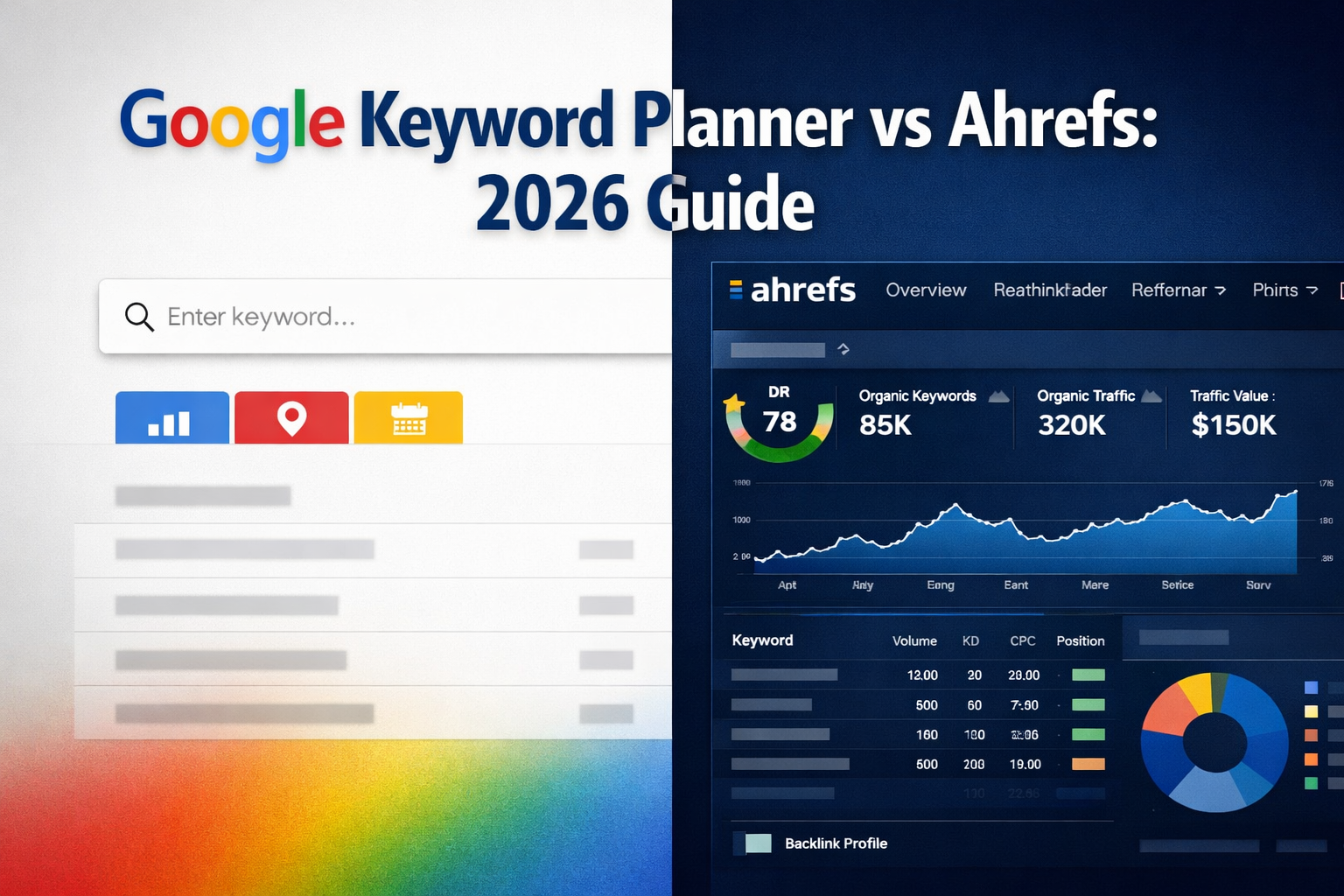
Quick Answer: Choosing between Google Keyword Planner and Ahrefs in 2026 depends entirely on your specific SEO goals, budget, and desired depth of analysis. Google Keyword Planner is free and ideal for understanding search demand directly from Google, primarily serving paid advertising strategies, while Ahrefs is a premium, all-in-one SEO suite offering extensive, detailed data for comprehensive organic search strategy, competitive analysis, and content planning.
Key Takeaways:
- Google Keyword Planner (GKP) is free, directly from Google, and best for PPC keyword research and initial organic volume estimates.
- Ahrefs is a paid, comprehensive SEO tool providing deep insights into organic keywords, backlinks, competitor strategies, and technical SEO.
- GKP offers search volume data directly from Google, which can be highly accurate for its own platform.
- Ahrefs uses proprietary algorithms to estimate search volume and other metrics, often providing more granular and diverse data points.
- For basic keyword research and PPC campaigns, GKP is sufficient and cost-effective.
- For advanced SEO, competitive intelligence, link building, and content strategy, Ahrefs offers superior capabilities.
- Many experienced SEO professionals use both tools, leveraging GKP for foundational Google data and Ahrefs for in-depth analysis and competitive tracking.
- Budget is a major factor; GKP is free, while Ahrefs requires a significant recurring investment.
The Great Debate: Google Keyword Planner vs Ahrefs in 2026
When diving into the world of search engine optimization, especially for businesses looking to expand their digital footprint in 2026, one of the most common dilemmas involves choosing the right tools for keyword research. At the heart of this decision often lies the comparison: Google Keyword Planner vs Ahrefs. These two platforms, while both offering keyword data, serve distinct purposes and cater to different needs within the SEO landscape. It’s not uncommon to hear SEO strategists passionately defending their preferred tool, making the choice less about right or wrong, and more about alignment with specific objectives and resources.
What is Google Keyword Planner?
Google Keyword Planner (GKP) is a free tool provided by Google, primarily designed to help advertisers find keywords for their Google Ads campaigns. It offers insights into keyword search volume, bid estimates, and competition levels directly within the Google ecosystem.
Think of GKP as Google’s official hint book for what people are searching for on its platform. It’s fantastic for getting a pulse on search demand and is an essential first step for anyone considering a pay-per-click (PPC) strategy or even just trying to understand basic search trends for organic content. While its main purpose is advertising, the keyword ideas and search volume data it provides are incredibly valuable for organic SEO too, offering a direct look at Google’s own data.
What is Ahrefs?
Ahrefs is a comprehensive, paid SEO suite that provides a vast array of tools for keyword research, competitor analysis, backlink auditing, site auditing, and content exploration. It aims to be an all-in-one solution for organic search professionals.
Ahrefs is like a high-powered microscope for the internet, revealing intricate details about how websites rank, what keywords they use, and who links to them. Unlike GKP, which focuses solely on Google’s own data for advertising, Ahrefs scrapes the entire web, building its own massive index of keywords, backlinks, and website data. This allows it to offer a much broader and deeper analysis, from identifying obscure long-tail keywords to uncovering competitor strategies and tracking your own website’s performance across various metrics.
Core Functionality: How Do They Differ?
The fundamental difference between Google Keyword Planner and Ahrefs lies in their scope and depth. GKP provides a foundational view primarily for Google Ads, while Ahrefs offers a panoramic, detailed perspective for all aspects of organic SEO.
To illustrate, imagine you’re planning a hiking trip. Google Keyword Planner would tell you which trails are popular, roughly how many people hike them monthly, and what gear is commonly searched for. It gives you the basics. Ahrefs, on the other hand, would provide detailed topographical maps, satellite imagery, real-time weather forecasts, historical trail usage patterns, information on local wildlife, and even reviews from other hikers. It gives you everything you need for a deep, strategic exploration.
Google Keyword Planner’s Key Features:
- Discover new keywords: Generate keyword ideas based on seed keywords, URLs, or categories.
- Get search volume and forecasts: See monthly search volume ranges and projections for potential ad campaigns.
- Competition level for ads: Understand how competitive a keyword is for paid advertising.
- Bid estimates: Get estimated bids for keywords on Google Ads.
- Direct from Google data: Leverage data straight from the source for Google searches.
Ahrefs’ Key Features:
- Keyword Explorer: Detailed keyword research, including global search volumes, keyword difficulty, traffic potential, SERP overview, and related keywords across multiple search engines (Google, YouTube, Amazon, Bing, etc.).
- Site Explorer: Comprehensive competitive analysis, backlink checker, organic traffic research, and content gap analysis.
- Content Explorer: Find trending content, analyze top-performing articles, and identify content gaps.
- Site Audit: Technical SEO analysis to identify and fix website issues.
- Rank Tracker: Monitor your keyword rankings and see how they change over time.
- Batch Analysis: Analyze multiple URLs or keywords simultaneously.
- Proprietary Metrics: Such as Keyword Difficulty (KD), Domain Rating (DR), and URL Rating (UR) to quickly assess opportunities. You can even increase your Ahrefs Domain Rating (DR) through strategic link building.
Depth of Keyword Data: Google Keyword Planner vs Ahrefs for Insights
Ahrefs generally offers a much richer and more granular dataset for keyword research compared to Google Keyword Planner, which tends to provide broader, often rounded, estimates.
When performing keyword research, the quality and depth of data are paramount. GKP often provides search volume as a range (e.g., “1K-10K” searches per month), especially for free users or those with low ad spend. This makes it difficult to prioritize keywords precisely. Ahrefs, however, typically provides exact monthly search volume estimates, often showing breakdown by country, along with crucial metrics like Keyword Difficulty (KD), which estimates how hard it would be to rank in the top 10 for that keyword. Imagine planning your content strategy in 2026 without knowing if a keyword has 1,000 or 9,000 searches within that range – Ahrefs helps eliminate that ambiguity.
GKP’s Data Depth:
- Monthly search volume (often in ranges for non-advertisers).
- Competition level (low, medium, high) for paid ads.
- Top-of-page bid estimates (low and high range).
- Geographic segmentation (country, region, city).
Ahrefs’ Data Depth:
- Exact monthly search volume (global and country-specific).
- Keyword Difficulty (KD) score (0-100) indicating ranking difficulty.
- Traffic Potential: Estimated total organic traffic to the top-ranking page for that keyword, not just the keyword itself.
- SERP (Search Engine Results Page) overview: Shows the top 10 ranking pages, their DR, UR, and number of backlinks, which is crucial for understanding how Google evaluates backlinks.
- Parent Topic: Identifies the broader topic a keyword belongs to.
- Return Rate, Clicks, Clicks Per Search (CPS), Paid Clicks, Organic Clicks.
- Semantic variations and related queries that broaden your content strategy SEO.
Choose GKP if you need quick, high-level volume ranges and are mainly focused on PPC.
Choose Ahrefs if you require precise volume estimates, difficulty metrics, and comprehensive SERP analysis for organic ranking.
Use Cases: Who Benefits More from Each Tool?
Each tool caters to different user types and strategic objectives, making them more suitable for specific scenarios.
It’s like comparing a trusty pickup truck to a high-performance race car. Both are vehicles, but they excel in different terrains and for different purposes. The pickup truck (GKP) is great for everyday hauling and getting the job done without much fuss. The race car (Ahrefs) is built for speed, precision, and winning competitions, but it requires a specialized driver and a higher investment.
When to Use Google Keyword Planner:
- Small Businesses on a Budget: It’s free! For startups or small businesses with limited funds, GKP offers essential keyword data without cost.
- Google Ads Campaigns: This is its primary design. If you’re running PPC campaigns, GKP is indispensable for finding keywords, forecasting performance, and managing bids.
- Initial Keyword Brainstorming: For a quick overview of what keywords are available and their general search popularity before investing in a paid tool.
- Understanding Google’s Perspective: Because the data comes directly from Google, it provides an authentic snapshot of search behavior on the world’s largest search engine.
When to Use Ahrefs:
- SEO Agencies & Consultants: Managing multiple client accounts requires deep insights into competitive landscapes, link building opportunities, and detailed performance tracking.
- Content Strategists: To identify high-potential topics, analyze competitor content, and plan comprehensive content calendars. Tools like Content Explorer are invaluable for writing content for SEO.
- Competitor Analysis: Uncover what keywords your competitors rank for, their top-performing content, and their backlink profiles. This is crucial for gaining a competitive edge.
- Link Building: Ahrefs’ Site Explorer is unparalleled for finding backlink opportunities, analyzing competitor backlinks, and monitoring your own. Understanding how backlinks work in SEO is made easier with Ahrefs.
- Technical SEO Audits: The Site Audit feature helps identify and fix on-site SEO issues that could hinder rankings.
- Large-Scale Website Optimization: For e-commerce sites, large publishers, or enterprises needing detailed data for thousands of keywords and pages.
- Comprehensive Market Research: Beyond just keywords, Ahrefs helps identify market trends, content gaps, and opportunities across various niches.
Pricing and Accessibility: A Major Deciding Factor
The most obvious and often the primary differentiator between Google Keyword Planner and Ahrefs is their cost structure: GKP is free, while Ahrefs is a premium subscription service.
This isn’t just about paying money; it’s about the investment curve and commitment. Ahrefs requires a recurring financial commitment, which naturally implies a higher expectation of return on investment (ROI) from its users. GKP, being free, is accessible to absolutely anyone with a Google account, making it a zero-risk entry point into keyword research.
Google Keyword Planner Pricing:
- Free: Yes, completely free to use with a Google account.
- Accessibility: Easily accessible to anyone, even without an active Google Ads campaign. However, specific search volume numbers (not ranges) are more readily available if you have an active ad campaign.
Ahrefs Pricing:
- Paid Subscription: Ahrefs offers various subscription tiers (Lite, Standard, Advanced, Enterprise) starting at around $99/month (as of 2026), with prices increasing based on features, data limits, and user seats.
- Investment: Requires a significant monthly investment, making it less suitable for very small businesses or individuals just starting out in SEO without a dedicated budget.
- Value Proposition: The high cost is justified by the depth and breadth of features, making it a powerful investment for serious SEO professionals and businesses.
If budget is your absolute top priority and you need basic keyword insights, GKP is your choice.
If you have a dedicated SEO budget and require a comprehensive toolset for advanced strategy, Ahrefs offers superior value despite the cost.
Accuracy of Search Volume Data
The “accuracy” of search volume data is a frequently debated topic, and the difference between Google Keyword Planner and Ahrefs here is nuanced.
It’s a bit like asking for the exact population of a city. One source might give you a census number from two years ago (GKP), while another provides a real-time estimate based on various data points and projections (Ahrefs). Both are “accurate” in their own way, but they represent different methodologies and timeframes. GKP pulls directly from Google’s internal data, which is undeniably authoritative for Google searches. Ahrefs, however, uses complex proprietary algorithms and a massive dataset to estimate volumes across a broader spectrum of search engines and time.
Google Keyword Planner’s Search Volume:
- Source: Directly from Google’s own search data.
- Precision: Often provided in ranges (e.g., 1K-10K) unless you have active, significant Google Ads spend, in which case more precise numbers might appear.
- Bias: Naturally optimized for informing Google Ads decisions, so the data might subtly lean towards what’s useful for advertisers.
- Real-world Anecdote: A client once panicked because GKP showed “10-100” searches for a critical long-tail keyword. We showed them Ahrefs’ estimate of 450 searches, which was much closer to their actual organic traffic for that term, highlighting how GKP’s ranges can sometimes be misleading for organic potential.
Ahrefs’ Search Volume:
- Source: Estimates derived from a massive database of clickstream data, historical ranking data, and proprietary algorithms.
- Precision: Provides exact monthly search volume numbers (not ranges).
- Coverage: Extends beyond just Google to include YouTube, Amazon, Bing, Yahoo, and more.
- Potential Discrepancies: Because it’s an estimate, Ahrefs’ numbers can sometimes differ from GKP’s, especially for very niche or new keywords. However, for most common keywords, its estimates are generally considered reliable and consistent across the industry.
For a definitive, albeit sometimes less precise, view of Google’s own search activity for PPC, GKP is the closest you’ll get to the source.
For detailed, estimated search volumes across multiple platforms and additional valuable metrics for organic SEO, Ahrefs is the industry standard.
Beyond Keywords: Additional Features and SEO Value
While keyword research is central, modern SEO requires a holistic approach, and Ahrefs vastly outperforms GKP in offering a full suite of tools for broader SEO tasks.
Think of it this way: GKP is a specialized tool for one specific job (keyword data, primarily for ads). Ahrefs is a fully equipped workshop with tools for every aspect of SEO, from carpentry (content creation) to electrical work (technical audits) and plumbing (link building). This comprehensive nature is why many SEO professionals consider Ahrefs indispensable for a full-scale digital marketing strategy. This includes critical tasks like understanding how Google evaluates backlinks and improving your site’s overall authority.
Google Keyword Planner’s Additional Value:
- Limited: Beyond keyword suggestions and volume, GKP offers very little in terms of broader SEO tools.
- Forecasting: Provides ad campaign forecasts, which can be useful for predicting potential traffic and conversions if you decide to run ads.
- Plan Creation: Allows you to build keyword plans for ad campaigns.
Ahrefs’ Additional Value:
- Backlink Analysis: Unrivaled in its backlink database. Crucial for competitive analysis and identifying link building opportunities. For instance, understanding what is a contextual backlink becomes much easier when you can analyze thousands of real-world examples.
- Competitor Research: Deep dive into competitor organic keywords, top pages, content, and backlinks.
- Site Audit: Automatically crawl your site to find technical SEO issues (broken links, missing meta descriptions, slow pages, etc.) – a critical component of healthy SEO.
- Content Gap Analysis: Identify keywords your competitors rank for but you don’t, providing actionable content ideas.
- Rank Tracking: Monitor your website’s performance for target keywords over time, a crucial aspect of measuring SEO success.
- Content Research: Explore top-performing content by topic or domain to inspire your own SEO content marketing.
- Domain Rating & URL Rating: Proprietary metrics that help assess the strength and authority of a domain or specific page, vital for link building efforts. Services like increasing Ahrefs Domain Rating (DR) to 50 often leverage these metrics.
Integration and Workflow
The seamlessness with which these tools integrate into your overall SEO workflow also influences their utility.
Google Keyword Planner, being a Google product, integrates naturally with Google Ads, creating a unified experience for paid campaigns. Ahrefs, on the other hand, aims to be the central hub for all SEO activities, often integrating with other tools through data exports or APIs, though it doesn’t have the same direct “native” integration with Google’s broader ecosystem.
Google Keyword Planner Workflow:
- Direct Integration with Google Ads: Keywords discovered can be directly added to ad campaigns.
- Simple Interface: Easy to navigate, even for beginners.
- Export Options: Can export keyword lists to CSV.
Ahrefs Workflow:
- All-in-One Dashboard: Centralizes various SEO tasks into a single platform, streamlining analysis.
- Project Management: Allows you to set up and track multiple projects (websites) within the tool.
- Alerts: Set up alerts for new backlinks, keyword movements, or mentions.
- Extensive Export Options: Offers highly customizable data exports for further analysis in spreadsheets or other tools.
- API Access: For advanced users and agencies needing to integrate Ahrefs data into custom dashboards or applications.
Choosing Your Tool: Google Keyword Planner vs Ahrefs
The decision between Google Keyword Planner and Ahrefs isn’t about which tool is universally “better,” but rather which tool aligns best with your immediate needs, long-term goals, and budget in 2026.
Here’s a simple framework to help you decide, based on the insights we’ve covered:
- For the Budget-Conscious Beginner: If you’re just starting, have little to no budget for SEO tools, and primarily need basic keyword ideas and search volume ranges for Google, then Google Keyword Planner is your ideal starting point. It provides foundational data to get your feet wet without any financial commitment.
- For PPC Specialists: If your main focus is running and optimizing Google Ads campaigns, Google Keyword Planner is non-negotiable. Its direct integration and bid estimates are specifically tailored for this purpose.
- For Comprehensive Organic SEO: If you’re serious about long-term organic growth, need deep competitive analysis, want to build high-quality backlinks, require detailed content planning insights, and have a dedicated budget for professional SEO tools, then Ahrefs is the superior choice. Its extensive features go far beyond simple keyword research, empowering a complete SEO strategy.
- For Hybrid Strategies: Many seasoned SEO professionals use both. They might start with GKP for a quick pulse check on broad keyword themes and leverage its direct Google search volume, then switch to Ahrefs for deeper dives into keyword difficulty, competitor strategies, backlink analysis, and content gaps. This “best of both worlds” approach is often the most effective for maximum impact.
| Feature / Aspect | Google Keyword Planner (GKP) | Ahrefs |
|---|---|---|
| Cost | Free | Paid subscription (starting ~$99/month in 2026) |
| Primary Use Case | PPC keyword research, basic organic volume estimates | Comprehensive organic SEO, content, competitor, backlinks |
| Keyword Data Depth | Basic, often ranges (1K-10K), limited metrics | Detailed, exact volumes, KD, Traffic Potential, SERP overview |
| Data Source | Direct Google internal data | Proprietary index, clickstream data, web crawl |
| Competitor Analysis | Limited/indirect | Extensive (organic keywords, backlinks, top pages) |
| Backlink Analysis | None | Industry-leading (Site Explorer) |
| Content Research | Basic ideas | Advanced (Content Explorer, content gaps) |
| Technical SEO | None | Comprehensive (Site Audit) |
| Ease of Use | Very easy, intuitive | Moderate learning curve, but powerful |
| Best For | Small businesses, PPC, beginners, budget-conscious users | SEO agencies, content marketers, enterprises, advanced users |
Decision Rule: Choose GKP if you are exclusively focused on Google Ads or have zero budget. Choose Ahrefs if you are building a comprehensive organic SEO strategy and require deep, actionable insights across multiple areas of SEO. If your budget allows, consider using both to maximize your insights.
Common Mistakes to Avoid
When navigating the world of SEO tools, it’s easy to fall into traps that can hinder your progress. Avoiding these common mistakes will help you get the most out of whichever tool you choose.
- Solely Relying on One Tool: No single tool provides the absolute truth. GKP has Google’s direct data, while Ahrefs offers deeper analytical capabilities. Using both for cross-referencing can provide a more balanced view.
- Ignoring Keyword Intent: Just because a keyword has high search volume doesn’t mean it’s right for your business. Understand if the searcher is looking to buy, learn, or navigate. Ahrefs helps with this by showing SERP features and top-ranking content.
- Obsessing Over Exact Numbers: While Ahrefs provides exact volumes, remember they are still estimates. Focus more on the trends, difficulty, and traffic potential rather than precise numbers. GKP’s ranges highlight this estimation.
- Neglecting Long-Tail Keywords: Both tools can help identify long-tail keywords, but it’s easy to get sidetracked by high-volume, competitive terms. Long-tail keywords, while individually low in volume, can add up to significant traffic and often have higher conversion rates.
- Forgetting Local SEO: If you’re a local business, remember that search volumes can differ significantly by location. GKP allows you to filter by location. For local SEO specifics, consider tools and strategies like Google Map Pack Ranking Factors and local SEO services for small business.
Conclusion
In the perennial debate of Google Keyword Planner vs Ahrefs, there isn’t a single victor, but rather a tool best suited for specific needs and budgets in 2026. Google Keyword Planner remains an invaluable, free resource for understanding basic search demand and planning Google Ads campaigns, directly leveraging Google’s own data. It’s the perfect entry point for small businesses and PPC specialists.
Ahrefs, conversely, is the powerhouse for comprehensive organic SEO. Its extensive features for keyword research, competitive analysis, backlink building, and technical audits make it an indispensable tool for SEO agencies, content marketers, and businesses committed to aggressive organic growth. While it comes with a significant investment, the depth and breadth of its data and features often justify the cost for serious practitioners.
Ultimately, the most effective strategy for many SEO professionals involves a combination of both. Using Google Keyword Planner for foundational Google-centric data and then layering on Ahrefs for its profound insights into organic strategy, competitive landscapes, and detailed metrics can provide the most robust and actionable intelligence for your SEO efforts in the current digital climate.
Actionable Next Steps:
- Assess Your Budget: Determine how much you can realistically allocate to SEO tools.
- Define Your Primary Goal: Are you focused on PPC, basic organic ideas, or a full-scale SEO overhaul?
- Start with GKP: If new to SEO or on a tight budget, explore Google Keyword Planner thoroughly to understand its capabilities.
- Explore Ahrefs: If your budget allows and you need advanced insights, consider a trial or monthly subscription to Ahrefs to experience its full suite of tools.
- Combine Forces: For a truly competitive edge, integrate both tools into your workflow, leveraging the unique strengths of each.
Keyword Tool Selector: GKP or Ahrefs?
Based on your choices, we recommend: