Last updated: February 27, 2026
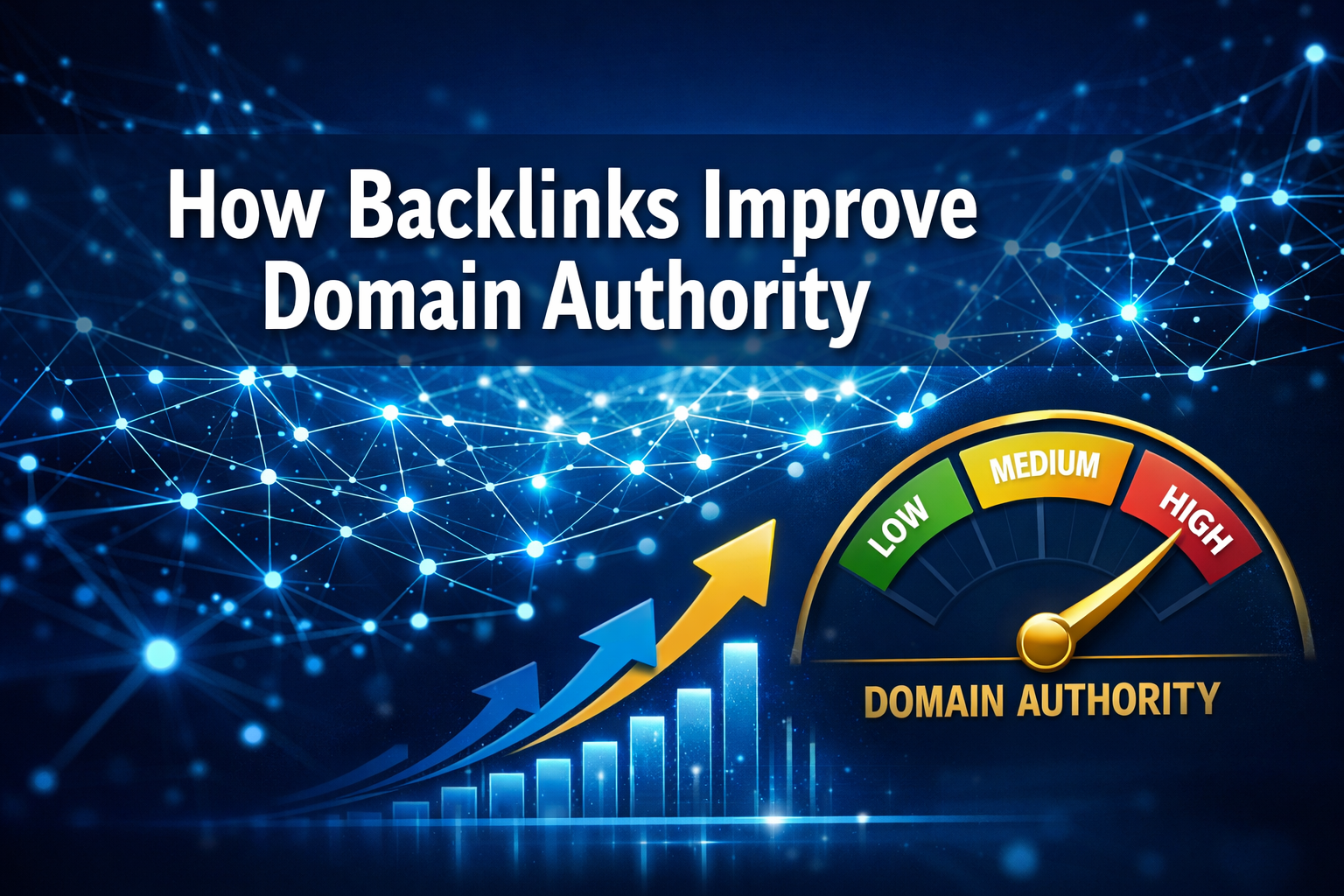
Imagine watching your website climb search rankings while competitors struggle to gain traction. The difference often comes down to one critical factor: understanding how backlinks improve domain authority and using that knowledge to build a stronger link profile. Backlinks serve as endorsements from other websites, and when search engines see trusted domains linking to your site, they interpret these connections as votes of confidence that directly strengthen your authority score.[1]
Key Takeaways
- Backlinks function as trust signals that search engines use to calculate domain authority scores ranging from 1-100
- Quality trumps quantity – five backlinks from DA 60+ sites deliver more SEO value than fifty links from DA 20 sites
- Referring domain diversity matters most – pages with more unique linking domains tend to rank higher than those with higher total link counts
- Domain authority isn’t a direct Google ranking factor but correlates strongly with search performance and provides reliable SEO benchmarks
- Timeline expectations are realistic – meaningful DA improvements typically require three to six months of consistent effort
- Content quality is the prerequisite for earning backlinks from high-authority sources that actually move the needle
- Link schemes cause long-term damage – buying links or using automated tactics typically harms authority despite short-term gains
- Industry-leading content formats like original research, detailed guides, and tools earn backlinks naturally
Quick Answer
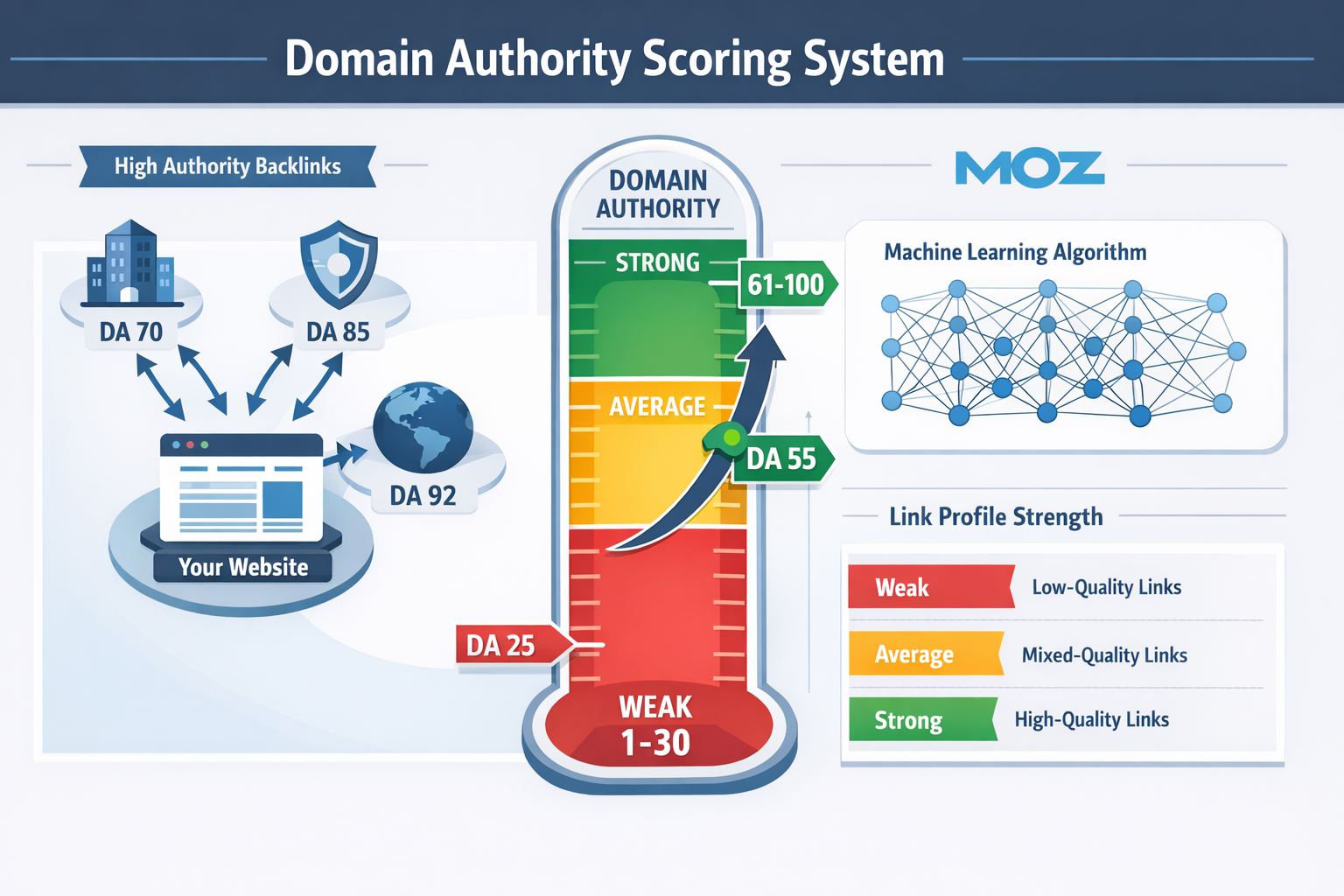
Backlinks improve domain authority by serving as endorsements that search engines interpret as trust signals. Each quality backlink from a high-authority domain strengthens your site’s credibility in search engine algorithms, which use machine learning models to compare your link profile against thousands of real-world rankings.[1] The number of unique referring domains matters more than total link count, and links from trusted industry sources (DA 60+) deliver exponentially more value than links from low-authority sites.[3][6]
What Is Domain Authority and How Does It Work?
Domain Authority (DA) is a search engine ranking score developed by Moz that predicts how likely a website is to rank in search results. DA scores range from 1 to 100, with higher scores indicating greater ranking potential.[1]
Moz calculates DA using a machine learning model that evaluates your complete link profile and compares it against thousands of actual search engine result page rankings. The algorithm considers multiple factors:
- Total number of backlinks pointing to your domain
- Number of unique referring domains (sites linking to you)
- Quality and authority of those linking domains
- Link profile diversity and natural growth patterns
- Internal link structure and site architecture
Industry benchmarks for DA scores:
| DA Score Range | Authority Level | Typical Use Case |
|---|---|---|
| 1-20 | Very Low | New sites, thin content, poor link profiles |
| 20-40 | Low to Moderate | Established sites with basic SEO, local businesses |
| 40-60 | Moderate to Good | Competitive sites with solid content and link building |
| 60-80 | Strong | Industry leaders, established brands, authoritative publishers |
| 80-100 | Exceptional | Major brands, government sites, top-tier publishers |
Scores above 60 are considered strong benchmarks for competitive industries, while scores between 30-50 represent average performance across most sectors.[1] Understanding why backlinks are important for SEO helps contextualize how they contribute to these authority measurements.
Common misconception: DA is not a direct Google ranking factor. Google doesn’t use Moz’s DA score in its algorithms. However, DA correlates strongly with search performance because it measures many of the same signals Google values, making it a reliable benchmark for tracking SEO progress.[1]
How Backlinks Improve Domain Authority Through Trust Signals
Backlinks improve domain authority by functioning as endorsements that search engines interpret as trust signals. When a reputable website links to your content, it transfers a portion of its credibility to your domain, strengthening your authority profile in the eyes of search algorithms.[1]
Search engines evaluate backlinks through several trust dimensions:
Source authority evaluation:
- Links from high-DA domains (60+) carry significantly more weight than links from low-authority sites
- Editorial links from industry publications signal expertise and credibility
- Government (.gov) and educational (.edu) domains often provide strong trust signals
- Links from sites in your industry or niche demonstrate topical relevance
Link context and placement:
- Contextual backlinks embedded within relevant content transfer more authority than sidebar or footer links
- Links surrounded by related keywords and topics signal stronger relevance
- Editorial placement within main content indicates genuine endorsement rather than paid placement
Natural link patterns:
- Gradual, organic link growth appears more trustworthy than sudden spikes
- Diverse anchor text distribution suggests natural linking behavior
- Links from varied referring domains demonstrate broad industry recognition
To understand how backlinks work in SEO at a technical level, search engines follow these links to discover new pages and assess the relationship between linking and linked sites. Each quality backlink serves as a “vote” in this system, with votes from trusted sources counting far more than votes from questionable sources.[1]
Decision rule: Focus on earning backlinks from domains with DA scores at or above your current score. If your site has DA 35, prioritize links from DA 40+ sources to create upward momentum in your authority profile.
Why Quality Matters More Than Quantity in Link Building
Five backlinks from domain authority 60+ sites deliver significantly more SEO value than fifty backlinks from domain authority 20 sites, making link profile quality the critical factor in authority improvement.[6]
Search engines use sophisticated algorithms to evaluate link quality based on multiple dimensions:
Authority transfer mechanics:
- High-authority domains pass more “link juice” through each backlink
- A single link from a DA 80 news publication can outweigh dozens of directory links
- Authority flows through dofollow links, while nofollow links provide limited direct SEO value
Quality indicators search engines evaluate:
✓ Linking domain authority – Sites with strong backlink profiles transfer more value
✓ Topical relevance – Links from industry-related sites carry more weight than unrelated sources
✓ Editorial nature – Links earned through content merit outperform paid or reciprocal links
✓ Link placement – Main content links transfer more authority than footer or sidebar links
✓ Page-level authority – Links from high-traffic, well-ranked pages provide stronger signals
Red flags that diminish link value:
✗ Links from known link farms or private blog networks
✗ Sitewide links appearing on every page of a domain
✗ Links from irrelevant or off-topic websites
✗ Excessive exact-match anchor text patterns
✗ Links from pages with hundreds of outbound links
Understanding what constitutes a high authority backlink helps prioritize link building efforts toward sources that actually move your DA score.
Common mistake: Pursuing high link counts through low-quality tactics like directory submissions, comment spam, or automated link building. These approaches often trigger algorithmic penalties that can actually decrease your domain authority despite increasing total backlink numbers.[1]
Choose quality if: You’re competing in a moderately to highly competitive niche where top-ranking sites have DA scores above 50. In these environments, a few authoritative links will advance your rankings more than hundreds of weak links.
How Referring Domain Diversity Impacts Domain Authority
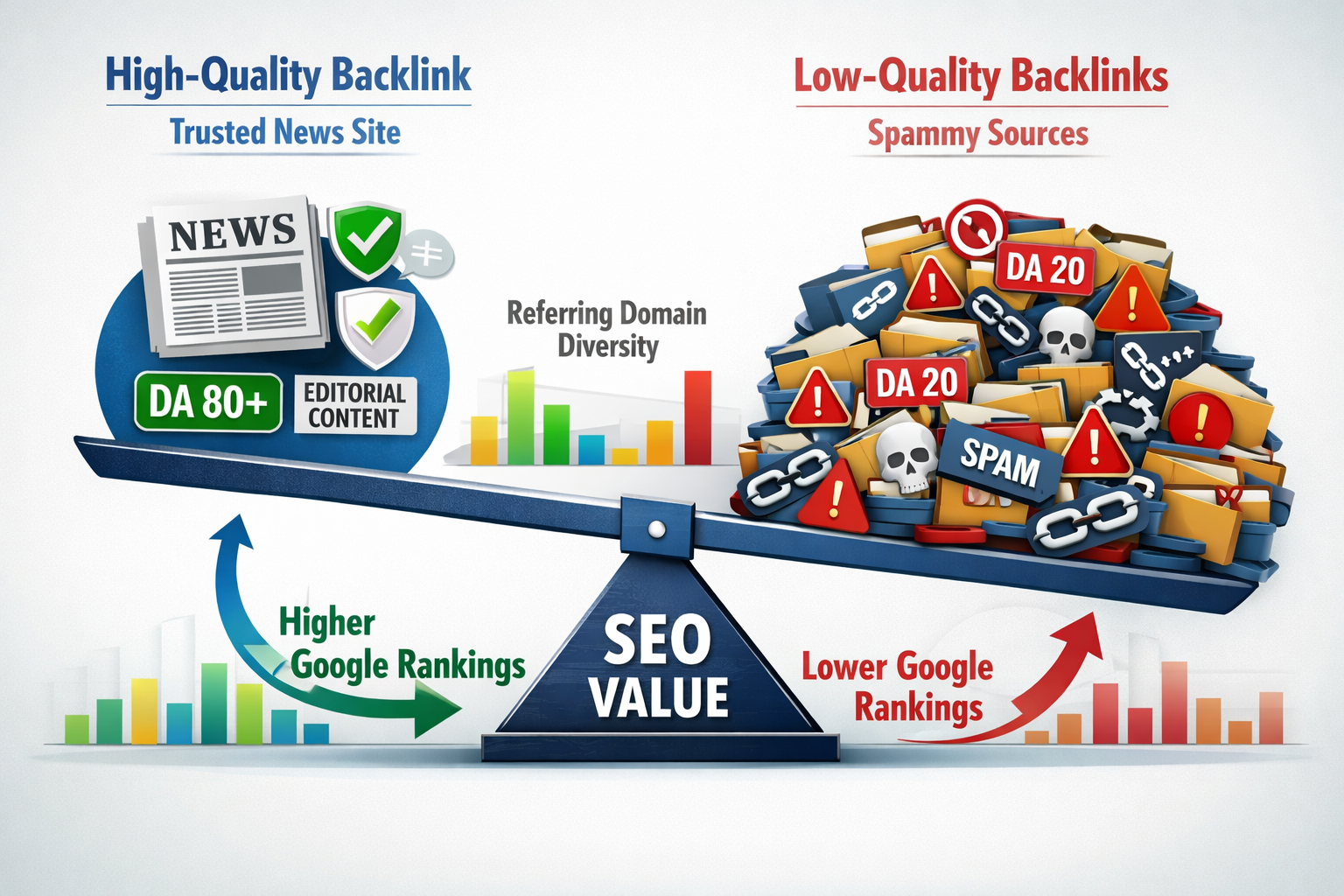
Pages with more referring websites tend to rank higher in Google search results, meaning the number of unique domains linking to you carries greater weight than raw backlink volume.[3]
Search engines prioritize referring domain diversity because it indicates broader industry recognition and reduces the impact of manipulative linking schemes. A site with 100 backlinks from 10 domains appears less authoritative than a site with 100 backlinks from 75 unique domains.
Why referring domain count matters:
- Validation from multiple sources – Links from diverse domains suggest your content provides genuine value across different audiences and contexts
- Reduced manipulation risk – It’s easier to create hundreds of links from a single source than to earn links from hundreds of legitimate sites
- Broader topical signals – Links from varied sources in your industry demonstrate comprehensive authority rather than narrow focus
- Natural link profile appearance – Organic authority builds through diverse discovery, not concentrated link building from limited sources
Referring domain quality tiers:
| Tier | Domain Characteristics | Impact on DA |
|---|---|---|
| Premium | DA 70+, industry leaders, major publications | Highest authority transfer |
| Strong | DA 50-70, established brands, niche authorities | Significant positive impact |
| Moderate | DA 30-50, legitimate businesses, quality blogs | Moderate contribution |
| Weak | DA 10-30, new sites, thin content | Minimal impact |
| Harmful | Spam sites, link farms, penalized domains | Negative impact, potential penalties |
Strategic approach: Aim for steady growth in unique referring domains rather than maximizing links from existing sources. If you have 50 backlinks from 10 domains, prioritize earning your next 10 links from 10 new domains rather than getting 10 more links from your existing sources.
More SEO professionals now value Domain Authority over total backlink counts when assessing link strength, reflecting an industry shift toward quality indicators rather than volume-based metrics.[3] Learn more about how Google evaluates backlinks to understand why this diversity matters at the algorithmic level.
What Content Types Earn Backlinks That Improve Domain Authority
High-authority websites are built on content that solves problems, presents new insights, or offers unique resources. Without strong content, earning quality backlinks becomes nearly impossible.[1]
Content formats that naturally attract backlinks from authoritative sources include:
Original research and data studies:
- Industry surveys with proprietary data
- Statistical analysis of trends or behaviors
- Case studies with measurable results
- Benchmark reports comparing solutions or approaches
These formats work because journalists, bloggers, and researchers actively seek credible data to cite in their own content. When you publish original findings, you create a citable resource that earns links as others reference your data.[2]
Comprehensive guides and tutorials:
- Step-by-step implementation guides
- Ultimate guides covering topics exhaustively
- How-to tutorials with visual documentation
- Best practice frameworks with actionable steps
Detailed guides earn links because they serve as definitive resources that other content creators reference when writing about related topics.
Tools, calculators, and interactive resources:
- Free calculators solving specific problems
- Assessment tools providing personalized results
- Templates and frameworks readers can implement
- Interactive visualizations of complex data
Utility-based content earns backlinks because it provides ongoing value that other sites want to share with their audiences.
Comparison content and curated resources:
- Product or service comparison charts
- “Best of” lists with detailed evaluation criteria
- Resource directories for specific industries
- Curated collections of tools or solutions
Comparison content attracts links because it saves readers research time and provides decision-making frameworks others want to reference.
Decision rule: Choose content formats based on your resources and audience needs. If you have access to unique data, prioritize original research. If you have deep expertise, create comprehensive guides. If you have development resources, build tools. Match format to your competitive advantages.
Common mistake: Creating “me too” content that duplicates existing resources without adding unique value. A generic blog post about “10 SEO Tips” won’t earn authoritative backlinks because hundreds of similar posts already exist. Focus on what makes your content uniquely valuable or comprehensive.
How Long Does It Take for Backlinks to Improve Domain Authority?
It takes three to six months or more to see meaningful gains in domain authority, particularly for sites starting from lower scores.[1] Domain authority doesn’t update in real-time—it changes as Moz recrawls the web and recalculates scores based on updated link data.
Timeline factors that influence DA improvement speed:
Months 1-2: Foundation building
- Publish high-quality content that attracts links
- Begin outreach to relevant websites
- Fix technical SEO issues that might hinder crawling
- Establish content promotion workflows
During this phase, you’re creating the assets and systems that will generate backlinks, but you won’t see DA movement yet.
Months 3-4: Initial link acquisition
- First backlinks begin appearing in link indexes
- Search engines discover and evaluate new links
- Link authority starts flowing to your domain
- Moz’s next crawl cycle picks up new referring domains
Some link building efforts start showing results, but DA scores typically lag behind actual link acquisition by several weeks.
Months 4-6: Measurable DA changes
- Accumulated backlinks reach critical mass
- Moz recalculates your DA score
- First noticeable improvements appear
- Momentum builds for continued growth
Most sites see their first DA increases during this window, assuming consistent link building efforts.
Months 6+: Sustained growth
- Compounding effects of earlier content and links
- Natural link velocity as authority increases
- Easier link acquisition as credibility grows
- Steady DA progression with continued effort
Factors that accelerate DA improvement:
✓ Starting from very low DA scores (easier to move from 15 to 25 than 65 to 75)
✓ Earning links from significantly higher-authority domains
✓ Consistent content publication creating multiple link-worthy assets
✓ Industry PR or viral content generating link spikes
✓ Strategic outreach to relevant, high-authority sources
Factors that slow DA improvement:
✗ Competing in saturated niches where competitors have strong link profiles
✗ Starting from moderate DA scores (40-60) where incremental gains are harder
✗ Inconsistent link building efforts with long gaps
✗ Low-quality content that doesn’t earn natural links
✗ Technical issues preventing proper link credit
Edge case: Sites that experience sudden viral success or major media coverage can see DA jumps within 2-3 months. However, this requires exceptional circumstances and isn’t a reliable strategy for most sites.
Explore various types of backlinks in SEO to understand which link varieties contribute most effectively to authority growth over different timeframes.
What Mistakes Damage Domain Authority Instead of Improving It?
Link schemes cause long-term damage to domain authority despite potential short-term gains, as Google penalizes artificial link patterns that violate search quality guidelines.[1]
Harmful practices that decrease DA:
Buying backlinks:
- Purchased links violate Google’s Webmaster Guidelines
- Paid link networks often use low-quality domains
- Algorithmic detection triggers ranking penalties
- Manual actions can result in severe authority drops
Even if purchased links temporarily boost DA, the long-term risk of penalties outweighs short-term gains.
Participating in link schemes:
- Reciprocal linking arrangements (“I’ll link to you if you link to me”)
- Private blog networks created solely for link building
- Article directories with minimal editorial standards
- Automated link building tools and services
These tactics create unnatural link patterns that search engines identify and devalue or penalize.
Low-quality directory submissions:
- Mass directory submissions to hundreds of sites
- Directories with no editorial review process
- Sites that exist only to sell directory listings
- Irrelevant category placements
While legitimate directories (industry associations, local chambers) provide value, mass directory submissions typically harm more than help.
Spammy outreach tactics:
- Generic, automated outreach emails
- Irrelevant link requests to off-topic sites
- Aggressive follow-up sequences
- Misleading or deceptive link requests
Poor outreach damages your brand reputation and generates low-quality links that don’t improve authority.
Warning signs your link profile needs cleanup:
⚠️ Sudden DA drops after algorithm updates
⚠️ Manual action notifications in Google Search Console
⚠️ High percentage of links from unrelated industries
⚠️ Excessive exact-match anchor text patterns
⚠️ Links from known spam domains or penalized sites
⚠️ Unnatural link velocity (hundreds of links appearing overnight)
Recovery approach: If you’ve acquired harmful links, use Google’s Disavow Tool to tell search engines to ignore specific backlinks. However, focus first on earning quality links that outweigh problematic ones, as disavowing should be a last resort for severe cases.
Common mistake: Obsessing over DA as the primary metric while ignoring actual search rankings and organic traffic. DA is a useful benchmark, but it’s a third-party metric that doesn’t directly determine your Google rankings. Focus on building genuine authority through quality content and natural links rather than gaming the DA score itself.
How to Build a Backlink Strategy That Improves Domain Authority
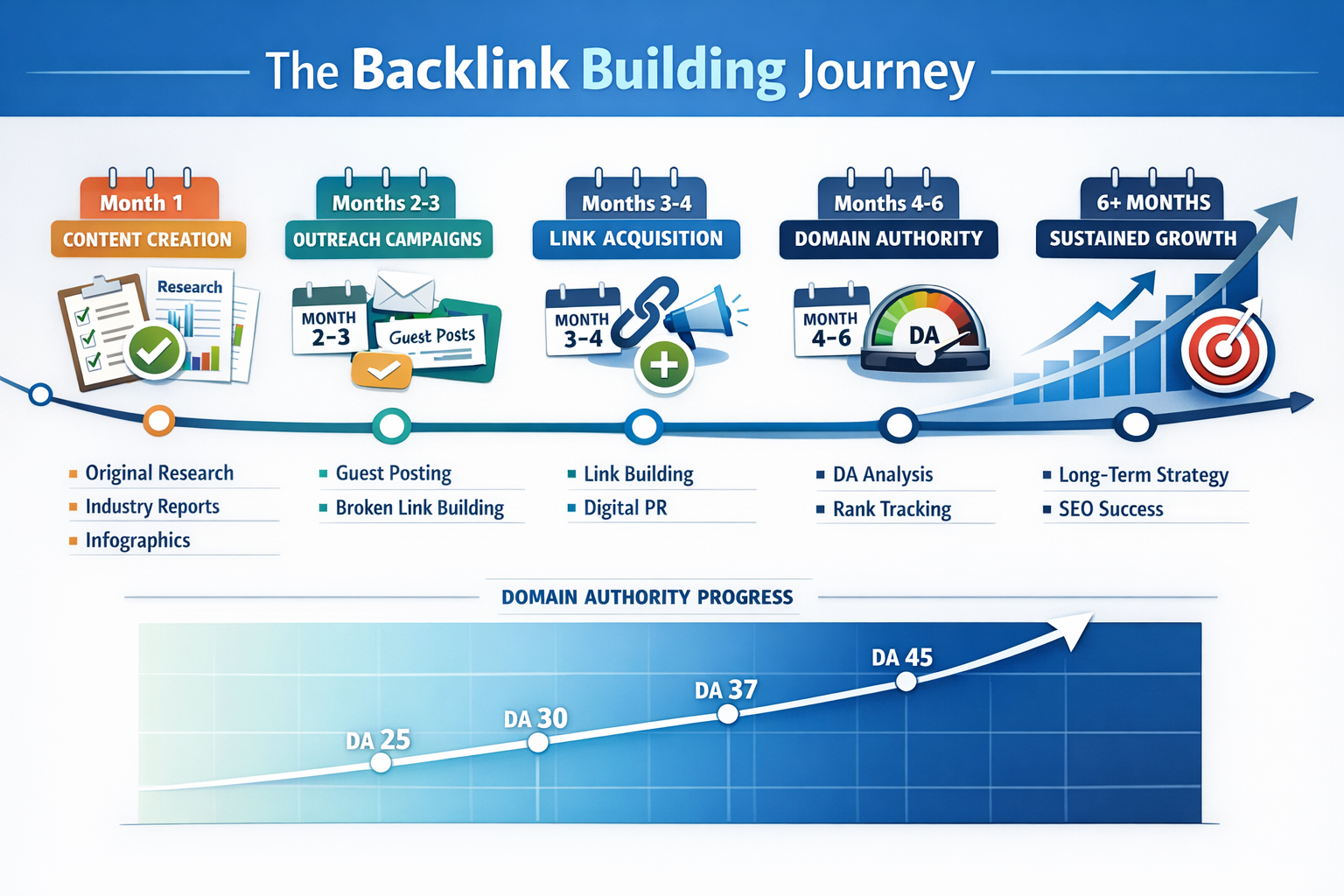
Building domain authority through backlinks requires a strategic approach focused on earning links from relevant, high-authority sources over time.
Step 1: Audit your current link profile
- Use tools like Moz, Ahrefs, or SEMrush to analyze existing backlinks
- Identify your current DA score and referring domain count
- Evaluate the quality distribution of your existing links
- Note competitor DA scores and link profiles for benchmarking
Step 2: Identify link-worthy content opportunities
- Research topics where you can provide unique value or data
- Analyze which competitor content earns the most backlinks
- Identify content gaps in your industry
- Plan content formats that naturally attract links (research, guides, tools)
Step 3: Create genuinely valuable content
- Develop comprehensive resources that solve specific problems
- Include original research, data, or unique perspectives
- Design content for shareability (clear structure, visuals, actionable insights)
- Ensure technical quality (fast loading, mobile-friendly, well-structured)
Step 4: Implement strategic outreach
- Identify relevant websites that might link to your content
- Personalize outreach messages explaining why your content adds value
- Build genuine relationships with industry publishers and bloggers
- Follow up appropriately without being pushy
Step 5: Leverage multiple link building tactics
Effective tactics for earning quality backlinks:
- Digital PR and journalist outreach – Respond to journalist queries on platforms like HARO, offering expert insights
- Guest posting on authoritative sites – Contribute valuable content to industry publications with editorial standards
- Broken link building – Find broken links on relevant sites and suggest your content as a replacement
- Original research promotion – Share unique data with journalists and bloggers who cover your industry
- Resource page link building – Identify industry resource pages and suggest your content for inclusion
- Competitor backlink replication – Analyze where competitors earn links and pursue similar opportunities
- Content partnerships – Collaborate with complementary businesses on co-created content
Step 6: Monitor and measure results
- Track DA score changes monthly (not daily—scores update periodically)
- Monitor referring domain growth and quality distribution
- Measure organic traffic and ranking improvements
- Adjust strategy based on what’s working
Realistic expectations by starting DA:
| Starting DA | 6-Month Goal | 12-Month Goal | Primary Focus |
|---|---|---|---|
| 1-20 | 25-30 | 35-40 | Volume of quality links, content foundation |
| 20-40 | 40-45 | 50-55 | Link quality improvement, niche authority |
| 40-60 | 60-65 | 65-70 | Premium links, thought leadership |
| 60+ | 65-70 | 70-75 | Exceptional links, industry recognition |
Choose this approach if: You’re committed to long-term authority building and have resources to create quality content consistently. This strategy requires patience but builds sustainable competitive advantages.
FAQ
How many backlinks do I need to improve domain authority?
There’s no specific number—quality and diversity matter more than quantity. Focus on earning backlinks from unique referring domains with higher authority than your current score. Ten backlinks from ten different DA 60+ sites will improve your authority more than 100 backlinks from the same DA 30 site.[3]
Can I improve domain authority without backlinks?
No. Domain authority is calculated primarily based on your backlink profile, including the number and quality of referring domains linking to your site. While technical SEO and content quality support authority, backlinks are the essential component that actually moves your DA score.[1]
Do nofollow backlinks improve domain authority?
Nofollow backlinks provide minimal direct impact on domain authority since they don’t pass link equity in the traditional sense. However, a natural link profile includes some nofollow links, and they can drive traffic and brand awareness that leads to dofollow links. Focus primarily on earning dofollow links for DA improvement.[1]
How often does domain authority update?
Moz updates domain authority scores approximately once per month as they recrawl the web and recalculate scores. Your DA won’t change daily, so check your score monthly rather than obsessing over daily fluctuations that don’t occur.
Why did my domain authority decrease?
DA can decrease when competitors earn backlinks faster than you, when Moz updates their calculation algorithm, when you lose existing backlinks, or when low-quality links are devalued. DA is relative—if competitors improve faster, your score can drop even if your link profile stays the same.[1]
What’s a good domain authority score for my industry?
This varies by industry competitiveness. Research your top 10 competitors’ DA scores to establish realistic benchmarks. Generally, DA 40+ is competitive for most industries, DA 60+ is strong, and DA 70+ indicates industry leadership. Compare yourself to direct competitors rather than absolute numbers.[1]
Can I improve domain authority quickly?
No legitimate method produces quick DA improvements. Expect three to six months minimum for meaningful changes, and longer for sites starting from moderate scores. Tactics promising fast DA increases typically involve risky practices that can result in penalties.[1]
Should I focus on domain authority or page authority?
Focus on both. Domain authority measures your entire site’s authority, while page authority measures individual page strength. Strong domain authority helps all your pages rank better, but specific pages need their own backlinks to compete for competitive keywords. Build both through strategic link building.
Do internal links improve domain authority?
Internal links don’t directly improve domain authority because DA measures external backlinks from other domains. However, smart internal linking distributes link equity throughout your site, helping individual pages rank better. Focus on external backlinks for DA improvement and internal links for distributing that authority.[1]
What’s the difference between domain authority and domain rating?
Domain Authority (DA) is Moz’s metric (1-100 scale), while Domain Rating (DR) is Ahrefs’ similar metric. Both predict ranking potential based on backlink profiles but use different calculation methods. Neither is a Google ranking factor—they’re third-party metrics that correlate with search performance.
Can bad backlinks hurt my domain authority?
Yes. Links from spam sites, penalized domains, or obvious link schemes can trigger algorithmic devaluation or manual penalties that decrease your authority. If you’ve acquired harmful links, consider using Google’s Disavow Tool, but focus primarily on earning quality links that outweigh problematic ones.[1]
How do I know if a backlink opportunity is worth pursuing?
Evaluate potential backlink sources based on their domain authority (aim for DA equal to or higher than yours), topical relevance to your industry, editorial standards, and traffic quality. Avoid sites that sell links, have thin content, or show obvious signs of being link farms.
Conclusion
Understanding how backlinks improve domain authority provides the foundation for building sustainable search visibility and competitive advantage. Backlinks function as trust signals that search engines use to evaluate your site’s credibility, with quality links from diverse, high-authority referring domains delivering the most significant authority improvements.
The path to higher domain authority requires patience and strategic focus. Most sites need three to six months of consistent effort to see meaningful DA gains, with the timeline extending for sites competing in established niches or starting from moderate authority levels. Success comes from creating genuinely valuable content that earns links naturally, combined with strategic outreach to relevant, authoritative sources in your industry.
Quality dramatically outweighs quantity in link building. Five backlinks from domain authority 60+ sites deliver more SEO value than fifty links from low-authority sources, making link profile quality the critical factor in authority improvement. Focus on earning links from unique referring domains rather than maximizing total link counts, as search engines prioritize referring domain diversity when evaluating authority signals.
Take these actionable steps to start improving your domain authority:
- Audit your current link profile using tools like Moz or Ahrefs to understand your baseline DA score and referring domain quality distribution
- Create link-worthy content in formats that naturally attract backlinks—original research, comprehensive guides, tools, or industry reports
- Implement strategic outreach to relevant, high-authority websites in your industry with personalized, value-focused communication
- Avoid harmful shortcuts like buying links, participating in link schemes, or using automated link building tools that risk penalties
- Monitor progress monthly rather than daily, tracking referring domain growth and quality alongside DA score changes
- Stay patient and consistent with your link building efforts, understanding that sustainable authority builds over months, not weeks
Domain authority isn’t a direct Google ranking factor, but it correlates strongly with search performance and provides a reliable benchmark for assessing SEO progress. By focusing on earning quality backlinks from diverse, authoritative sources through valuable content and genuine relationship building, you create the foundation for long-term search visibility and competitive advantage in your industry.
References
[1] Improve Domain Authority – https://smithdigital.io/blog/improve-domain-authority
[2] Website Authority In 2026 – https://www.dmcockpit.com/blogs/website-authority-in-2026
[3] Link Building Statistics 2026 – https://heroicrankings.com/seo/linkbuilding/link-building-statistics-2026/
[4] The Ultimate Guide To Backlink Strategy In 2026 – https://www.chainreaction.ae/blog/the-ultimate-guide-to-backlink-strategy-in-2026/
[5] Link Building Strategies That Actually Work In 2026 – https://skyseodigital.com/link-building-strategies-that-actually-work-in-2026/
[6] Outreach Links Guide – https://lagrowthmachine.com/outreach-links-guide/
[7] Ways To Get High Authority Backlinks – https://www.elysiandigitalservices.com/blogs/ways-to-get-high-authority-backlink
Tags
backlinks, domain authority, link building, SEO strategy, referring domains, high authority backlinks, search engine optimization, DA score, link quality, backlink profile, domain rating, SEO metrics
Domain Authority Improvement Calculator
Estimate your potential DA growth based on backlink strategy
Note: This calculator provides estimates based on typical DA growth patterns. Actual results vary based on content quality, niche competitiveness, existing link profile, and algorithm updates. Focus on earning quality backlinks from relevant, authoritative sources for best results.