Last updated: February 27, 2026
Key Takeaways
- Google evaluates backlinks using hundreds of signals, with link quality, diversity, and relevance ranking among the top three factors influencing search rankings
- Links from unique domains carry more weight than multiple links from the same domain—breadth matters more than concentrated linking
- Editorial links earned through valuable content outperform manipulated or purchased links because they align with content quality signals
- Anchor text, topical relevance, and C-Class IP diversity all contribute to how Google weighs individual backlinks
- Brand mentions and community engagement now compete with traditional backlinks as authority signals in 2026
- Low-quality directory links and widget-generated backlinks can trigger penalties rather than boost rankings
- Google’s algorithm continuously re-evaluates how backlinks are weighted relative to other ranking factors through core updates
Quick Answer
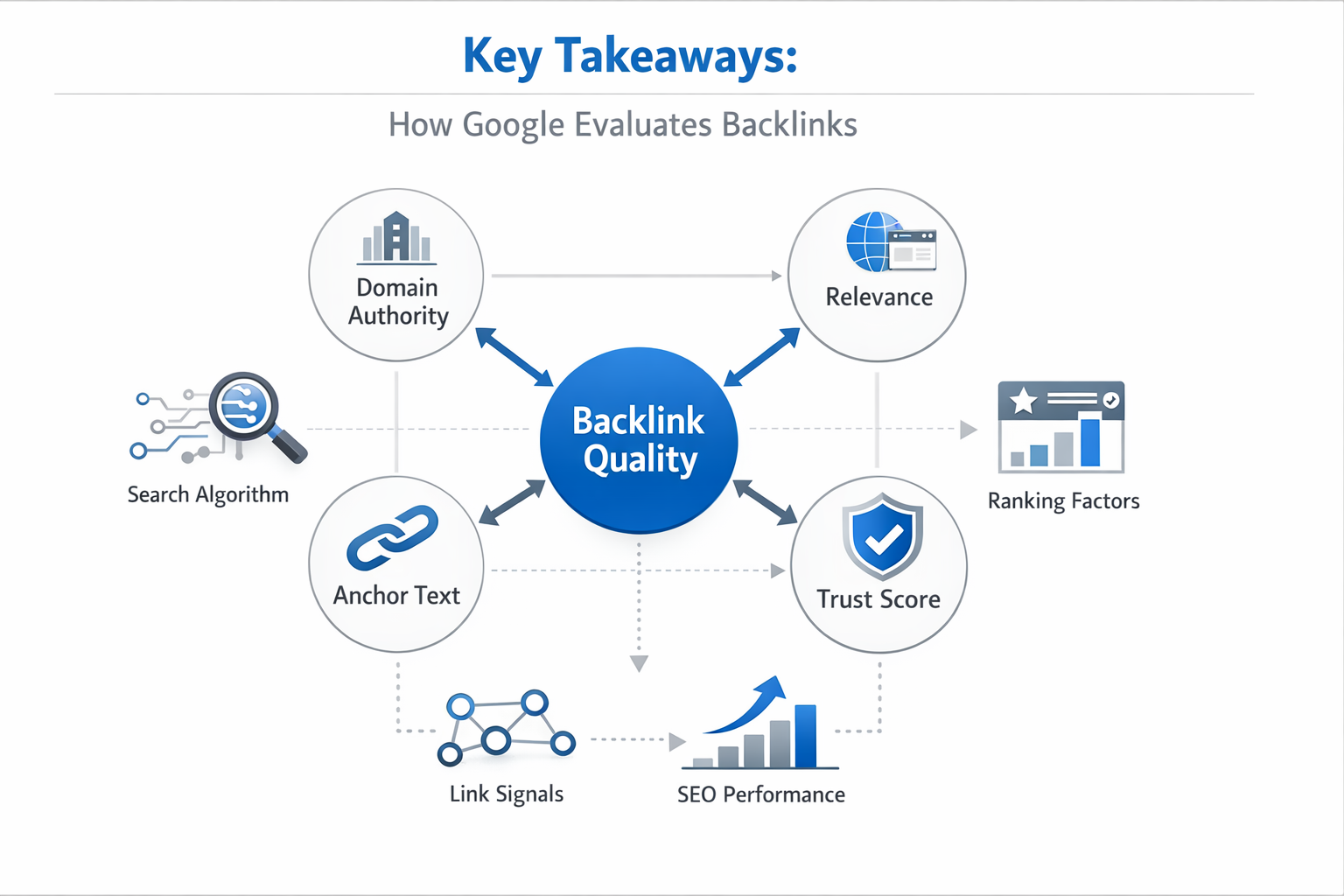
Google evaluates backlinks by analyzing link quality, relevance, diversity, and naturalness using hundreds of ranking signals. The search engine prioritizes editorial links from authoritative, topically relevant domains while penalizing manipulative link schemes. In 2026, backlinks remain one of the three most influential ranking factors alongside content quality and user experience, though brand authority and community engagement increasingly compete as alternative trust signals[4].
What Are Backlinks and Why Does Google Care?
Backlinks are incoming links from one website to another, and Google treats them as votes of confidence that signal content value and authority. When a reputable site links to your page, it tells Google that your content deserves recognition.
Google cares about backlinks because they serve as an independent validation system. Unlike on-page content that site owners control completely, backlinks require other webmasters to find value in your work. This external validation helps Google:
- Discover new pages through crawling link networks
- Assess content authority based on who references it
- Determine topic expertise by analyzing linking site relevance
- Identify trusted sources through link pattern analysis
The search engine’s PageRank algorithm, though evolved significantly since its inception, still uses backlinks as a foundation for measuring page importance. However, not all backlinks carry equal weight. A single link from an authoritative news site can outweigh dozens of links from low-quality directories.
Common mistake: Assuming more backlinks always equals better rankings. Google prioritizes quality and relevance over sheer quantity—100 spammy links can actually harm your site while 10 high-quality editorial links can dramatically improve visibility.
Understanding the difference between Google’s index and backlink indexes helps clarify how the search engine discovers and evaluates these connections.
How Google Evaluates Backlinks: The Core Quality Factors
Google evaluates backlinks through a multi-layered analysis that examines link quality, source authority, relevance, and placement context. The algorithm considers each backlink’s contribution to your site’s overall trust and expertise signals.
Domain Authority and Trust
The linking domain’s authority significantly impacts backlink value. Google assesses:
- Historical reputation of the linking site
- Content quality across the domain
- User engagement metrics like bounce rate and time on site
- Previous algorithm compliance (sites with penalty history pass less value)
Links from established domains with strong topical authority in your niche carry substantially more weight than links from new or unrelated sites. For example, a backlink from a medical journal matters more for health content than a link from a general business blog.
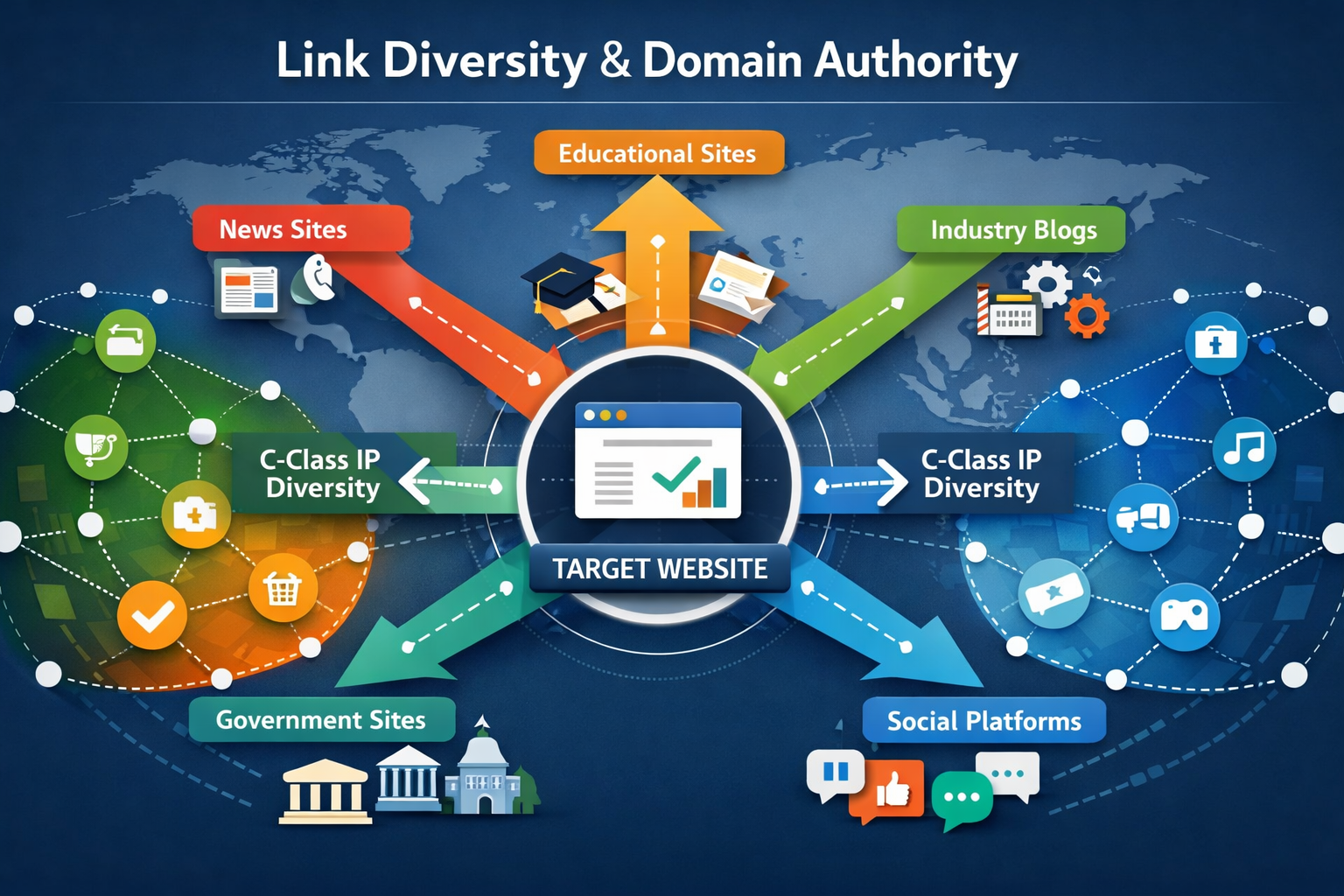
Link Diversity and Unique Domains
Pages attracting links from a larger number of unique domains tend to perform better in search results[4]. Google values widespread recognition rather than concentrated linking from the same sources.
Key diversity factors:
- Unique referring domains (10 domains linking once each beats 1 domain linking 10 times)
- C-Class IP diversity (links from separate IP addresses suggest broader site variety)[3]
- Domain type variety (mix of .com, .edu, .org, .gov domains)
- Geographic diversity (links from different countries and regions)
Edge case: Getting an unnatural number of links from sites on the same server IP may signal blog networks to Google, potentially triggering manual review[3].
Topical Relevance and Context
The February 1, 2026 core update reinforced Google’s focus on rewarding “true topical authority,” which affects how backlinks from topically relevant sources are weighted[5]. A link from a site covering similar topics carries more value than one from an unrelated niche.
Google analyzes:
- Content topic alignment between linking and linked pages
- Semantic relationship of surrounding content
- Industry clustering (links from sites in your industry vertical)
- Passage-level relevance (how the link connects to specific content sections)[2]
Choose topically relevant link sources when possible—a link from an industry publication will outperform a general directory listing.
Editorial Placement vs. Manipulated Links
Editorial links acquired organically through valued content tend to be most effective because they align with content quality and user experience simultaneously[4]. Google distinguishes between natural editorial links and those created through manipulation.
Editorial link characteristics:
- Placed within main content body (not sidebars or footers)
- Surrounded by relevant contextual content
- Added by content creators or editors (not automated)
- Provide genuine value to readers
Manipulated link patterns Google penalizes:
- Widget-generated links (automatically created when users embed widgets)[3]
- Low-quality directory submissions[3]
- Paid links without proper rel=”sponsored” attributes
- Reciprocal link schemes designed solely for SEO
- Blog network links from the same IP ranges
How Does Anchor Text Influence Backlink Evaluation?
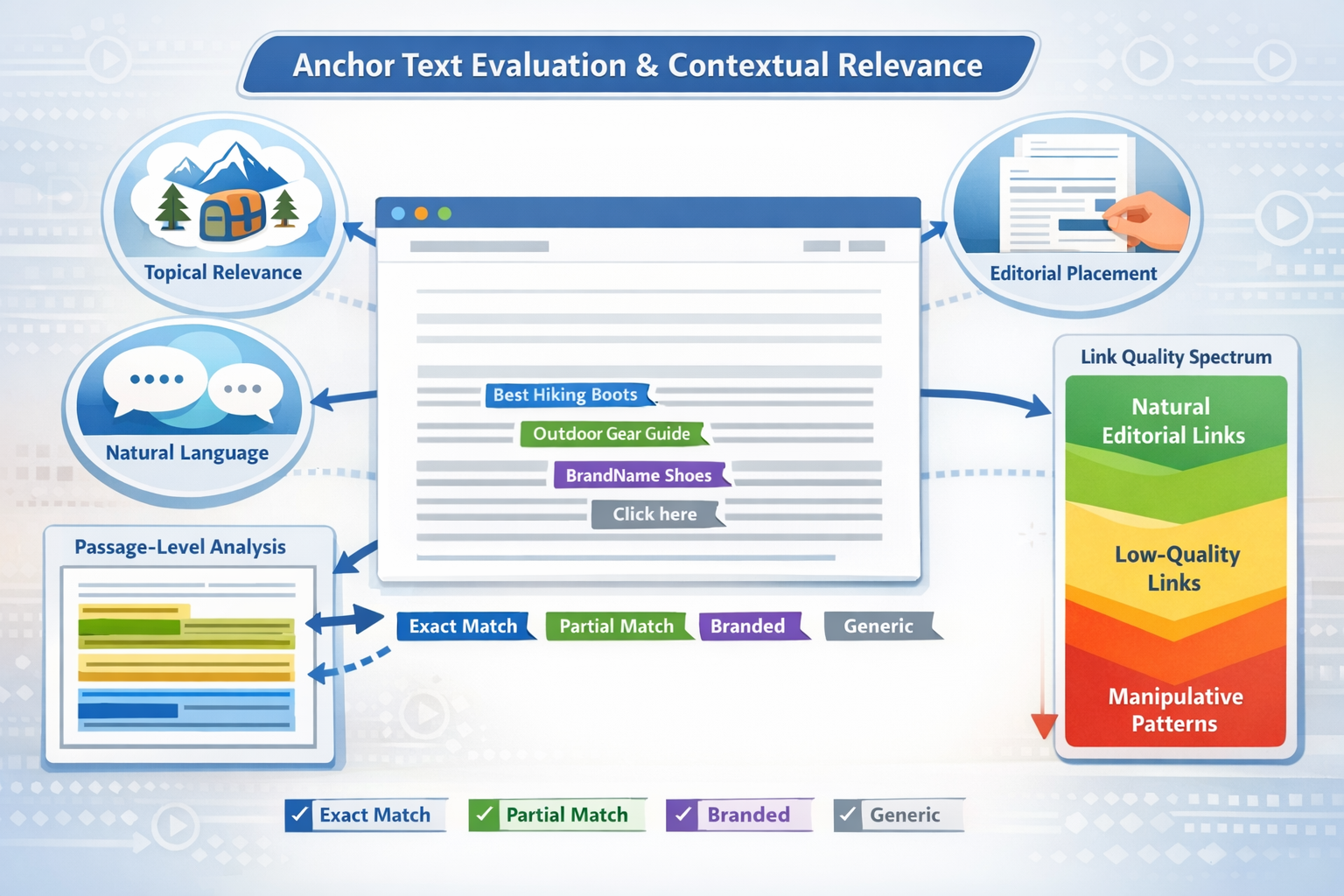
Anchor text—the clickable words in a hyperlink—continues to influence rankings as Google evaluates it within broader context rather than in isolation[3]. The algorithm uses anchor text to understand what the linked page is about and whether the link appears natural.
Natural Anchor Text Distribution
A healthy backlink profile includes varied anchor text types that reflect how people naturally link to content. Google expects to see:
| Anchor Text Type | Example | Typical Healthy % |
|---|---|---|
| Branded | “LinkinTech” or “LinkinTech SEO” | 40-50% |
| Naked URL | “linkintechseo.com” | 15-25% |
| Generic | “click here” or “read more” | 15-25% |
| Partial Match | “SEO backlink services” | 10-20% |
| Exact Match | “how google evaluates backlinks” | 1-5% |
Decision rule: If more than 10% of your anchor text uses exact-match keywords, you may be at risk for appearing manipulative. Aim for a natural distribution that prioritizes branded and generic anchors.
Context Matters More Than Keywords
Google analyzes the content surrounding anchor text to validate relevance. A keyword-rich anchor from an unrelated page carries less weight than a generic anchor from highly relevant content.
The algorithm examines:
- Paragraph context where the link appears
- Semantic relationship between anchor text and surrounding words
- Page topic alignment with anchor text meaning
- User intent match between link and destination content
Common mistake: Over-optimizing anchor text with exact-match keywords. This pattern looks unnatural and can trigger algorithmic filters that reduce link value or apply penalties.
What Role Does Link Placement Play in Evaluation?
Link placement within a page significantly affects how Google values that backlink. Links positioned in primary content areas carry more weight than those relegated to sidebars, footers, or author bio sections.
Content-Area Links vs. Supplementary Links
Google distinguishes between links that serve editorial purposes and those added for navigation or supplementary reasons:
High-value placements:
- Within main article body
- In contextually relevant paragraphs
- As natural citations or references
- Early in the content (above the fold)
Lower-value placements:
- Footer site-wide links
- Sidebar widget links
- Author bio boxes
- Comment sections
- Blogroll or “partners” pages
Choose content-area links when building relationships: A single in-content link from a guest post typically outweighs dozens of footer links across a site network.
Passage-Level Analysis
Google breaks content into chunks and analyzes each separately, which means backlinks may increasingly be evaluated based on how they connect to specific content sections rather than entire pages[2]. This passage-level approach affects:
- Link value calculation based on surrounding passage quality
- Relevance scoring tied to specific content sections
- User experience signals from how visitors interact with linked passages
- Topic clustering at a more granular level
If you’re earning backlinks, ensure the linking passage provides clear context about why the link adds value for readers.
How Do Brand Signals Compete with Traditional Backlinks?
The algorithm increasingly considers brand mentions across community platforms, social media, and forums—meaning “the game isn’t just about backlinks anymore” in determining authority[2]. Google’s 2026 ranking systems weigh brand recognition as a complementary trust signal.
Brand Mentions Without Links
Unlinked brand mentions (when sites reference your brand name without hyperlinking) contribute to authority signals through:
- Entity recognition in Google’s Knowledge Graph
- Co-occurrence patterns with industry terms and topics
- Sentiment analysis of how brands are discussed
- Community engagement on platforms Google monitors
While these mentions don’t pass traditional PageRank, they help establish brand legitimacy and topical authority.
Community and Forum Engagement
Google monitors discussions on platforms like Reddit, Quora, industry forums, and social networks to assess brand authority:
- Genuine recommendations from community members
- Expert participation in industry discussions
- Problem-solving contributions that demonstrate expertise
- Consistent presence across relevant communities
Edge case: Artificially created forum profiles or fake community engagement can backfire. Google’s algorithm detects patterns of manipulation, and inauthentic participation may harm rather than help rankings.
Building authentic community presence complements traditional link building. For comprehensive backlink strategies, explore guest post backlinks that combine editorial links with brand visibility.
What Backlink Patterns Trigger Penalties in 2026?
Google’s historical Penguin update fundamentally changed how the algorithm evaluates backlinks by fighting link manipulation—an approach that continues to inform 2026 evaluations[1]. The search engine actively penalizes specific backlink patterns that indicate manipulation.
Link Schemes and Manipulation Signals
Google explicitly targets these backlink patterns:
Penalized link types:
- Low-quality directory links from sites that exist solely to pass PageRank[3]
- Private blog networks (PBNs) with footprint signals
- Paid links without proper disclosure attributes
- Reciprocal linking schemes (you link to me, I link to you arrangements)
- Article spinning networks with duplicate or low-quality content
- Footer links exchanged across unrelated sites
- Automated link generation through software or services
Warning signs Google monitors:
- Sudden spikes in backlink acquisition
- Links from the same C-Class IP ranges[3]
- Identical anchor text across multiple domains
- Links from unrelated language or geographic regions
- Patterns matching known link networks
System-Wide Re-evaluations vs. Penalties
In 2026, ranking shifts primarily come from system-wide re-evaluations of ranking signals rather than penalties, meaning how backlinks are weighted relative to other factors continues to evolve[1]. This distinction matters:
Algorithmic devaluation (more common):
- Links simply lose value and stop contributing
- No manual action in Search Console
- Gradual ranking changes as algorithm updates roll out
Manual penalties (less common but more severe):
- Triggered by egregious manipulation
- Notification in Google Search Console
- Requires disavow file submission and reconsideration request
- Can result in complete de-indexing
Decision rule: If you notice gradual ranking declines after core updates, audit your backlink profile for low-quality links. If you receive a manual action notification, immediately address the specific issues Google identifies.
How Can You Build Backlinks Google Values?
Building backlinks that Google values requires focusing on editorial acquisition through content quality, relationship building, and providing genuine value to linking sites and their audiences.
Create Link-Worthy Content Assets
The most sustainable backlink strategy centers on creating content that naturally attracts editorial links:
High-performing content types:
- Original research and data (surveys, studies, industry reports)
- Comprehensive guides that serve as definitive resources
- Visual assets (infographics, charts, interactive tools)
- Case studies with measurable results and insights
- Expert roundups featuring industry authorities
- Newsworthy content that journalists reference
Example: Publishing original research about link building statistics can attract backlinks from dozens of industry blogs citing your data, as demonstrated by link building statistics resources.
Relationship-Based Link Building
Building genuine relationships with industry peers, journalists, and content creators leads to higher-quality editorial links:
Effective relationship tactics:
- Contribute expert quotes to journalist requests (HARO, SourceBottle)
- Guest post on relevant sites with editorial standards
- Participate in industry events and speaking opportunities
- Collaborate on research projects with complementary brands
- Provide expert commentary on industry news and trends
These approaches generate natural editorial links while building brand authority simultaneously.
Strategic Link Building Services
When executed properly, professional link building services can supplement organic efforts. Consider EDU and GOV backlinks for high-authority signals or article backlinks placed in relevant editorial content.
Choose services that prioritize:
- Editorial placement in relevant content
- Unique domain diversity
- Natural anchor text distribution
- Transparent reporting and link sources
- White-hat acquisition methods
Avoid services promising:
- Guaranteed rankings or specific positions
- Thousands of links for minimal investment
- Links from “high DA” sites without relevance context
- Automated link generation
- PBN or link network access
How Should You Monitor Backlink Quality and Performance?
Regular backlink auditing helps identify quality issues before they impact rankings and reveals opportunities to improve your link profile.
Essential Backlink Metrics to Track
Monitor these key indicators of backlink health:
Diversity metrics:
- Unique referring domains (total count and growth rate)
- Domain authority distribution (mix of high, medium, and emerging sites)
- C-Class IP diversity
- Geographic and language distribution
Quality indicators:
- Editorial vs. supplementary link ratio
- Anchor text distribution
- DoFollow vs. NoFollow ratio
- Link placement (content vs. sidebar/footer)
- Topical relevance scores
Risk signals:
- Sudden backlink spikes or drops
- Links from penalized domains
- Exact-match anchor text concentration
- Links from the same IP ranges
- Unnatural velocity patterns
Tools and Monitoring Frequency
Use these approaches for ongoing backlink monitoring:
Monthly reviews:
- New backlink acquisition rate
- Lost backlinks and reasons
- Anchor text distribution changes
- Domain authority trends
Quarterly audits:
- Comprehensive link quality assessment
- Competitor backlink gap analysis
- Disavow file updates if needed
- Strategic adjustments based on performance
After algorithm updates:
- Correlation analysis between ranking changes and backlink metrics
- Quality assessment of recent link acquisitions
- Comparison with competitors who gained or lost rankings
For sites with extensive backlink profiles, consider multi-tier backlink strategies that build supporting links to your main backlinks, though these require careful execution to avoid appearing manipulative.
What’s the Future of Backlink Evaluation?
Google’s backlink evaluation continues evolving as the algorithm incorporates more sophisticated signals and alternative authority indicators.
AI-Driven Signal Re-evaluation
Ranking shifts in 2026 primarily result from system-wide re-evaluations of how different signals are weighted[1]. Machine learning models continuously adjust:
- Relative importance of backlinks vs. other ranking factors
- Quality thresholds for different link types
- Pattern recognition for manipulation detection
- Context understanding for relevance assessment
This means backlink strategies that worked in previous years may gradually lose effectiveness even without penalties.
Integration with E-E-A-T Signals
Google increasingly evaluates backlinks within the broader context of Experience, Expertise, Authoritativeness, and Trustworthiness (E-E-A-T):
- Author authority of linking content creators
- Site reputation in specific topic areas
- Content accuracy and fact-checking standards
- User satisfaction signals from visitors following links
Backlinks from sites with strong E-E-A-T signals in your niche will likely carry increasing weight.
Beyond Traditional Backlinks
Alternative authority signals continue gaining importance:
- Brand search volume and trends
- Community engagement and recommendations[2]
- Social proof across platforms
- Direct traffic and user loyalty metrics
- Entity associations in Google’s Knowledge Graph
Prepare for this shift: Build holistic authority rather than focusing exclusively on backlink acquisition. Combine traditional link building with brand development, community engagement, and content excellence.
For ongoing education about evolving SEO strategies, explore resources from top SEO blogs that track algorithm changes and best practices.
Frequently Asked Questions
How many backlinks do I need to rank on Google?
There’s no specific number of backlinks required to rank. Google prioritizes link quality and relevance over quantity, so 10 high-authority editorial links from topically relevant sites can outperform 1,000 low-quality directory links. Focus on earning diverse links from unique domains rather than hitting arbitrary numbers.
Does Google still use PageRank to evaluate backlinks?
Yes, though the public-facing PageRank toolbar was discontinued years ago, Google still uses PageRank concepts internally as part of its ranking algorithm. The modern implementation is more sophisticated, incorporating hundreds of additional signals beyond the original PageRank formula.
Are NoFollow links worthless for SEO?
No. While NoFollow links don’t pass traditional PageRank, they contribute to natural link profiles, drive referral traffic, and help Google understand your site’s context and authority. A healthy backlink profile includes both DoFollow and NoFollow links in natural proportions.
How long does it take for backlinks to impact rankings?
Google typically discovers and evaluates new backlinks within days to weeks, but ranking impact can take 2-4 months as the algorithm processes the links and re-evaluates your site’s authority. High-authority links from frequently crawled sites may show impact faster than links from obscure sources.
Should I disavow low-quality backlinks?
Only disavow backlinks if you have a manual penalty notification in Google Search Console or if you’ve engaged in link schemes that could trigger penalties. Google generally ignores low-quality links automatically, so aggressive disavowing can accidentally remove legitimate links and harm rankings.
Do social media links help with Google rankings?
Social media links are typically NoFollow and don’t directly pass PageRank, but they contribute to discovery, referral traffic, and brand signals. Strong social engagement can indirectly support SEO by increasing content visibility and earning secondary editorial links.
What’s the difference between toxic and low-quality backlinks?
Low-quality backlinks simply provide minimal value and are typically ignored by Google. Toxic backlinks come from penalized sites, link schemes, or manipulative networks and can potentially harm your rankings. Most backlinks fall into the low-quality category rather than truly toxic.
Can I buy backlinks safely in 2026?
Buying backlinks violates Google’s guidelines unless properly disclosed with rel=”sponsored” attributes, which prevent PageRank transfer. Instead of purchasing links, invest in content marketing, digital PR, and relationship building that earn editorial links naturally.
How important are backlinks compared to content quality?
Backlinks remain one of the three most influential ranking factors alongside content quality and user experience[4]. Neither alone guarantees rankings—you need high-quality content to attract backlinks and backlinks to signal that content’s authority. They work together synergistically.
Do backlinks from the same domain count multiple times?
Yes, but with diminishing returns. The first link from a domain passes the most value, while subsequent links from the same domain contribute progressively less. This is why link diversity from multiple unique domains matters more than concentrated linking from few sources[4].
How do I know if my backlinks are helping or hurting?
Monitor your rankings, organic traffic, and Search Console for manual action notifications. If you’re gaining rankings and traffic without penalties, your backlinks are likely helping. Use backlink analysis tools to identify potential issues like excessive exact-match anchors or links from penalized domains.
Are directory backlinks still valuable?
Most directory links provide minimal value, and Google explicitly penalizes backlinks from low-quality directories[3]. However, links from highly curated, industry-specific directories (like legal directories for law firms) can provide relevance signals and referral traffic. Avoid general submission directories that exist solely for SEO.
Conclusion
Understanding how Google evaluates backlinks in 2026 requires recognizing that link building has evolved from a numbers game into a sophisticated quality and relevance assessment. Google’s algorithm analyzes hundreds of signals to determine backlink value, prioritizing editorial links from authoritative, topically relevant domains while penalizing manipulative schemes.
The most effective backlink strategy combines several key elements: creating genuinely valuable content that naturally attracts editorial links, building relationships with industry authorities and journalists, ensuring link diversity across unique domains and IP addresses, and maintaining natural anchor text distribution. Quality consistently outweighs quantity, with a single link from a trusted industry publication delivering more impact than dozens of directory submissions.
As Google’s algorithm continues incorporating AI-driven re-evaluations and alternative authority signals like brand mentions and community engagement, successful SEO requires thinking beyond traditional backlink acquisition. The search engine increasingly evaluates backlinks within the broader context of E-E-A-T signals, passage-level relevance, and overall site trustworthiness.
Take these actionable next steps:
- Audit your current backlink profile to identify quality issues, anchor text distribution problems, and opportunities for improvement
- Create link-worthy content assets like original research, comprehensive guides, or valuable tools that naturally attract editorial links
- Build genuine industry relationships through expert contributions, guest posting on relevant sites, and community participation
- Monitor backlink health monthly and conduct comprehensive quarterly audits to catch issues early
- Diversify your authority signals by combining traditional link building with brand development and community engagement
- Stay informed about algorithm updates and adjust your strategy as Google’s evaluation methods evolve
Remember that sustainable backlink success comes from providing genuine value to other sites and their audiences. Focus on earning links through excellence rather than manipulating rankings through schemes, and your backlink profile will continue supporting your search visibility as Google’s algorithm evolves.
For additional resources on building effective backlink strategies, explore the SEO category for comprehensive guides and case studies.
References
[1] Google Algorithm Updates – https://www.clickrank.ai/google-algorithm-updates/
[2] How To Improve Google Search Ranking In 2026 – https://www.linkbuildinghq.com/blog/how-to-improve-google-search-ranking-in-2026/
[3] Google Ranking Factors – https://backlinko.com/google-ranking-factors
[4] Link Building Statistics 2026 – https://heroicrankings.com/seo/linkbuilding/link-building-statistics-2026/
[5] February 2026 Google Core Update What It Means For Seo And Search Intelligence – https://resultsrepeat.com/february-2026-google-core-update-what-it-means-for-seo-and-search-intelligence/
[6] Google Ranking Factors The Complete List 2026 – https://www.wixseoexpert.com/post/google-ranking-factors-the-complete-list-2026
🔗 Backlink Quality Evaluator
Assess how Google might evaluate your backlink based on key quality factors
💡 Recommendations
Tags:
backlink evaluation, Google ranking factors, link building, SEO backlinks, domain authority, anchor text optimization, editorial links, link quality, topical relevance, PageRank, backlink diversity, SEO strategy