Last updated: February 27, 2026
Not all backlinks deliver the same SEO value. Understanding the different types of backlinks in SEO determines whether your link building efforts boost rankings or waste resources. Some links pass authority and improve search visibility, while others offer minimal benefit or even risk penalties.
Key Takeaways
- Dofollow links pass PageRank and link equity directly to your site, making them the most valuable for SEO rankings
- One-way editorial links carry the highest authority because they represent natural, unprompted endorsements from other websites
- Nofollow links don’t directly pass ranking power but can still drive referral traffic and brand visibility
- Earned links from quality content outperform outreach-based or created links in algorithmic value
- Guest post and HARO links offer medium-to-high value when they come from relevant, authoritative sources
- Footer, comment, and forum links provide minimal SEO benefit and can trigger spam filters if overused
- Link placement, context, and source authority matter more than raw link quantity in 2026
- AI Overview citations have become increasingly valuable as Google features them in over 60% of commercial searches
Quick Answer
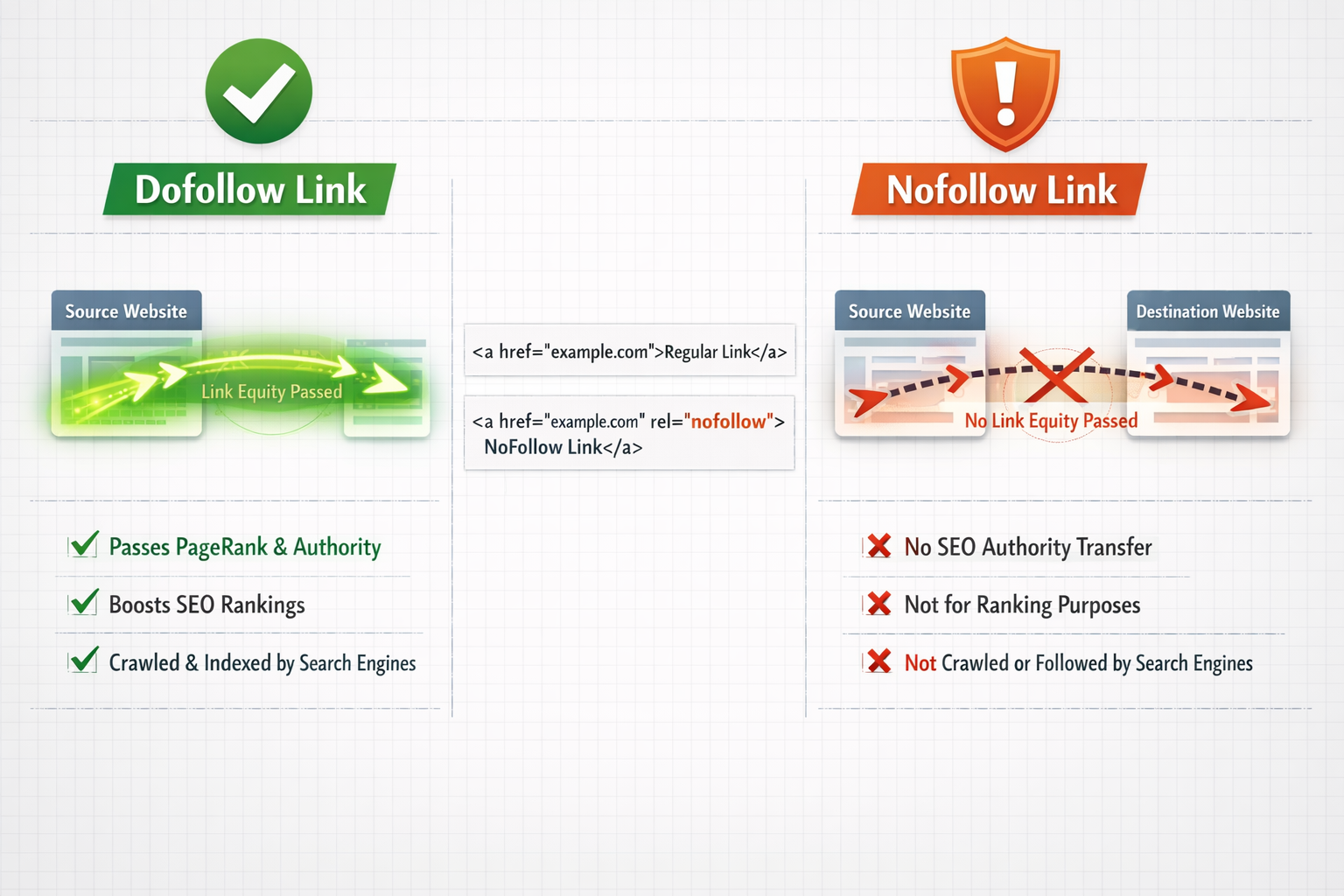
The main types of backlinks in SEO fall into categories based on how they’re acquired (earned, outreach-based, created, or paid) and their technical attributes (dofollow vs. nofollow). Dofollow links remain the default type that passes PageRank and influences rankings, while one-way editorial links from authoritative sources carry the highest value[1]. Understanding these distinctions helps you prioritize link building strategies that deliver measurable results rather than wasting effort on low-value tactics.
What Are the Main Types of Backlinks in SEO?
Backlinks divide into several core categories based on acquisition method and technical implementation. The most important distinction separates dofollow links (which pass ranking authority) from nofollow links (which don’t)[1].
Beyond this technical split, backlinks also categorize by how you acquire them:
- Earned/natural links – Editorial links you receive without asking, based purely on content quality
- Outreach-based links – Links acquired through deliberate relationship building and content promotion
- Created links – Links you place yourself in directories, profiles, or forums
- Paid links – Links purchased directly or through sponsored content arrangements
Each category carries different SEO value, risk levels, and scalability potential. Earned links align most closely with what search algorithms reward, while created links often provide the least benefit[1].
Common mistake: Treating all backlinks equally. A single editorial link from an authoritative publication typically outweighs dozens of directory or forum links.
How Do Dofollow and Nofollow Links Differ?
Dofollow links remain the default link type that passes PageRank and link equity directly to your site, requiring no special HTML attributes[1]. When another website links to you with a standard dofollow link, search engines follow that link and transfer a portion of the linking page’s authority to your site.
Nofollow links include the rel="nofollow" attribute, telling search engines not to pass ranking credit. While they don’t directly boost rankings, nofollow links still provide value through:
- Referral traffic from users clicking the link
- Brand exposure and awareness
- Natural link profile diversity
- Potential for future dofollow opportunities
Google introduced additional link attributes in recent years:
| Attribute | Purpose | SEO Impact |
|---|---|---|
rel="nofollow" | General instruction not to follow | No direct ranking benefit |
rel="sponsored" | Identifies paid/sponsored links | No direct ranking benefit |
rel="ugc" | Marks user-generated content links | No direct ranking benefit |
Decision rule: Prioritize acquiring dofollow links from relevant, authoritative sources. Accept nofollow links when they drive traffic or come from high-visibility platforms, but don’t make them your primary strategy.
What Makes One-Way Links More Valuable Than Reciprocal Links?
One-way links have the highest value because they represent natural, unprompted endorsements from other websites[1]. When a site links to you without expecting a link back, it signals genuine editorial merit to search algorithms.
Reciprocal links (where two sites link to each other) carry less weight because:
- They can appear manipulative if done excessively
- They lack the pure editorial endorsement signal
- Search engines may discount or ignore obvious link exchanges
- They’ve been historically overused for manipulation
Three-way link exchanges (where Site A links to Site B, Site B links to Site C, and Site C links to Site A) attempt to disguise reciprocal arrangements but remain detectable at scale.
Choose one-way links when: You’re building sustainable, long-term SEO authority. Focus your efforts on creating content worthy of unprompted citations rather than arranging link swaps.
Edge case: Legitimate reciprocal links between genuine partners or complementary businesses pose minimal risk. The problem arises when reciprocal linking becomes your primary acquisition strategy.
Which Types of Backlinks in SEO Carry the Highest Authority?
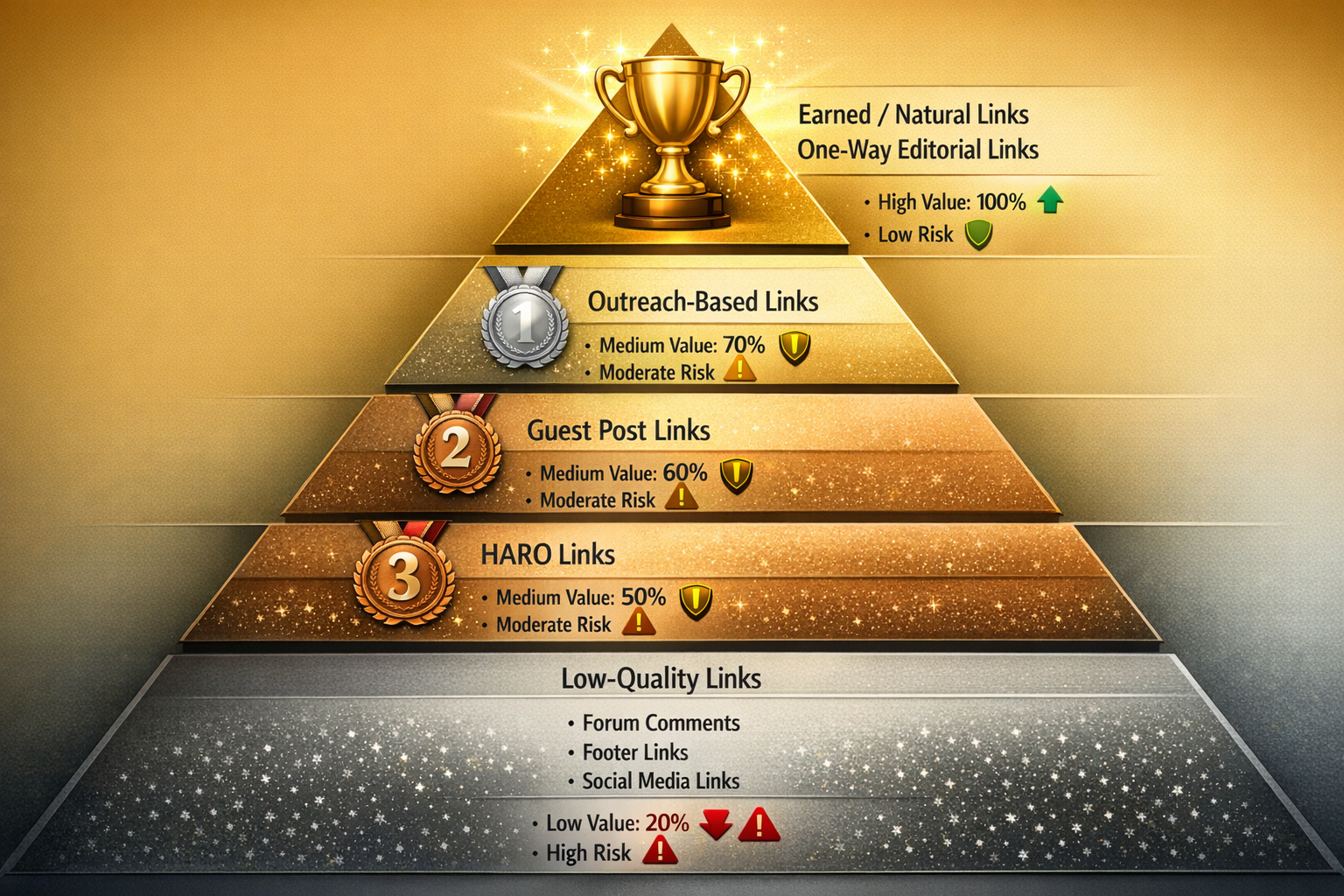
The highest-value backlinks share specific characteristics that signal genuine editorial endorsement and topical relevance.
Earned/Natural Links
Earned links carry the highest value because they’re acquired through quality content without direct outreach[1]. These represent completely organic editorial decisions where another site chooses to reference your content as a valuable resource.
Examples include:
- News articles citing your research or data
- Bloggers referencing your content in roundup posts
- Industry publications linking to your guides
- Academic or educational institutions citing your resources
Why they work: Earned links align perfectly with what search algorithms reward and are virtually impossible to fake at scale.
HARO and Journalist Outreach Links
HARO links carry high value because they often come from major publications with strong editorial standards[1]. Help a Reporter Out (HARO) and similar services connect journalists with expert sources, resulting in contextual links within news articles.
Benefits include:
- Links from high-authority news domains
- Contextual placement within relevant content
- Natural anchor text based on your expertise
- Potential for long-term visibility
Trade-off: These links require genuine expertise and involve competitive acquisition, as multiple sources compete for each opportunity.
Guest Post Links (When Done Right)
Guest post backlinks offer medium-to-high value when they appear on relevant, authoritative sites with genuine editorial standards. The key is providing substantial value to the host site’s audience rather than treating guest posting as pure link acquisition.
High-quality guest posts include:
- Original research or unique insights
- Comprehensive how-to content
- Expert analysis of industry trends
- Author bio links (which have medium value when earned through expertise)[1]
Common mistake: Publishing thin, promotional guest posts solely for link acquisition. These often get devalued or can trigger manual penalties if the pattern becomes obvious.
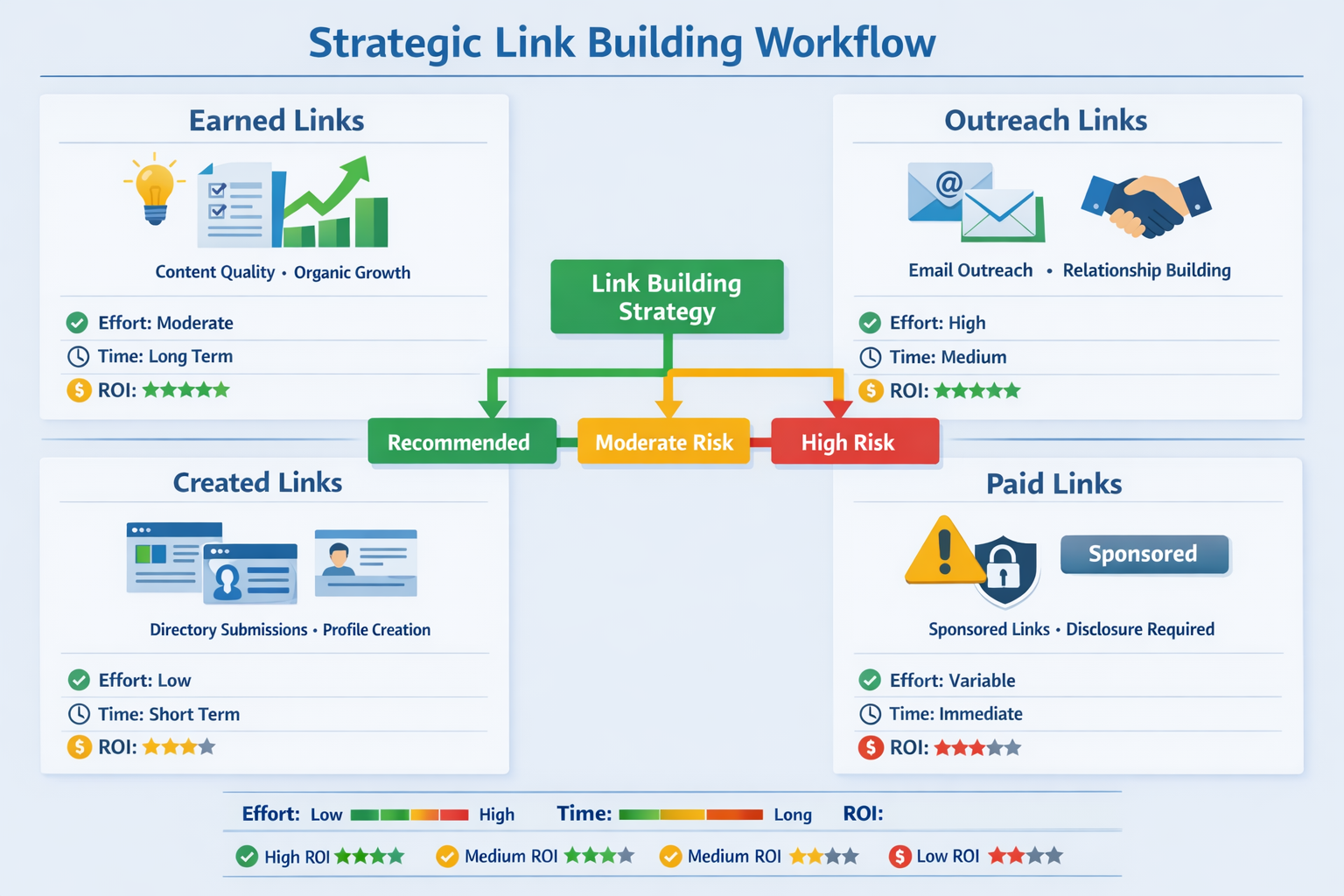
How Do Different Link Building Strategies Compare?
Different acquisition methods require varying levels of effort and deliver different returns on investment.
Outreach-Based Link Building
Outreach-based links fall into the medium-to-high value category when they offer genuine value and require quality content backing[1]. This includes:
- Skyscraper technique – Creating superior content compared to what’s currently linked, then reaching out to sites linking to inferior resources[1]
- Broken link building – Finding dead links on relevant sites and suggesting your content as a replacement
- Resource page outreach – Getting listed on curated resource collections
- Niche edits – Requesting contextual link insertions into existing content (medium-to-high value when legitimate)[1]
Success factors: Personalized outreach, genuine relationship building, and content that’s demonstrably better than alternatives.
Created Links
Created links typically offer the lowest value but require minimal effort. These include:
- Directory submissions – Listing your site in web directories
- Profile links – Adding your website to social media or forum profiles
- Forum signatures – Links in your forum signature
- Comment links – Links in blog or forum comments (mostly nofollow with low value)[1]
When to use them: As minor supplementary tactics for referral traffic and brand mentions, never as a primary strategy. For broader link building options, explore powerful backlink packages that combine multiple acquisition methods.
Paid and Sponsored Links
Paid links require disclosure and proper attribution to avoid penalties. When transparently marked with rel="sponsored", they provide brand visibility without direct ranking benefits.
Critical rule: Never purchase links intended to manipulate rankings without proper disclosure. This violates Google’s guidelines and risks severe penalties.
What Role Do Link Attributes and Placement Play?
Beyond the basic dofollow/nofollow distinction, where and how a link appears significantly impacts its value.
Contextual vs. Non-Contextual Links
Contextual links (embedded within the main content) carry substantially more weight than:
- Footer links – Appearing sitewide with low value and little contextual relevance[1]
- Sidebar links – Often promotional with minimal editorial context
- Author bio links – Having medium value when earned through expertise[1]
Why it matters: Contextual placement signals editorial endorsement rather than templated or paid placement.
Anchor Text Considerations
The clickable text of a link provides context about the linked page. Natural link profiles include:
- Branded anchors – Your company or website name
- Naked URLs – The actual URL as anchor text
- Generic phrases – “click here,” “read more,” “this article”
- Partial match – Variations of your target keywords
- Exact match – Precise keyword phrases (use sparingly)
Balance is key: Over-optimization with exact-match anchors triggers spam filters. Natural profiles show variety weighted toward branded and generic anchors.
Domain Authority and Relevance
A link’s value depends heavily on:
- Source domain authority – Higher-authority sites pass more equity
- Topical relevance – Links from related niches carry more weight
- Page-level authority – Links from well-established pages outperform new pages
- Traffic potential – Links from pages that actually receive visitors
Choose relevance over raw authority when: You’re building topical authority in a specific niche. A link from a medium-authority but highly relevant site often outperforms one from a high-authority but unrelated source.
How Are AI Overviews Changing Backlink Strategy?
AI Overview citations have become increasingly valuable as Google AI Overviews appear on over 60% of commercial searches[3]. Getting cited as a source in these AI-generated summaries represents a new form of high-visibility backlink.
To increase chances of AI Overview citation:
- Create authoritative, well-researched content with clear data and expert insights
- Structure information with clear headings and scannable formatting
- Include verifiable facts and statistics that AI can confidently cite
- Build links from other authoritative sources to establish topical authority
- Answer specific questions comprehensively rather than providing surface-level content
The shift: Traditional backlinks now serve dual purposes—passing direct ranking equity and establishing the authority needed for AI citation selection.
For insights on how different indexes track your backlinks, see our guide on Google Index vs Backlink Index.
What Are the Biggest Backlink Building Mistakes to Avoid?
Understanding what not to do prevents wasted effort and potential penalties.
High-Risk Tactics
Avoid these outdated or manipulative approaches:
- Link farms and PBNs – Networks of sites created solely for link manipulation
- Automated link building – Software-generated links at scale
- Irrelevant directory spam – Submitting to hundreds of low-quality directories
- Excessive reciprocal linking – Obvious link exchange schemes
- Hidden or deceptive links – Links designed to manipulate without user awareness
- Purchased links without disclosure – Violates search engine guidelines
Low-Value Time Investments
These tactics aren’t necessarily risky but deliver poor return on effort:
- Social media links as a primary strategy – They carry low direct SEO value despite being nofollow[1]
- Forum and comment link building – Easy to create but shouldn’t be your main focus[1]
- Mass directory submissions – Minimal benefit for significant time investment
- Generic guest posting – Publishing thin content solely for link acquisition
Better approach: Invest the same time in creating genuinely valuable content that earns editorial links naturally. Consider multi-tier backlink strategies that combine different link types strategically.
How Do You Build a Balanced Backlink Profile?
A natural, sustainable backlink profile includes variety across multiple dimensions.
Link Type Diversity
Your profile should include:
- Majority dofollow with some natural nofollow links
- Mix of contextual and non-contextual placements
- Various anchor text types weighted toward branded and natural phrases
- Different acquisition methods (earned, outreach, and minimal created)
- Range of source types (blogs, news sites, directories, social platforms)
Quality Over Quantity
Focus on these quality indicators:
- Source relevance – Links from topically related sites
- Editorial standards – Sites that curate content carefully
- Real traffic – Links from pages that actual users visit
- Natural context – Links that make sense to human readers
- Sustainable acquisition – Methods you can maintain long-term
Measurement tip: Track not just link count but also referring domain quality, traffic from backlinks, and ranking improvements for target keywords.
Scaling Strategically
Build your profile progressively:
- Start with foundation links – Quality directory listings, social profiles, basic citations
- Add earned links – Create linkable assets (research, tools, comprehensive guides)
- Layer outreach links – Systematically promote your best content to relevant sites
- Maintain consistency – Steady growth appears more natural than sudden spikes
For businesses needing comprehensive link building, explore case studies showing real-world results from strategic backlink campaigns.
FAQ
What’s the difference between dofollow and nofollow backlinks?
Dofollow links pass PageRank and ranking authority to your site, while nofollow links include a rel="nofollow" attribute telling search engines not to pass ranking credit. Dofollow links directly impact SEO, while nofollow links primarily drive traffic and brand awareness[1].
Which type of backlink is most valuable for SEO?
One-way editorial links from authoritative, relevant sources carry the highest value because they represent genuine, unprompted endorsements. Earned links from quality content outperform all other acquisition methods in algorithmic value[1].
Are footer links bad for SEO?
Footer links have low value due to their sitewide placement and lack of contextual relevance. They’re not inherently harmful in small numbers but shouldn’t be a primary link building strategy, especially since they’ve been historically overused for manipulation[1].
Do social media backlinks help SEO?
Social media links typically carry nofollow attributes and provide no direct ranking benefits. However, they remain valuable for content distribution, audience building, and driving indirect links when your content gets discovered and cited by others[1].
What are HARO links and why are they valuable?
HARO (Help a Reporter Out) connects journalists with expert sources, resulting in links from major publications with strong editorial standards. These links carry high value because they appear in contextual, authoritative news content[1].
How many backlinks do I need to rank?
Quality matters far more than quantity. A few high-authority, relevant links often outperform dozens of low-quality links. Focus on earning links from sources that pass genuine authority and drive real traffic rather than chasing arbitrary link counts.
Are guest post backlinks still effective in 2026?
Yes, when done properly. Guest posts on relevant, authoritative sites with genuine editorial standards offer medium-to-high value. The key is providing substantial content value rather than thin, promotional posts created solely for link acquisition[1].
What’s the safest way to build backlinks?
Create genuinely valuable content that earns editorial links naturally, supplement with legitimate outreach to relevant sites, and avoid manipulative tactics like link farms or undisclosed paid links. Prioritize relevance and quality over quantity.
Can too many backlinks hurt my SEO?
Sudden spikes in low-quality links can trigger spam filters, and obvious manipulation patterns risk penalties. Natural link growth varies by industry, but consistency matters more than volume. Focus on sustainable acquisition methods.
What’s a niche edit and is it legitimate?
A niche edit involves adding a contextual link to existing content on another site. These carry medium-to-high value when legitimate, but become problematic when they represent pure transactional insertions without contextual relevance or proper disclosure[1].
How do I check the quality of a potential backlink source?
Evaluate domain authority metrics, check for real organic traffic, review editorial standards, assess topical relevance, and verify the site isn’t a link farm or PBN. Use tools like Ahrefs or Moz to analyze domain metrics.
What’s the difference between earned and built links?
Earned links come naturally without outreach when others find and cite your content. Built links result from deliberate acquisition efforts like outreach, guest posting, or directory submissions. Earned links carry higher algorithmic value but are harder to scale[1].
Conclusion
Understanding the different types of backlinks in SEO transforms link building from guesswork into strategic advantage. Dofollow links from authoritative, relevant sources remain the foundation of effective SEO, while one-way editorial links represent the gold standard that algorithms reward most heavily.
The most successful approach combines earned links from exceptional content with strategic outreach to amplify visibility. Avoid low-value tactics like excessive forum commenting or footer link schemes, and never purchase links without proper disclosure. Instead, invest in creating genuinely valuable resources that naturally attract citations.
Take these next steps:
- Audit your current backlink profile – Identify which types of links you have and their quality distribution
- Create linkable assets – Develop comprehensive guides, original research, or useful tools worth citing
- Start strategic outreach – Connect with relevant sites about your best content
- Monitor and measure – Track not just link quantity but quality metrics and ranking improvements
- Stay consistent – Build links steadily over time rather than in sudden bursts
Remember that backlink quality, relevance, and natural acquisition patterns matter far more than raw numbers. Focus on building a diverse, sustainable link profile that serves both search algorithms and real users, and you’ll see lasting SEO results in 2026 and beyond.
References
[1] Types Of Backlinks Complete List – https://backlinkgrid.com/blog/types-of-backlinks-complete-list
[3] Definitive Guide Link Building 2026 – https://almcorp.com/blog/definitive-guide-link-building-2026/
Tags:
types of backlinks in seo, dofollow links, nofollow links, link building, earned links, guest post backlinks, HARO links, SEO strategy, backlink quality, one-way links, outreach links, PageRank
🔗 Backlink Value Calculator
Estimate the SEO value of your backlink opportunities