Last updated: February 27, 2026
Key Takeaways
- Backlinks are incoming links from one website to another, acting as votes of confidence that signal credibility and authority to search engines
- Quality matters far more than quantity – a single link from a high-authority, relevant site outweighs dozens of low-quality links
- Backlinks directly impact search rankings by transferring authority (link juice) from the linking site to your page
- Contextual relevance is critical – links from industry-related websites carry substantially more weight than unrelated sources
- Dofollow links pass SEO value while nofollow links don’t transfer ranking power, though both can drive traffic
- Earned backlinks from quality content provide the most sustainable long-term SEO benefits
- Backlinks enhance crawling and indexing by creating pathways for search engines to discover your content faster
- E-E-A-T framework integration means backlinks now contribute to Google’s assessment of Experience, Expertise, Authoritativeness, and Trustworthiness[2]
- Referral traffic from backlinks drives conversions and provides ongoing value beyond search rankings[1]
- Monitoring multiple metrics (referring domains, organic keywords, traffic, conversions) is essential for measuring backlink success
Quick Answer
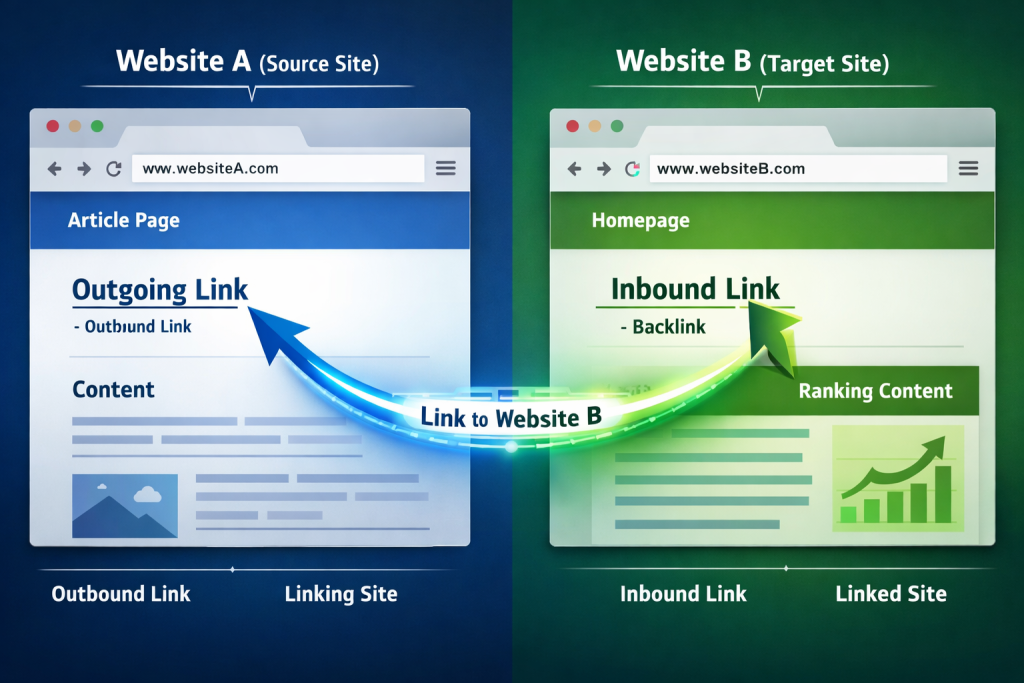
Backlinks in SEO are hyperlinks from external websites that point to your site. They function as endorsements that tell search engines your content is valuable, credible, and worth ranking higher in search results. When authoritative websites link to your pages, they transfer a portion of their credibility (called link equity or “link juice”) to your site, which directly influences your search engine rankings.[1] Quality backlinks from relevant, trusted sources remain one of the most powerful ranking factors in 2026, helping search engines discover your content faster while simultaneously driving referral traffic and building domain authority.
What Are Backlinks in SEO and How Do They Work?
Backlinks are incoming hyperlinks from one website to another website. When Site A creates a link pointing to Site B, Site B has received a backlink from Site A. Search engines interpret these links as votes of confidence – each quality backlink signals that your content is valuable enough for others to reference and recommend.[2]
The mechanism works through link equity transfer. When an authoritative site links to your page, it passes a portion of its credibility and ranking power to your site. Search engines like Google use sophisticated algorithms to evaluate these connections, considering factors like the linking site’s authority, relevance to your topic, and the context surrounding the link.[1]
The Technical Process
Search engines discover and evaluate backlinks through several steps:
- Crawling: Search engine bots follow links from known pages to discover new content across the web
- Indexing: Once discovered, pages and their backlink profiles are stored in search engine databases
- Evaluation: Algorithms assess each backlink’s quality based on authority, relevance, anchor text, and context
- Ranking calculation: The cumulative value of quality backlinks contributes to your page’s position in search results[2]
Common mistake: Assuming all backlinks provide equal value. A single link from a major industry publication can outperform hundreds of directory submissions or forum comments. Focus on quality sources that align with your niche.
For a deeper understanding of the technical mechanics, see our guide on how backlinks work in SEO.
Why Are Backlinks Important for SEO Success?
Backlinks remain one of Google’s top-ranking factors because they provide objective, third-party validation of content quality. Unlike on-page elements you control directly, backlinks represent external endorsements that are harder to manipulate and therefore more trustworthy as quality signals.[5]
Core Benefits of Quality Backlinks
Higher search rankings: Pages with strong backlink profiles consistently outrank competitors with similar content but fewer quality links. Google’s algorithm weighs backlink authority heavily when determining which pages deserve top positions.[7]
Faster indexing: New pages with backlinks get discovered and indexed significantly faster than orphaned pages with no incoming links. Each backlink creates a pathway for search engine crawlers to find your content.[2]
Increased organic traffic: Better rankings translate directly to more clicks. The difference between position 3 and position 1 can mean thousands of additional monthly visitors for competitive keywords.
Enhanced domain authority: Accumulated quality backlinks over time build your site’s overall authority, making it easier for new pages to rank well even without extensive individual backlink building.[1]
Referral traffic generation: Beyond SEO benefits, backlinks from high-traffic sites send direct visitors who are already interested in your topic and more likely to convert.[2]
Brand visibility and credibility: Being mentioned and linked by respected industry sources builds brand recognition and establishes your site as a trusted authority.
The E-E-A-T Connection
Google’s E-E-A-T framework (Experience, Expertise, Authoritativeness, Trustworthiness) now incorporates backlinks as key trust signals. Links from established medical journals, educational institutions, or recognized industry leaders directly contribute to your site’s perceived expertise and trustworthiness in Google’s evaluation.[2]
Choose backlink building if: You’re competing in moderately to highly competitive niches where organic visibility matters for business growth. Skip aggressive link building if you operate in an uncompetitive local niche where basic on-page SEO suffices.
Learn more about the strategic value in our article on why backlinks are important for SEO.
What Are the Different Types of Backlinks in SEO?
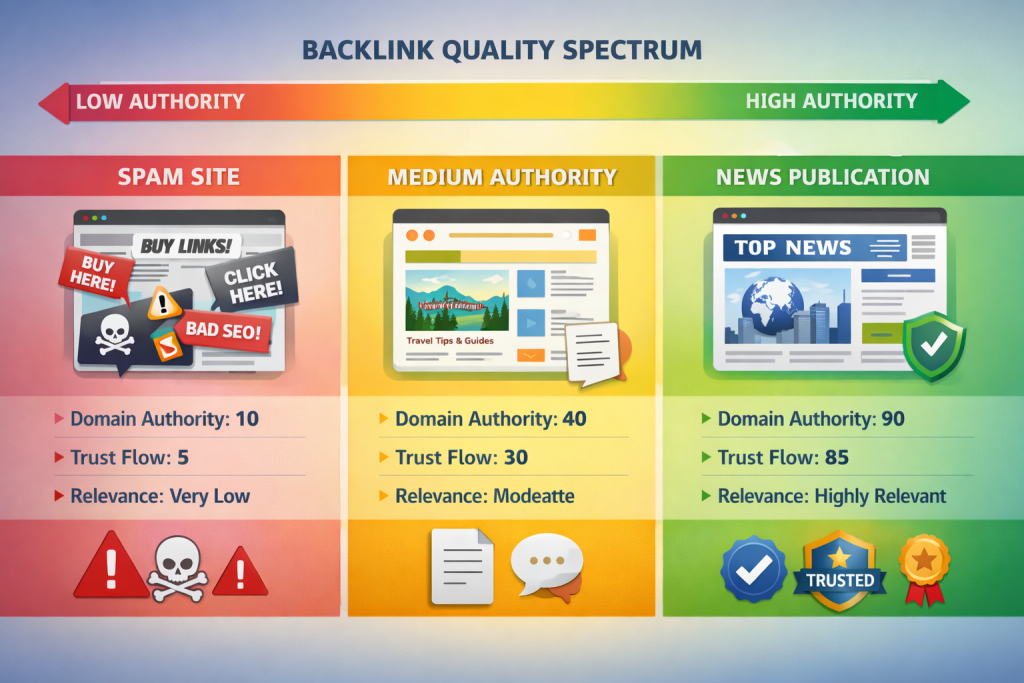
Not all backlinks function the same way. Understanding the distinctions helps you prioritize acquisition efforts and evaluate your backlink profile effectively.
Dofollow vs. Nofollow Links
Dofollow links are the default link type that passes link equity and directly impacts search rankings. When a site links to you with a standard HTML link, it’s dofollow unless specifically modified.[3]
Nofollow links include a rel="nofollow" attribute that tells search engines not to pass ranking value. While they don’t directly boost rankings, they still drive traffic, build brand awareness, and create a natural-looking link profile.[3]
| Link Type | Passes SEO Value | Drives Traffic | Use Cases |
|---|---|---|---|
| Dofollow | ✅ Yes | ✅ Yes | Editorial content, partnerships, quality directories |
| Nofollow | ❌ No | ✅ Yes | User-generated content, paid links, untrusted sources |
Editorial vs. Manual Links
Editorial links are naturally earned when others reference your content because it’s valuable, informative, or newsworthy. These represent the gold standard because they’re genuine endorsements.[3]
Manual links come from deliberate outreach, such as requesting links from partners, submitting to directories, or guest posting. While legitimate, they require more effort and may carry less weight than organic editorial mentions.
Contextual vs. Non-Contextual Links
Contextual backlinks appear within the main content body, surrounded by relevant text that provides context about why the link exists. These carry significantly more weight because they demonstrate genuine relevance.[3]
Non-contextual links appear in footers, sidebars, author bios, or navigation menus. While still valuable for traffic and discovery, they typically pass less ranking power.
For detailed explanations of each category, visit our comprehensive guide on types of backlinks in SEO.
Homepage vs. Deep Links
Homepage backlinks point to your domain’s main page (yoursite.com) and act as domain-wide votes of confidence, boosting overall brand authority.[3]
Deep links point to specific internal pages (yoursite.com/specific-article) and help those individual pages rank for targeted keywords.
Edge case: A balanced profile includes both types. Too many homepage links compared to deep links can appear unnatural, while only deep links may leave your domain authority underdeveloped.
How Do You Evaluate Backlink Quality?
Quality decisively outweighs quantity in 2026. A handful of high-authority, relevant links provides exponentially more value than hundreds of low-quality links from unrelated or spammy sources.[3][1]
Key Quality Indicators
Domain authority and trust: Links from established, authoritative domains (major publications, educational institutions, government sites, industry leaders) carry substantially more weight. Tools like Moz, Ahrefs, and SEMrush provide domain authority metrics to assess linking site strength.
Topical relevance: A backlink from a site in your industry or niche carries far more value than an unrelated link. A veterinary clinic benefits more from a pet care blog than a car dealership link, even if the car site has higher overall authority.[2][3]
Link placement and context: Links embedded naturally within relevant content paragraphs outperform footer links, sidebar widgets, or site-wide templates. The surrounding text should logically relate to your linked page’s topic.
Anchor text optimization: The clickable text of the link should be descriptive and relevant without being over-optimized. Natural anchor text variation (branded terms, URLs, generic phrases, exact-match keywords) creates a healthy profile.
Traffic potential: Links from pages that actually receive visitors provide referral traffic beyond SEO value. A link from a popular, high-traffic page beats a link from a rarely-visited archive page on the same domain.
Editorial nature: Links that exist because an editor or content creator genuinely found your content valuable and chose to reference it carry more weight than links you requested or paid for.
Red Flags to Avoid
- Links from known link farms or private blog networks
- Site-wide footer or sidebar links appearing on every page of a domain
- Links from completely unrelated industries (unless it’s a major news outlet covering diverse topics)
- Sudden spikes of dozens of new links appearing simultaneously
- Links from sites with thin, low-quality, or auto-generated content
- Reciprocal link schemes where sites exchange links solely for SEO purposes
- Links with overly optimized, keyword-stuffed anchor text
Decision rule: Accept a link if you’d be happy to have that site’s audience visit your page, even if search engines didn’t exist. Decline links from sites you wouldn’t want associated with your brand.
To understand how search engines assess these factors, read our article on how Google evaluates backlinks.
What Are the Most Effective Backlink Acquisition Strategies?
Earning quality backlinks requires creating link-worthy content and strategically promoting it to the right audiences. The most sustainable approaches focus on providing genuine value rather than manipulating algorithms.
Create Link-Worthy Content Assets
Original research and data: Publish unique studies, surveys, or data analysis that others will naturally reference and cite. Industry statistics, benchmark reports, and trend analyses generate consistent backlinks over time.
Comprehensive guides and resources: In-depth tutorials, how-to guides, and resource compilations that thoroughly cover topics become go-to references that accumulate links naturally.[3]
Visual content: Infographics, charts, interactive tools, and data visualizations are highly shareable and frequently embedded with attribution links.
Expert roundups and interviews: Featuring industry experts creates natural incentives for participants to share and link to the content.
Strategic Outreach Methods
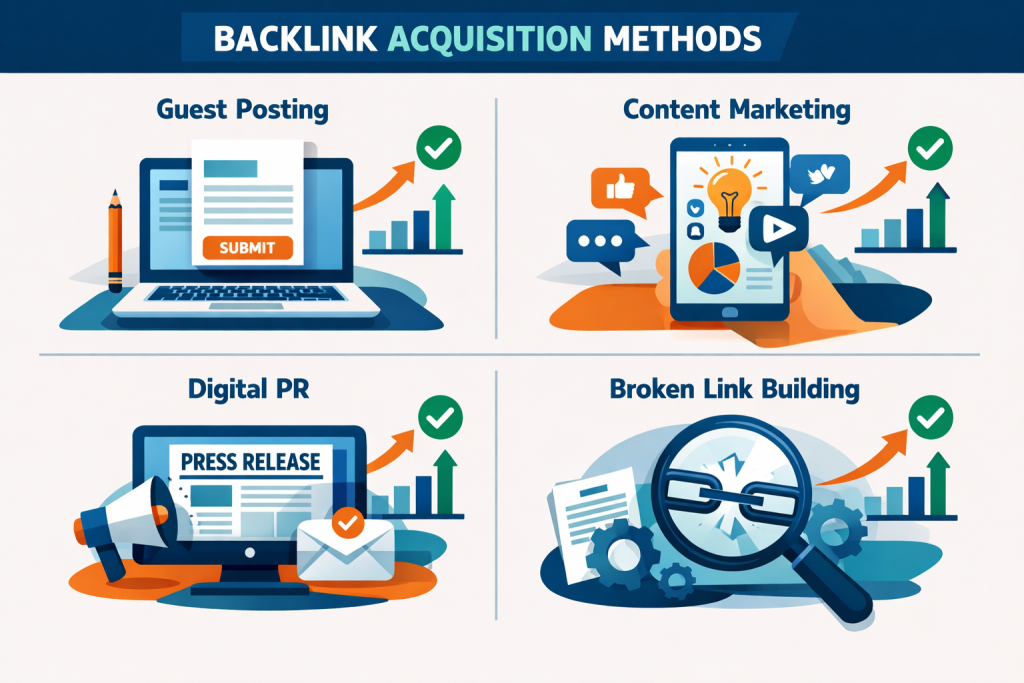
Guest posting: Write valuable articles for relevant industry publications, including a natural link back to your site. Focus on high-quality sites where your target audience already spends time.
Digital PR and newsjacking: Create newsworthy content or commentary on trending topics that journalists and bloggers will reference. Press releases about significant company developments, expert opinions on breaking news, or unique angles on popular topics can earn media coverage and backlinks.[8]
Broken link building: Find broken links on relevant sites, then reach out suggesting your content as a replacement. This provides value to the site owner while earning you a quality backlink.
Resource page outreach: Identify curated resource pages in your industry and suggest your high-quality content for inclusion.
Competitor backlink analysis: Research where competitors earn their backlinks, then pursue similar opportunities with better content or stronger relationships.
Relationship Building
Networking with industry peers: Build genuine relationships with other content creators, bloggers, and industry professionals. Natural link opportunities emerge from authentic connections.
Partnerships and collaborations: Joint ventures, co-created content, and strategic partnerships often result in mutual linking and cross-promotion.
Community participation: Active, valuable participation in industry forums, communities, and discussions builds visibility and credibility that leads to natural link opportunities.
Emerging 2026 Strategies
AI-era source content: Create authoritative, well-cited content that becomes the “source of truth” AI tools and large language models reference. As AI-generated content proliferates, original sources gain citation value.[3]
Thought leadership on emerging platforms: Establish presence on newer platforms where competition for authority is lower, building backlinks before markets become saturated.
Common mistake: Prioritizing quantity over quality by submitting to hundreds of low-value directories or buying link packages. These tactics waste resources and risk penalties. Instead, invest time in earning fewer, higher-quality links from genuinely relevant sources.
How Do Backlinks Improve Domain Authority and Rankings?
Backlinks contribute to domain authority through accumulated trust and credibility signals that search engines use to evaluate your entire site’s quality and ranking potential.
The Domain Authority Concept
Domain authority (DA) is a predictive metric (popularized by Moz) that estimates how well a website will rank in search results based on its backlink profile strength. While not a direct Google ranking factor, it correlates strongly with ranking performance because it measures the same signals Google considers.[1]
How backlinks build DA:
- Quality accumulation: Each high-authority backlink adds credibility to your domain
- Trust transfer: Links from trusted domains make your site more trustworthy by association
- Topic authority: Relevant backlinks from industry sources establish you as an authority in your niche
- Link diversity: Backlinks from various quality domains demonstrate broad recognition
Impact on Individual Page Rankings
While domain authority affects your entire site, individual page rankings depend on both domain-level and page-level backlink signals:
Page-level factors:
- Number and quality of backlinks pointing specifically to that page
- Relevance of linking pages to the target page’s topic
- Anchor text distribution for links to that page
- Freshness and recency of backlinks
Domain-level factors:
- Overall domain authority from accumulated backlinks
- Historical trust and credibility signals
- Breadth of linking domain diversity
- Quality of the site’s overall backlink profile
Combined effect: A page on a high-authority domain needs fewer individual backlinks to rank well compared to the same page on a low-authority domain. This is why new pages on established sites often rank faster than identical content on new sites.
The Compounding Effect
Domain authority builds momentum over time. As your site accumulates quality backlinks:
- New content ranks faster with less individual link building
- You attract more natural links because others discover your content through higher rankings
- Your site becomes a more attractive link target because linking to authoritative sites benefits the linker
- Search engines crawl your site more frequently, indexing new content faster
Timeline consideration: Building meaningful domain authority typically requires 6-12 months of consistent quality backlink acquisition. Expect gradual improvements rather than overnight transformations.
For detailed insights into this process, see our guide on how backlinks improve domain authority.
What Is a Backlink Profile and Why Does It Matter?
A backlink profile is the complete collection of all backlinks pointing to your website, including their sources, quality, anchor text distribution, and growth patterns. Search engines analyze your entire profile rather than individual links in isolation.[1]
Components of a Healthy Backlink Profile
Diverse linking domains: Backlinks from many different domains indicate broad recognition. 100 links from 100 different sites carries more weight than 100 links from a single site.
Natural anchor text distribution: A healthy profile includes varied anchor text:
- Branded terms (your company name)
- Generic phrases (“click here,” “read more”)
- Naked URLs (yoursite.com)
- Partial-match keywords
- Exact-match keywords (used sparingly)
Balanced link types: Mix of dofollow and nofollow links, contextual and non-contextual placements, homepage and deep links creates natural appearance.
Steady growth patterns: Gradual, consistent backlink acquisition over time appears more natural than sudden spikes followed by long periods of inactivity.
Quality source variety: Links from different types of sources (news sites, blogs, industry publications, educational resources, business directories) demonstrate broad appeal.
Profile Analysis and Monitoring
Key metrics to track:
| Metric | What It Measures | Why It Matters |
|---|---|---|
| Referring domains | Number of unique sites linking to you | More domains = broader recognition |
| Total backlinks | All links from all sources | Shows overall link volume |
| Domain authority | Predictive ranking strength | Indicates competitive positioning |
| Link velocity | Rate of new link acquisition | Detects unnatural patterns |
| Toxic link ratio | Percentage of low-quality links | Identifies penalty risks |
| Anchor text distribution | Keyword vs. branded vs. generic | Reveals over-optimization |
Tools for profile analysis:
- Google Search Console (free, shows links Google discovered)
- Ahrefs Site Explorer (comprehensive backlink database)
- Moz Link Explorer (domain authority metrics)
- SEMrush Backlink Analytics (competitive comparisons)
- Majestic (trust flow and citation flow metrics)
Profile Cleanup and Maintenance
When to disavow toxic links: If you’ve acquired spammy or manipulative links (from previous SEO mistakes, negative SEO attacks, or inherited issues), use Google’s Disavow Tool to tell search engines to ignore them.
Regular audits: Review your backlink profile quarterly to identify:
- New toxic links requiring disavowal
- Lost valuable links that might be recovered
- Opportunities based on competitor analysis
- Anchor text over-optimization issues
Edge case: Not all low-authority links are toxic. A link from a small but legitimate industry blog is fine. Only disavow links from obvious spam sites, link farms, or manipulative schemes.
Learn more in our detailed explanation of backlink profile analysis.
How Do You Measure Backlink Success and ROI?
Effective backlink strategies require measuring outcomes beyond just link counts. Track metrics that connect backlinks to actual business results and SEO performance improvements.[1]
Primary Performance Metrics
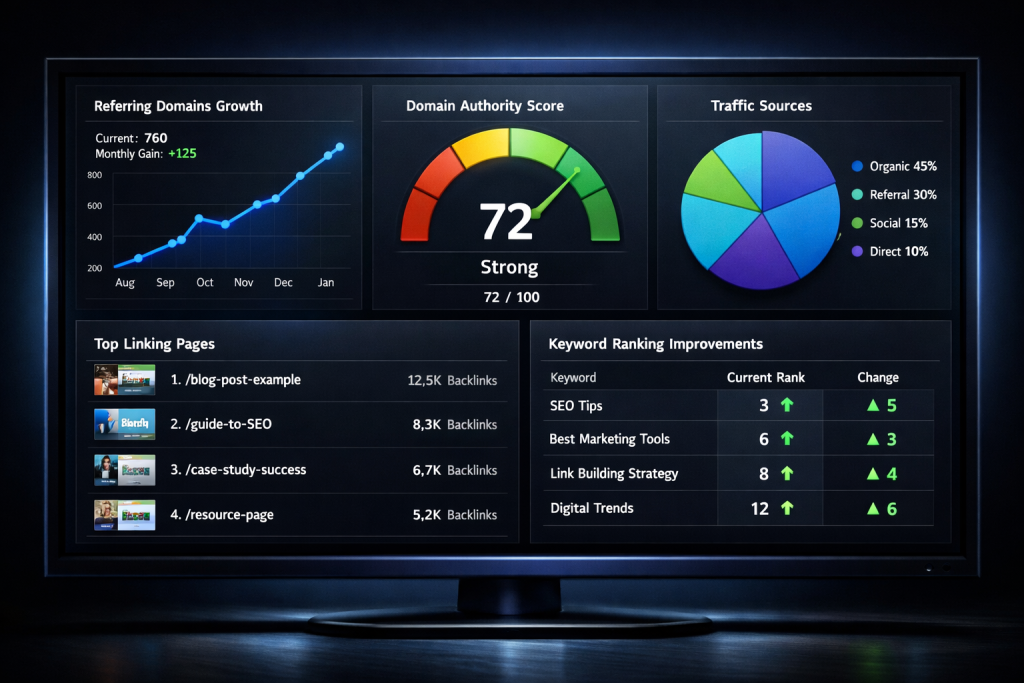
Referring domains growth: Monitor the number of unique domains linking to your site over time. Aim for steady, consistent growth rather than sudden spikes.
Organic keyword rankings: Track position improvements for target keywords. Quality backlinks should correlate with gradual ranking increases over 3-6 months.
Organic search traffic: Measure total organic sessions, new users, and traffic to specific pages that received backlinks. Backlink campaigns should drive measurable traffic increases.
Referral traffic volume: Track visitors coming directly through backlinks (visible in Google Analytics under Acquisition > All Traffic > Referrals). High-quality links generate ongoing referral traffic.
Conversion rates from referrals: Measure how referral traffic converts compared to other channels. Quality backlinks often bring highly qualified visitors with above-average conversion rates.
Domain authority progression: Monitor your site’s domain authority score monthly. Expect gradual increases as you accumulate quality backlinks.
Setting Realistic Benchmarks
Timeline expectations:
- 1-3 months: New backlinks discovered and indexed by search engines
- 3-6 months: Measurable ranking improvements for target keywords
- 6-12 months: Significant domain authority increases and compounding effects
- 12+ months: Established authority with faster ranking for new content
Quality vs. quantity targets: Rather than setting goals like “acquire 100 backlinks monthly,” focus on “earn 5-10 backlinks monthly from sites with DA 40+ in our industry.”
ROI Calculation Framework
Investment costs:
- Content creation (research, writing, design)
- Outreach time and tools
- Guest posting fees or contributor time
- PR services or tools
- Link analysis software subscriptions
Value generated:
- Increased organic traffic × average customer value
- Direct conversions from referral traffic
- Brand visibility and authority (harder to quantify but valuable)
- Reduced paid advertising needs as organic traffic grows
Simple ROI formula: (Revenue from organic + referral traffic – backlink acquisition costs) ÷ backlink acquisition costs × 100
Example: Spending $2,000 monthly on content and outreach that generates 10 quality backlinks, resulting in 500 additional monthly organic visitors with a 2% conversion rate and $100 average order value = $1,000 monthly revenue. After 6 months of compounding, this could reach $6,000+ monthly revenue from a $12,000 investment (50% ROI in first 6 months, improving over time).
Common Measurement Mistakes
- Tracking only link quantity without assessing quality or relevance
- Expecting immediate ranking changes (backlinks take time to impact rankings)
- Ignoring referral traffic value and focusing only on SEO metrics
- Not connecting backlink efforts to actual business outcomes (revenue, leads, conversions)
- Failing to account for the compounding, long-term nature of domain authority building
Decision rule: If a backlink strategy doesn’t show measurable ranking or traffic improvements within 6 months, reassess your targeting and quality standards. The issue is typically quality or relevance, not the strategy itself.
What Are Common Backlink Mistakes to Avoid in 2026?
Understanding what doesn’t work prevents wasted resources and potential penalties. Many outdated tactics persist despite being ineffective or actively harmful.
Quantity-Over-Quality Approaches
Buying link packages: Services offering “100 backlinks for $50” deliver low-quality, often spammy links from irrelevant sites that provide zero value and risk penalties.[8]
Mass directory submissions: Submitting to hundreds of low-quality directories wastes time. Focus on a few high-quality, industry-specific directories instead.
Article spinning and syndication: Publishing the same or slightly modified content across dozens of sites creates duplicate content issues and generates low-value links.
Why this fails: Google’s algorithms easily identify these patterns. Quality signals from genuine editorial mentions far outweigh hundreds of manipulative links.[3]
Over-Optimization Patterns
Exact-match anchor text abuse: Using your target keyword as anchor text for most backlinks creates an unnatural pattern that triggers algorithmic filters. Natural profiles include mostly branded, URL, and generic anchor text.
Irrelevant link sources: Links from completely unrelated industries (unless from major news outlets) provide minimal value and can appear manipulative.
Site-wide links: Getting your link placed in a site’s footer or sidebar (appearing on every page) looks unnatural compared to contextual mentions in specific articles.
Neglecting Link Maintenance
Ignoring lost backlinks: Valuable links disappear when sites redesign, remove content, or go offline. Monitor lost links and attempt recovery when possible.
Failing to update outdated content: Links to outdated, incorrect, or broken content on your site waste the backlink’s value. Keep linked content fresh and accurate.
Not monitoring toxic links: Negative SEO attacks or inherited spam from previous owners can damage your profile if left unaddressed.
Strategic Missteps
Ignoring relevance: Pursuing high-authority links from irrelevant sources delivers less value than lower-authority links from highly relevant industry sites.[2][3]
Focusing only on homepage links: While valuable, exclusively targeting homepage links misses opportunities to boost specific pages and keywords with deep links.
Neglecting relationship building: Transactional, one-off link requests are less effective than building genuine industry relationships that generate ongoing link opportunities.
Copying competitor tactics blindly: What worked for a competitor’s established site may not work for yours. Understand the strategy behind their links rather than just replicating the sources.
Penalty-Risk Activities
Private blog networks (PBNs): Networks of sites created solely for link manipulation are against Google’s guidelines and risk severe penalties when detected.
Reciprocal link schemes: Excessive link exchanges (“I’ll link to you if you link to me”) appear manipulative, especially when done at scale.
Paid links without disclosure: Buying links that pass PageRank without proper nofollow or sponsored attributes violates Google’s guidelines.
Common misconception: “More links always help.” In reality, toxic links can actively harm your rankings. A smaller profile of quality links outperforms a larger profile diluted with spam.
Frequently Asked Questions
How many backlinks do I need to rank well?
There’s no magic number because quality and relevance matter far more than quantity. A single backlink from a major industry publication can outperform 100 low-quality directory links. Focus on earning as many high-quality, relevant backlinks as possible rather than hitting arbitrary numbers. Competitive keywords typically require more backlinks than low-competition terms, but the linking sites’ authority and relevance determine actual impact.[3][1]
Can I rank without backlinks?
You can rank for very low-competition, long-tail keywords without backlinks, especially if you have strong on-page SEO and comprehensive content. However, for moderately to highly competitive terms, quality backlinks remain essential. Sites without backlinks struggle to build the domain authority needed to compete with established competitors who have strong link profiles.[7]
How long does it take for backlinks to affect rankings?
Search engines typically discover and index new backlinks within 1-3 months, but measurable ranking impacts often take 3-6 months to materialize. The effect compounds over time as your domain authority builds. Don’t expect overnight results—backlink SEO is a long-term strategy that delivers increasing returns as your profile strengthens.[1]
What’s the difference between backlinks and internal links?
Backlinks (also called inbound links or external links) come from other websites pointing to yours. Internal links connect pages within your own website. Both matter for SEO, but backlinks carry more weight because they represent third-party endorsements. Internal links help search engines understand your site structure and distribute authority among your pages.[2]
Are nofollow backlinks worthless for SEO?
No. While nofollow links don’t directly pass ranking value, they still drive referral traffic, build brand awareness, and contribute to a natural-looking link profile. A profile with only dofollow links appears manipulated. Additionally, Google has stated it may use nofollow links as “hints” in certain contexts, so they’re not completely ignored.[3]
How do I check my backlinks?
Use Google Search Console (free) to see backlinks Google has discovered. For more comprehensive analysis, use paid tools like Ahrefs, SEMrush, Moz Link Explorer, or Majestic. These tools provide deeper insights into linking domains, anchor text distribution, domain authority metrics, and competitive comparisons. Check your backlink profile at least monthly to monitor growth and identify issues.
Can backlinks hurt my SEO?
Yes, if they come from spammy, manipulative, or irrelevant sources. Links from known link farms, adult sites, gambling sites (if unrelated to your business), or obvious spam can trigger algorithmic filters or manual penalties. Use Google’s Disavow Tool to tell search engines to ignore toxic links you can’t remove manually. However, a few low-quality links among many good ones typically won’t cause problems.[2]
What makes a backlink “high-quality”?
A high-quality backlink comes from an authoritative, trustworthy site relevant to your industry, appears in the main content area (not footer or sidebar), includes natural anchor text, and exists because the site genuinely found your content valuable enough to reference. The linking page should have its own traffic and authority rather than being a rarely-visited archive page.[3][1]
Should I buy backlinks?
No. Buying links that pass PageRank violates Google’s Webmaster Guidelines and risks penalties. If you do purchase sponsored content or paid placements, they must include proper rel=”sponsored” or rel=”nofollow” attributes to avoid penalties. Focus on earning links through quality content and legitimate outreach rather than purchasing them.[5]
How do I get my first backlinks for a new website?
Start with: (1) Creating genuinely valuable, comprehensive content worth linking to, (2) Submitting to a few high-quality, relevant directories, (3) Reaching out to industry contacts and partners, (4) Guest posting on relevant blogs, (5) Creating shareable visual content like infographics, and (6) Participating meaningfully in industry communities. Focus on building relationships and providing value rather than just asking for links.
What’s the difference between a backlink and a mention?
A backlink is a clickable hyperlink that connects one site to another. A mention is when another site references your brand or content without creating a clickable link. While backlinks provide direct SEO value, unlinked mentions still build brand awareness and can sometimes be converted into backlinks through outreach asking the site to add a link.
Do social media links count as backlinks?
Links from social media platforms (Facebook, Twitter, LinkedIn, etc.) are typically nofollow and don’t directly pass SEO value. However, they drive traffic, increase content visibility, and can lead to natural backlinks when your content gets discovered by bloggers and journalists through social sharing. Social signals indirectly support SEO by amplifying content reach.
Conclusion
Backlinks remain a cornerstone of effective SEO in 2026, functioning as third-party endorsements that signal content quality, relevance, and trustworthiness to search engines. Understanding what backlinks are in SEO—and how they influence rankings, domain authority, and organic visibility—is essential for anyone serious about long-term search success.
The landscape has evolved significantly. Quality decisively outweighs quantity, with a single high-authority, contextually relevant link providing more value than dozens of low-quality alternatives.[3][1] Search engines now integrate backlinks into comprehensive quality assessments through frameworks like E-E-A-T, making authentic editorial mentions and strategic relationship building more valuable than ever.[2]
Key Principles to Remember
Focus on earning rather than acquiring backlinks through genuinely valuable content that others want to reference. Create comprehensive resources, original research, and unique insights that naturally attract links over time.[3]
Prioritize relevance and authority over raw numbers. A backlink from a respected industry publication carries exponentially more weight than hundreds of directory submissions or forum comments.
Maintain a natural, diverse profile with varied anchor text, multiple link types, and steady growth patterns. Avoid over-optimization and manipulative tactics that risk algorithmic penalties.
Monitor meaningful metrics that connect backlinks to business outcomes: organic rankings, traffic growth, referral conversions, and domain authority progression rather than just link counts.[1]
Actionable Next Steps
- Audit your current backlink profile using Google Search Console or comprehensive tools like Ahrefs to understand your baseline and identify improvement opportunities
- Identify your top competitors’ backlink sources to discover relevant link opportunities in your industry
- Create at least one comprehensive, link-worthy content asset (original research, in-depth guide, or valuable tool) designed specifically to attract natural backlinks
- Develop a systematic outreach plan targeting 5-10 high-quality, relevant sites monthly rather than pursuing hundreds of low-value opportunities
- Establish monthly monitoring of referring domains, organic rankings, and traffic to measure backlink strategy effectiveness
- Build genuine industry relationships through networking, collaboration, and community participation that generates ongoing link opportunities
The most successful backlink strategies in 2026 combine technical understanding with authentic relationship building and consistent value creation. While the tactics evolve, the fundamental principle remains constant: quality backlinks from relevant, authoritative sources drive sustainable search visibility and business growth.
For practical examples of successful backlink strategies, explore our backlink case studies and real-world backlink examples.
References
[1] Are Backlinks Still Important – https://www.docommunication.io/blog/are-backlinks-still-important
[2] Backlinks – https://moz.com/learn/seo/backlinks
[3] What Are Backlinks – https://digitalnomadshq.com.au/blog/what-are-backlinks/
[4] What Are Backlinks And Why Are They Important For Seo – https://www.legalcommunications.com/what-are-backlinks-and-why-are-they-important-for-seo/
[5] Backlinks Seo Importance 442529 – https://searchengineland.com/backlinks-seo-importance-442529
[6] Link Building In 2026 – https://www.imaginaire.co.uk/blog/link-building-in-2026/
[7] Backlinks – https://www.rankability.com/ranking-factors/google/backlinks/
[8] Backlinks Seo 2026 Stop Making Hundreds Of Links – https://airbow.io/backlinks-seo-2026-stop-making-hundreds-of-links/
Interactive Backlink Quality Evaluator
🔗 Backlink Quality Evaluator
Answer these questions to assess the quality of a potential backlink
Score Breakdown
Recommendations
Tags:
backlinks, SEO, link building, domain authority, search rankings, dofollow links, nofollow links, link equity, backlink quality, digital marketing, Google rankings, off-page SEO