Last updated: February 27, 2026
Understanding what is a high authority backlink can transform your search engine rankings more effectively than almost any other SEO tactic. A single link from a trusted, high-traffic website carries more ranking power than hundreds of low-quality links combined. This guide breaks down exactly what makes a backlink “high authority,” how to identify quality links, and why they remain critical for SEO success in 2026.
Key Takeaways
- High authority backlinks come from websites with Domain Authority (DA) scores typically above 70-80 and consistent organic traffic exceeding 1,000 monthly visitors
- A single high-quality backlink can match the ranking influence of hundreds of regular links, making quality far more valuable than quantity
- Editorial links placed within main article content outperform links in footers, sidebars, or automatically-generated sections by a significant margin
- Topical relevance matters as much as domain authority—a relevant niche link often outranks an unrelated high-DA link
- Backlinks remain one of the most important ranking factors in 2026, with search algorithms prioritizing quality and context more than ever
- Four essential validation factors include traffic verification, editorial quality, topical relevance, and proper placement context
- High authority sources include editorial publications, research institutions, and recognized industry leaders with established reputations
- These backlinks serve dual purposes—improving SERP rankings while simultaneously driving qualified referral traffic
Quick Answer
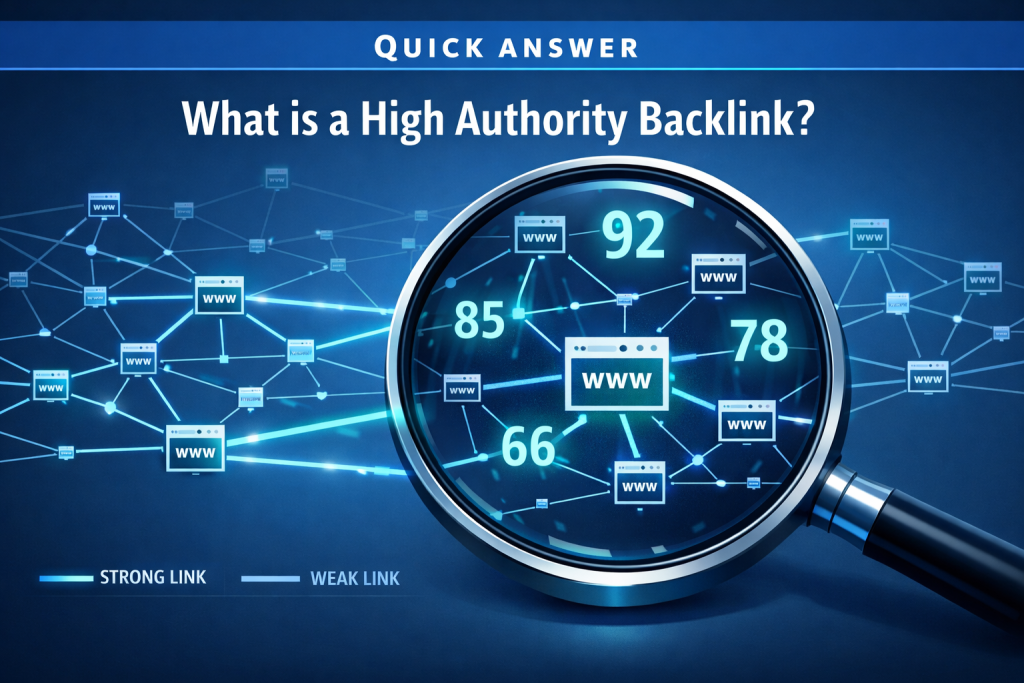
A high authority backlink is a link from a trusted, high-traffic website with strong domain metrics (typically DA 70+), clear editorial standards, and topical relevance to your content.[3] These links appear within the main article content where they add genuine value, not in footers or sidebars.[1][2] High authority backlinks significantly boost search rankings because Google treats them as credible recommendations from established sources, and a single quality link can outweigh hundreds of low-quality links.[4]
What Is a High Authority Backlink?
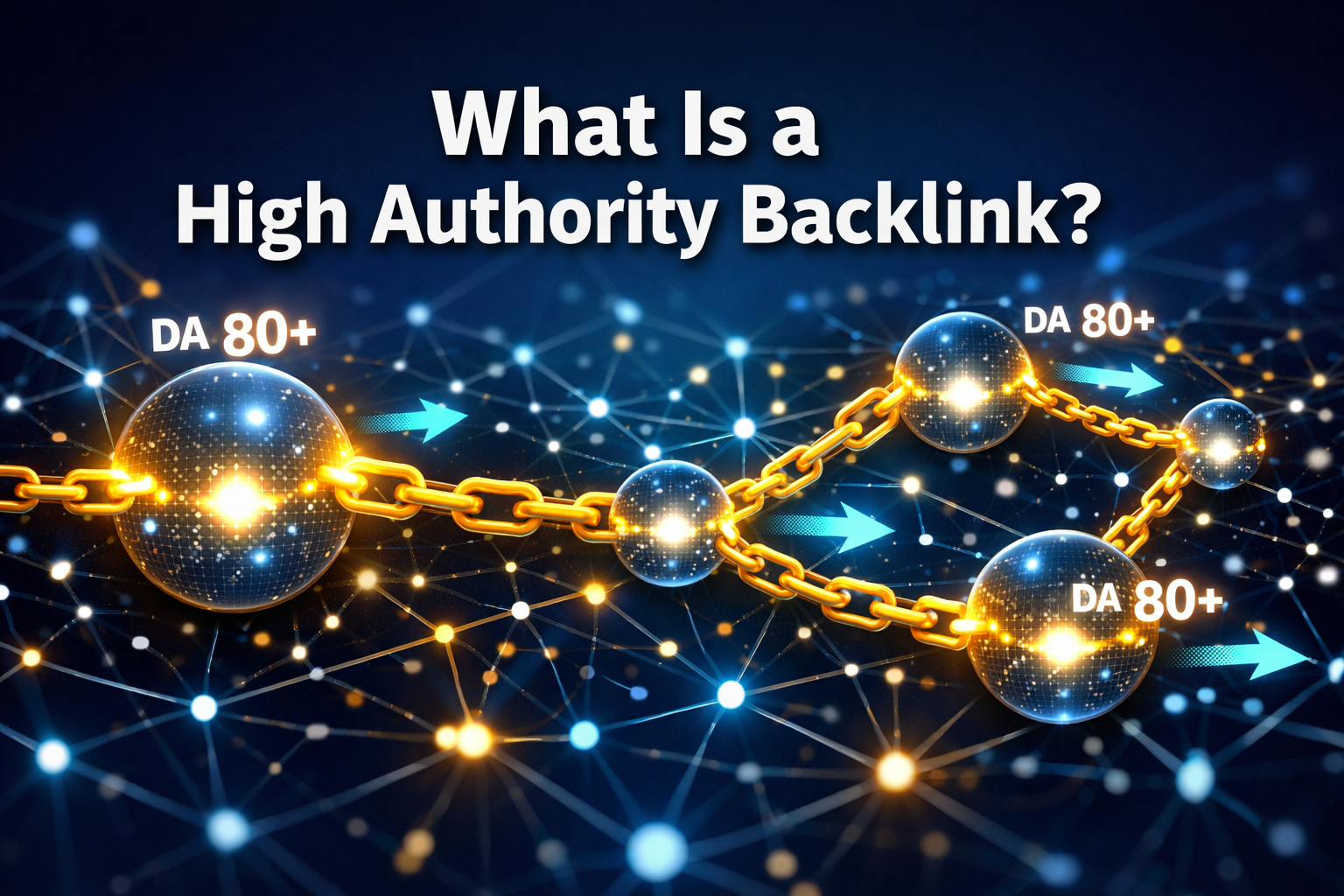
A high authority backlink is a hyperlink from a website that search engines recognize as trustworthy, relevant, and influential within its industry or topic area. These links come from sites with established reputations, consistent traffic, strong domain metrics, and rigorous editorial standards.[1][3]
High authority backlinks differ fundamentally from regular backlinks in several ways:
- Domain metrics: Authority sites typically score above 70-80 on Domain Authority (Moz) or Domain Rating (Ahrefs) scales, though the exact threshold varies by industry[3][4]
- Traffic consistency: These sites maintain organic traffic levels of 1,000+ monthly visitors verified through analytics tools[1]
- Editorial standards: Content appears under named authors with fact-checking processes and clear content guidelines[1][2]
- Contextual placement: Links appear naturally within main article content where they provide genuine value to readers[1][2]
- Topical relevance: The linking site operates within your industry or covers related topics that make the connection logical[1][2]
Choose high authority backlinks when: You want sustainable, long-term ranking improvements rather than quick wins that might disappear after algorithm updates. Prioritize quality over quantity, especially if you’re in competitive industries where established sites dominate search results.
Common mistake: Assuming any link from a high-DA site qualifies as high authority. A link from a DA 80 news site placed in an unrelated article or a paid directory section carries far less weight than an editorial link from a DA 60 industry publication that’s topically relevant.[7]
Why Are High Authority Backlinks Important for SEO?
High authority backlinks remain one of the most important ranking factors in 2026 because they signal to search engines that credible sources vouch for your content.[8] Google’s algorithms evaluate both the authority of linking domains and the context surrounding each link to determine how much ranking power to transfer.
Key benefits include:
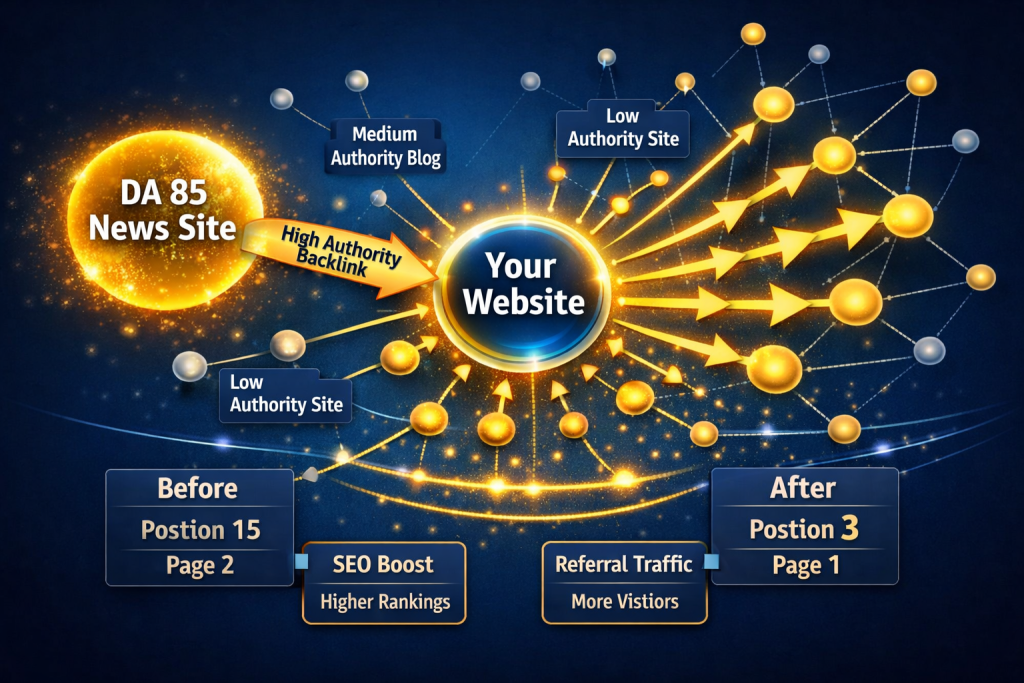
- Ranking acceleration: Quality backlinks from trusted sources can move pages from position 15 to top 3 positions faster than most other SEO tactics[4]
- Algorithm resilience: Editorial links from genuine sources withstand algorithm updates better than manipulative link schemes
- Referral traffic: High authority sites already attract relevant audiences, so backlinks function as qualified traffic sources beyond SEO value[4]
- Domain authority growth: Accumulating quality backlinks gradually increases your own site’s authority metrics
- Competitive advantage: In saturated markets, superior backlink profiles often determine which sites rank in top positions
According to Google Search Advocate John Mueller, a single high authority backlink can match the influence of hundreds of regular links.[4] This quality-over-quantity principle has intensified as search algorithms evolved to prioritize link quality significantly over raw backlink volume.
Decision rule: If you can only secure one backlink per month, invest time in earning a single high-authority editorial link rather than building dozens of directory submissions or blog comment links. The ranking impact and longevity justify the additional effort.
For more context on how different types of backlinks compare, see our backlink case study analyzing real ranking improvements.
How Do You Identify a High Authority Backlink?
Identifying genuine high authority backlinks requires evaluating multiple factors beyond simple domain metrics. Use this four-factor validation checklist before pursuing any backlink prospect:[1]
1. Traffic Verification
Check whether the site maintains consistent organic search traffic:
- Use Ahrefs Site Explorer or SEMrush Organic Research to verify monthly traffic
- Look for 1,000+ monthly organic visitors as a baseline threshold[1]
- Review traffic trends over 6-12 months to confirm stability
- Verify traffic comes from genuine search queries, not just branded searches
2. Editorial Quality Assessment
Evaluate the site’s content standards and publishing practices:
- Named authors with verifiable credentials and author pages
- Clear editorial guidelines and content policies
- Fact-checking processes or citations for claims
- Professional writing quality without excessive ads or pop-ups
- Regular publishing schedule indicating active site maintenance
Sites with strong editorial standards include news publications, industry magazines, research institutions, and recognized thought leaders.[1][3]
3. Topical Relevance Check
Assess how closely the linking site aligns with your industry:
- The site covers your industry, related topics, or complementary niches
- A relevant backlink from a niche site often outranks an unrelated high-DA link[1][2]
- Shared audience demographics and interests
- Logical connection between their content and yours
Example: A backlink from a DA 65 marketing blog carries more SEO value for a digital agency than a DA 80 general news site’s unrelated mention.
4. Placement Context Evaluation
Verify where and how the link appears on the page:
- Links within main article content significantly outperform footer/sidebar links[1][2]
- Surrounded by relevant text that explains the connection
- Appears naturally rather than in obvious “sponsored” or “partner” sections
- Placed on pages that are indexed, maintained, and promoted[2]
Common mistake: Accepting guest post placements on high-DA sites where your link appears alongside dozens of other obviously-paid links. Search engines discount these patterns even on otherwise-authoritative domains.
Tools like Moz Link Explorer and Ahrefs can help verify these factors, but manual review remains essential for assessing editorial quality and context.
What Are Examples of High Authority Backlink Sources?
High authority backlinks typically originate from three main categories of trusted sources that search engines recognize as credible:[1][3]
Editorial Publications
Major news outlets and industry-specific publications with established reputations:
- National news sites: The New York Times, BBC, The Guardian, Wall Street Journal
- Industry magazines: TechCrunch (technology), Mayo Clinic (health), Forbes (business)
- Trade publications: Niche-specific magazines and journals serving particular industries
- Local news outlets: Regional newspapers with strong local authority
These sources maintain strict editorial standards and employ professional journalists, making their links particularly valuable.
Research and Educational Institutions
Academic and research organizations with .edu domains or equivalent authority:
- Universities and colleges: Links from academic departments, research centers, or educational resources
- Research institutions: Think tanks, scientific organizations, and policy centers
- Government agencies: .gov domains with relevant information resources
- Medical institutions: Hospitals, medical schools, and healthcare research centers
Links from these sources carry exceptional weight because they represent verified expertise and institutional credibility.
Recognized Industry Leaders
Established businesses and organizations that dominate their respective fields:
- Industry associations: Professional organizations and trade groups
- Leading brands: Companies recognized as category leaders
- Influential blogs: Long-established blogs with loyal audiences and consistent traffic
- Expert platforms: Sites run by recognized authorities and thought leaders
Choose sources based on: Your specific industry and target audience. A backlink from a respected industry association often delivers better results than a mention on a general news site, even if the news site has higher overall DA.
For businesses looking to build authority systematically, exploring guest post backlinks from relevant industry sites can provide structured opportunities.
How Do High Authority Backlinks Differ from Regular Backlinks?
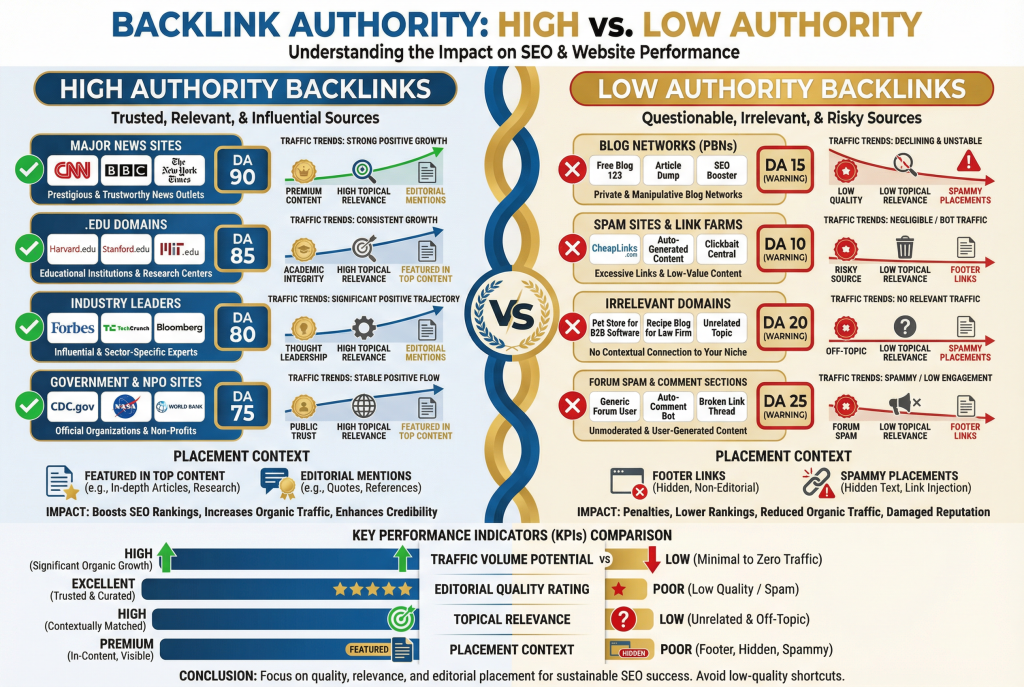
High authority backlinks and regular backlinks differ across five critical dimensions that determine their SEO impact:
| Factor | High Authority Backlinks | Regular Backlinks |
|---|---|---|
| Domain Metrics | DA/DR typically 70-80+, established sites with years of history[3][4] | DA/DR below 50, newer or less-established domains |
| Traffic Volume | 1,000+ monthly organic visitors, consistent traffic patterns[1] | Low or inconsistent traffic, often minimal organic reach |
| Editorial Standards | Named authors, fact-checking, clear guidelines, professional content[1][2] | Minimal editorial oversight, often user-generated or automated content |
| Link Placement | Within main article content, contextually relevant, adds reader value[1][2] | Footers, sidebars, blog rolls, comment sections, or directory listings |
| Topical Relevance | Strong alignment with your industry, shared audience interests[1][2] | Often unrelated topics, generic directories, or broad categories |
| Ranking Impact | Single link can match hundreds of regular links[4] | Minimal individual impact, requires volume to influence rankings |
| Longevity | Links remain live and indexed long-term on maintained pages[2] | Higher risk of link removal, page deletion, or site abandonment |
The fundamental difference: High authority backlinks function as genuine editorial recommendations from trusted sources, while regular backlinks often represent basic citations, directory listings, or reciprocal arrangements with limited credibility signals.
Edge case: Some high-DA sites host low-quality sections (user forums, unmoderated directories, paid placements) where links carry minimal authority despite the overall domain strength. Always evaluate the specific page and section where your link appears, not just the root domain metrics.
Understanding the distinction between Google’s index and backlink indexes can help clarify how search engines evaluate different link types.
What Makes a Backlink “High Quality” Beyond Domain Authority?
Domain authority alone doesn’t determine backlink quality. Several additional factors combine to create truly valuable links that improve rankings:[7][9]
Contextual Relevance
The surrounding content and anchor text must make logical sense:
- Natural anchor text that fits the sentence flow rather than exact-match keywords stuffed awkwardly
- Supporting context in surrounding paragraphs that explains why the link matters
- Topic alignment between the linking page’s subject and your linked content
- User intent match where the link genuinely helps readers find related information
Search engines analyze the text surrounding each link to understand the connection between pages.
Link Velocity and Pattern
How you acquire backlinks matters as much as the links themselves:
- Gradual accumulation appears more natural than sudden spikes in backlinks
- Diverse link sources from multiple domains and content types
- Varied anchor text using different phrases and natural language
- Sustainable acquisition through content quality rather than manipulation
Common mistake: Purchasing bulk backlink packages that deliver dozens of links simultaneously from similar sources. This pattern triggers algorithm filters even if individual links come from decent domains.
Page-Level Authority
The specific page linking to you carries its own authority separate from domain metrics:
- Page traffic and engagement levels
- Existing backlinks pointing to that specific page
- Content quality and depth on the linking page
- Freshness and update frequency
A link from a highly-trafficked, frequently-updated article on a DA 60 site often outperforms a link from an abandoned page on a DA 80 site.
Link Survivability
High-quality backlinks must remain active and indexed over time:[2]
- Placed on pages that receive ongoing maintenance and updates
- From sites with stable hosting and long-term viability
- In content that remains relevant rather than time-sensitive news that gets archived
- On pages that continue attracting traffic and engagement
Decision rule: Prioritize evergreen content placements on actively-maintained pages over news mentions that might get buried in archives after a few weeks.
How Can You Earn High Authority Backlinks?
Earning high authority backlinks requires strategic content creation and relationship building rather than quick shortcuts:
Create Link-Worthy Content Assets
Develop resources that naturally attract editorial links:
- Original research and data that journalists and bloggers cite as sources
- Comprehensive guides that become go-to resources in your industry
- Visual content like infographics, charts, and data visualizations
- Expert analysis offering unique perspectives on industry trends
- Tools and calculators that provide practical value to users
Content that answers questions, solves problems, or provides unique data earns links because other creators reference it naturally.
Build Genuine Relationships
Connect with editors, journalists, and content creators in your industry:
- Contribute expert quotes when journalists seek sources for articles
- Share valuable insights on social media that demonstrate expertise
- Engage authentically with industry publications and their content
- Attend industry events and build real-world connections
- Offer help first before requesting anything in return
Relationships built on genuine value exchange lead to editorial mentions and backlink opportunities.
Leverage Digital PR Strategies
Use newsworthy angles to earn media coverage:
- Publish original research and proactively pitch findings to relevant publications
- Comment on industry news with expert analysis that adds perspective
- Create reactive content responding to trending topics in your field
- Develop case studies showing concrete results and real-world applications
- Issue newsworthy announcements about significant company developments
Digital PR focuses on earning coverage through news value rather than paying for placements.
Strategic Guest Contributions
Write for respected industry publications with clear editorial standards:
- Target publications your audience already reads and trusts
- Pitch unique angles rather than recycled content from your blog
- Follow editorial guidelines precisely and respect editorial processes
- Provide genuine value to the publication’s readers, not just promotional content
- Build ongoing relationships rather than one-off placements
Guest posts on high-authority industry sites can provide valuable exposure when done strategically. Explore options for article backlinks from relevant publications.
What to avoid: Link schemes, private blog networks, paid link exchanges disguised as editorial content, and automated outreach templates that ignore relationship building.
What Are Common Mistakes When Building High Authority Backlinks?
Several common mistakes undermine backlink quality and can trigger search engine penalties:
Prioritizing Metrics Over Relevance
The mistake: Chasing any high-DA link regardless of topical alignment or audience fit.
Why it fails: Search engines evaluate contextual relevance alongside authority metrics. An unrelated high-DA link carries less weight than a relevant mid-authority link.[1][2]
Better approach: Target sites where your content genuinely fits the editorial focus and serves the existing audience.
Ignoring Link Placement Context
The mistake: Accepting backlinks in footers, sidebars, or obvious “sponsored links” sections just because they’re from high-DA sites.
Why it fails: Search engines discount links that appear outside main content areas or in patterns associated with paid placements.[1][2]
Better approach: Insist on in-content editorial placement where the link adds value to readers.
Buying Links Disguised as Editorial Content
The mistake: Paying for “guest posts” or “sponsored content” without proper disclosure, hoping search engines won’t notice.
Why it fails: Search algorithms identify payment patterns, and undisclosed paid links violate Google’s guidelines, risking penalties.
Better approach: If you pay for content placement, ensure it’s properly disclosed and uses rel=”sponsored” or rel=”nofollow” attributes as required by search engine guidelines.
Neglecting Link Velocity Patterns
The mistake: Acquiring dozens of backlinks simultaneously through bulk services or aggressive outreach campaigns.
Why it fails: Sudden backlink spikes appear unnatural and trigger algorithmic scrutiny, potentially devaluing the entire link profile.
Better approach: Build links gradually through consistent content creation and relationship development that mirrors organic growth patterns.
Focusing Solely on Domain Authority
The mistake: Using DA as the only evaluation criterion without assessing traffic, editorial quality, or page-level factors.
Why it fails: Domain Authority is a third-party metric (not used by Google) that doesn’t capture editorial standards, traffic quality, or contextual relevance.[3][4]
Better approach: Use the four-factor validation checklist (traffic, editorial quality, topical relevance, placement context) rather than relying on any single metric.
Ignoring Link Maintenance
The mistake: Treating backlink building as a one-time task without monitoring link status or page health.
Why it fails: Links disappear when pages get deleted, sites shut down, or content gets removed, gradually eroding your backlink profile.[2]
Better approach: Regularly audit your backlink profile, monitor for lost links, and maintain relationships with linking sites to preserve valuable connections.
For comprehensive SEO strategies beyond backlinks, explore resources in our SEO category.
How Do You Measure the Impact of High Authority Backlinks?
Measuring backlink impact requires tracking multiple metrics that reflect both direct SEO effects and broader business outcomes:
Ranking Position Changes
Monitor search position movements for target keywords:
- Track specific keywords where you’ve acquired relevant backlinks
- Measure position changes over 4-8 weeks after link acquisition (rankings rarely change overnight)
- Compare ranking velocity for pages with new high-authority links versus pages without
- Use rank tracking tools like Ahrefs Rank Tracker or SEMrush Position Tracking
What to expect: Quality backlinks typically show ranking improvements within 4-12 weeks, though competitive keywords may take longer.
Organic Traffic Growth
Analyze traffic increases to pages that received backlinks:
- Segment organic traffic in Google Analytics by landing page
- Compare traffic trends before and after backlink acquisition
- Track new keyword rankings that appear after gaining authority
- Monitor traffic quality through engagement metrics (time on page, bounce rate, conversions)
High authority backlinks often improve rankings for multiple related keywords, not just the exact anchor text used.
Domain Authority Progression
Watch your overall site authority metrics evolve:
- Check DA/DR monthly using Moz or Ahrefs
- Track referring domain growth (quality over quantity)
- Monitor link profile diversity across different domain types
- Assess competitive positioning relative to top-ranking competitors
Important note: Domain Authority changes slowly and shouldn’t be the primary success metric. Focus on traffic and rankings as more direct business indicators.
Referral Traffic Volume
Measure direct click-through traffic from backlinks:
- Track referral traffic in Google Analytics by source domain
- Assess traffic quality through conversion rates and engagement
- Identify high-value referral sources that send qualified visitors
- Calculate referral traffic value using goal completion or revenue data
Remember that high authority backlinks serve dual purposes—SEO value and direct referral traffic.[4]
Link Retention Rate
Monitor whether acquired backlinks remain active:
- Audit backlink status quarterly using backlink monitoring tools
- Calculate retention rate (percentage of links still active after 6-12 months)
- Identify lost links and determine causes (page deletion, content updates, relationship issues)
- Track link survivability by source type to inform future strategies[2]
Benchmark: Quality editorial links typically show 80%+ retention after one year, while lower-quality links often disappear within months.
FAQ
What is considered a high authority backlink?
A high authority backlink comes from a trusted website with Domain Authority typically above 70-80, consistent organic traffic exceeding 1,000 monthly visitors, clear editorial standards, topical relevance to your content, and placement within main article content where it adds genuine value to readers.[1][3]
How many high authority backlinks do I need to rank?
The number varies significantly by keyword competition and industry, but quality matters far more than quantity. A single high authority backlink can match the ranking power of hundreds of low-quality links.[4] Focus on earning 5-10 highly relevant, editorially-placed links rather than pursuing volume targets.
Are high authority backlinks the same as high Domain Authority backlinks?
Not necessarily. Domain Authority is one indicator, but high authority backlinks also require editorial quality, topical relevance, proper placement context, and consistent traffic.[1][7] A link from a DA 60 industry publication with strong editorial standards often outperforms a DA 80 link from an unrelated site or poor placement.
How long does it take for high authority backlinks to improve rankings?
Most high authority backlinks show ranking impact within 4-12 weeks after Google crawls and processes the link.[4] Competitive keywords may take longer, and the effect compounds as you accumulate multiple quality links over time. Monitor rankings monthly rather than daily for realistic assessment.
Can I buy high authority backlinks safely?
Purchasing backlinks violates Google’s Webmaster Guidelines and risks penalties. While some services offer “high authority” links, paid links must use rel=”sponsored” or rel=”nofollow” attributes, which prevent SEO value transfer. Focus on earning editorial links through content quality and relationship building instead.[2][7]
What’s the difference between dofollow and nofollow high authority backlinks?
Dofollow links pass ranking power (link equity) to your site, while nofollow links include a tag telling search engines not to transfer authority. High authority backlinks should ideally be dofollow to maximize SEO benefit, though nofollow links from major sites still provide referral traffic and brand visibility.[4]
How do I find high authority backlink opportunities?
Analyze competitor backlink profiles using Ahrefs or SEMrush to identify sites linking to similar content. Research industry publications, news sites, and educational resources in your niche. Look for sites with 1,000+ monthly traffic, named authors, and editorial standards. Focus on sources where your expertise genuinely adds value.[1]
Do high authority backlinks from social media platforms help SEO?
Most social media links use nofollow attributes and don’t directly transfer ranking power. However, social media presence can lead to content discovery by journalists and bloggers who then create editorial backlinks. Social signals also drive traffic and engagement that indirectly supports SEO efforts.[4]
What makes a backlink “editorial” versus “unnatural”?
Editorial backlinks appear because content creators genuinely chose to reference your content as a valuable resource. They appear in natural sentence context, come from relevant sources, and add reader value. Unnatural backlinks result from manipulation, payment (without disclosure), link exchanges, or automated schemes that violate search engine guidelines.[1][2]
How often should I audit my high authority backlinks?
Audit your backlink profile quarterly to monitor link retention, identify lost links, spot potential toxic links, and assess overall profile health. Use tools like Ahrefs or Moz to track changes and ensure your most valuable links remain active and indexed.[2]
Can too many high authority backlinks hurt my site?
Quality backlinks rarely cause problems, but unnatural acquisition patterns (sudden spikes, identical anchor text, obvious schemes) can trigger algorithmic filters even if individual links come from high-authority sources. Build links gradually through diverse sources with varied anchor text for sustainable growth.[7][9]
What’s the best anchor text strategy for high authority backlinks?
Use natural, varied anchor text that fits the sentence context. Include a mix of branded terms, naked URLs, generic phrases (“click here,” “learn more”), and descriptive text related to your content. Avoid exact-match keyword stuffing that appears manipulative. Editorial links naturally use diverse anchor text patterns.[1][2]
Conclusion
High authority backlinks represent one of the most powerful SEO assets available in 2026, capable of accelerating rankings, driving qualified traffic, and establishing domain authority that compounds over time. These links come from trusted sources with Domain Authority typically above 70-80, consistent organic traffic, rigorous editorial standards, and strong topical relevance to your content.[1][3][4]
The fundamental principle remains clear: quality dramatically outweighs quantity. A single editorial link from a respected industry publication delivers more ranking power than hundreds of directory submissions or blog comment links.[4] Success requires focusing on the four essential validation factors—traffic verification, editorial quality, topical relevance, and proper placement context—rather than chasing domain metrics alone.
Building high authority backlinks demands patience and strategic effort. Create genuinely valuable content assets that naturally attract editorial mentions, build authentic relationships with industry publications and journalists, and leverage digital PR strategies that earn coverage through news value rather than manipulation. Avoid common mistakes like prioritizing metrics over relevance, accepting poor placement contexts, or pursuing bulk link schemes that trigger algorithmic penalties.
Actionable next steps:
- Audit your current backlink profile using Ahrefs or Moz to identify existing high-authority links and gaps in your profile
- Create one comprehensive content asset (original research, in-depth guide, or valuable tool) designed to attract editorial links
- Identify 10-15 high-authority targets in your industry using the four-factor validation checklist
- Develop genuine relationships with editors and content creators at those publications before pitching content
- Monitor results monthly by tracking ranking positions, organic traffic, and referral traffic from acquired backlinks
- Build consistently rather than in bursts, aiming for 1-2 quality editorial links per month through sustainable strategies
The sites that dominate search results in 2026 share one common characteristic: backlink profiles built on editorial relationships, content quality, and genuine industry authority rather than manipulation or shortcuts. Invest in earning high authority backlinks systematically, and the compounding benefits will support your SEO success for years to come.
For additional insights on building comprehensive SEO strategies, explore our blog for the latest tactics and case studies.
🔗 High Authority Backlink Checker
Evaluate whether a backlink qualifies as high authority
References
[1] High Authority Backlinks – https://buildingbacklinks.io/high-authority-backlinks/
[2] High Quality Backlink – https://www.outreachmama.com/blog/high-quality-backlink/
[3] Authority Backlinks – https://editorial.link/authority-backlinks/
[4] High Authority Backlinks – https://loganix.com/high-authority-backlinks/
[7] What Makes A Backlink High Quality – https://rankomedia.com/blog/what-makes-a-backlink-high-quality/
[8] Are Backlinks Still Important – https://astute.co/are-backlinks-still-important/
[9] What Makes A High Quality Backlink In 2026 A Complete Seo Guide And Checklist – https://www.velizaratellalyan.com/link-building/what-makes-a-high-quality-backlink-in-2026-a-complete-seo-guide-and-checklist/
Tags:
high authority backlinks, backlink quality, Domain Authority, SEO ranking factors, link building, editorial backlinks, topical relevance, backlink strategy, SEO 2026, link equity, organic traffic, digital PR