Last updated: February 27, 2026
Imagine pouring months of effort into creating the perfect website, only to watch it languish on page five of Google’s search results where virtually no one will ever find it. This frustrating scenario plays out for millions of websites because they’re missing one critical element: quality backlinks. Understanding why backlinks are important for SEO isn’t just academic knowledge—it’s the difference between online visibility and digital obscurity.
Key Takeaways
- Backlinks remain a top-three ranking signal confirmed by Google, directly influencing where your pages appear in search results
- Top-ranking pages average 3.8x more backlinks than lower positions, with the #1 spot typically having around 220 backlinks[1][2]
- 94-95% of web pages have zero backlinks and receive virtually no organic traffic, making link building essential for visibility[1][3]
- Quality trumps quantity—backlinks from high-authority domains provide significantly more ranking power than numerous low-quality links
- Each quality backlink contributes approximately 1.5 ranking positions on average, creating measurable improvements[1][2]
- First-page results capture 71% of all clicks, making backlink-driven rankings directly tied to traffic and revenue[1]
- Long-form content attracts 77.2% more backlinks than shorter articles, creating a virtuous cycle for SEO performance[1][4]
- Backlinks influence AI algorithm trust signals, becoming increasingly important as search evolves in 2026[1]
Quick Answer
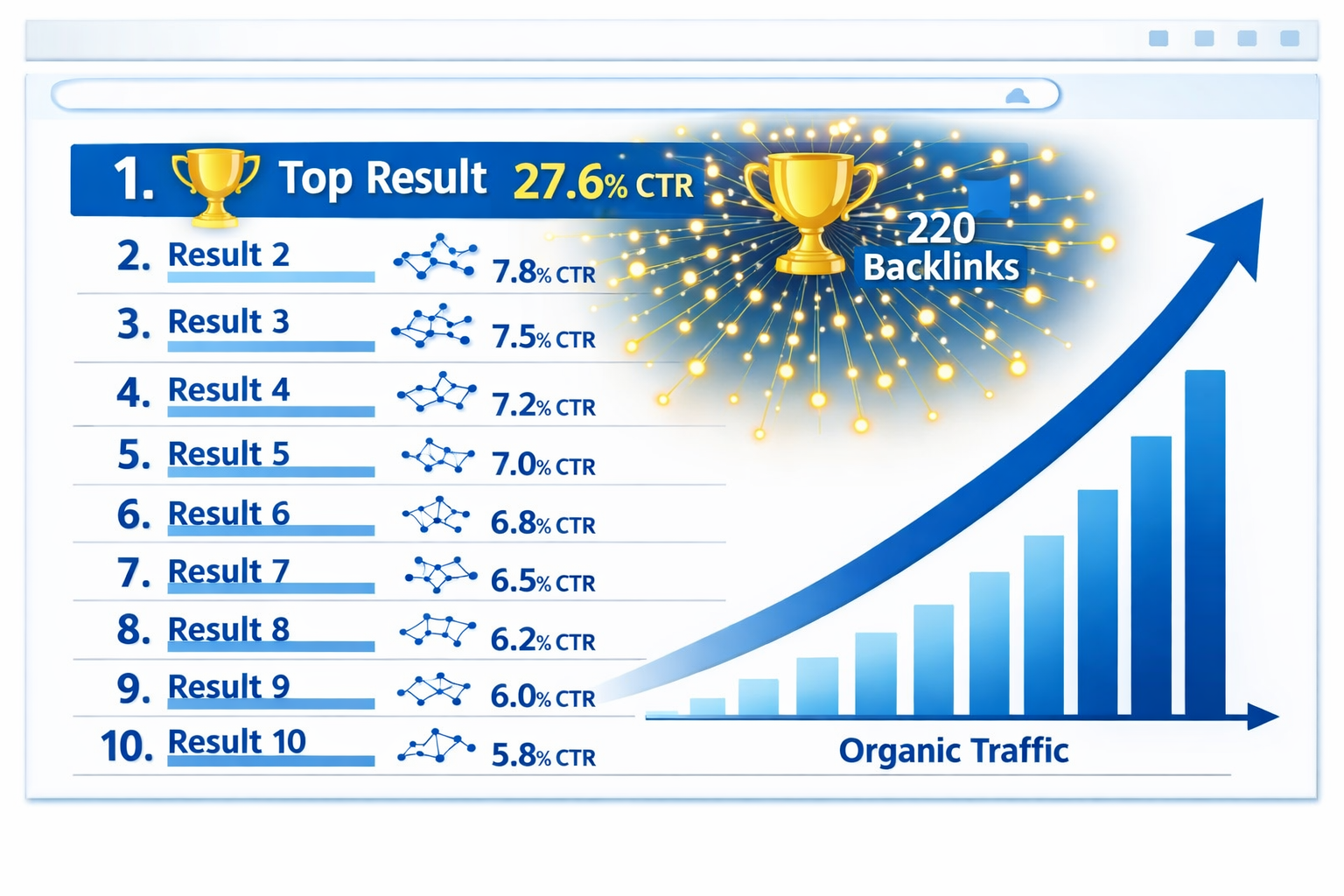
Backlinks are important for SEO because they serve as trust votes from other websites, signaling to search engines that your content is valuable and authoritative. Google uses backlinks as one of its primary ranking factors, with top-ranking pages averaging 220 backlinks compared to significantly fewer for lower positions[1][2]. Without quality backlinks, your website faces an uphill battle for visibility—94-95% of pages with zero backlinks receive virtually no organic traffic[1][3]. Building a strong backlink profile directly translates to higher rankings, more traffic, and better business outcomes.
What Are Backlinks and How Do They Work?
Backlinks are hyperlinks from one website to another, functioning as digital endorsements that tell search engines your content deserves attention. When a reputable website links to your page, it passes along “link equity” or “link juice”—authority signals that boost your credibility in Google’s eyes.
Search engines use sophisticated algorithms to evaluate backlinks based on several factors:
- Source authority: Links from high-authority domains (news sites, educational institutions, industry leaders) carry more weight than links from low-quality directories
- Relevance: A backlink from a website in your industry or niche provides more value than one from an unrelated site
- Link placement: Editorial links within main content outperform footer links or sidebar placements
- Anchor text: The clickable text of the link provides context about your page’s topic
- Follow vs. nofollow: “Followed” links pass ranking power, while “nofollow” links don’t directly impact rankings but still drive traffic
Common mistake: Assuming all backlinks provide equal value. A single link from a major publication can outweigh dozens of links from low-authority blogs.
Understanding the difference between Google’s index and backlink indexes helps clarify how search engines discover and evaluate these connections.
Why Backlinks Are Important for SEO Rankings
Backlinks directly influence where your pages appear in search results because Google treats them as votes of confidence. Pages ranking in position #1 average 220 backlinks, while lower positions have significantly fewer[1][2]. This correlation isn’t coincidental—it reflects how search algorithms prioritize content that other websites trust enough to reference.
The ranking impact breaks down into measurable patterns:
Position-based backlink averages:
- Position 1: ~220 backlinks
- Positions 2-10: 3.8x fewer backlinks than position 1[1][2]
- Pages without backlinks: 94-95% receive zero organic traffic[1][3]
Traffic implications:
- Position 1 receives 27.6% average click-through rate
- Positions 4-5 drop to 7-8% CTR
- Page 2+ results receive less than 1% of clicks[1]
Each quality backlink contributes approximately 1.5 ranking positions on average, though high-authority links can provide substantially greater boosts[1][2]. This means strategic link building creates compounding returns—as you rise in rankings, you gain more visibility, which often attracts additional natural backlinks.
Choose this approach if: You’re competing in moderately to highly competitive niches where top results already have established backlink profiles. In low-competition spaces, on-page optimization alone might suffice initially.
How Backlinks Build Domain Authority and Trust
Domain authority isn’t an official Google metric, but the concept reflects a measurable reality: websites with diverse, high-quality backlink profiles rank better across all their pages. Search engines view backlinks as trust signals that extend beyond individual pages to your entire domain.
Key trust indicators backlinks provide:
- Editorial validation: When journalists, researchers, or industry experts link to your content, it signals expertise
- Topical relevance: Backlinks from sites in your niche establish you as an authority in that subject area
- Longevity: Older backlinks from stable domains demonstrate sustained credibility
- Diversity: Links from many different referring domains (unique websites) matter more than numerous links from the same few sources[5]
The numbers support this relationship: 92.3% of top 100 ranking pages have high-quality backlink networks[7]. Companies that actively publish blog content receive 97% more backlinks company-wide compared to those without content strategies[4].
Decision rule: Prioritize acquiring backlinks from diverse referring domains rather than chasing high link counts from limited sources. Ten backlinks from ten different authoritative websites outperform 100 backlinks from a single domain.
If you’re looking to systematically build authority, consider exploring powerful backlink packages designed to increase domain credibility through diverse link sources.
Why Backlinks Are Important for SEO Traffic Generation
Beyond rankings, backlinks create direct traffic pathways to your website. When someone clicks a link on another site, they arrive at your page regardless of search engine involvement. This referral traffic often converts better than cold search traffic because visitors arrive with context and pre-existing interest.
The traffic multiplication effect works like this:
- Direct referral visits: Each backlink on a high-traffic page sends visitors your way
- Search ranking improvements: More backlinks → higher rankings → exponentially more organic traffic
- Discovery amplification: Links help search engines find and index your content faster
The math becomes compelling quickly. First-page organic results capture 71% of all clicks[1]. Moving from position 5 (7-8% CTR) to position 1 (27.6% CTR) represents roughly 4x traffic increase for the same keyword[1]. Since backlinks drive those ranking improvements, they’re directly responsible for traffic growth.
Real-world application: A website ranking #5 for a keyword with 10,000 monthly searches receives approximately 750 visits. Improving to #1 through strategic backlink acquisition could increase that to 2,760 visits monthly—an additional 2,010 visitors without changing the keyword or content.
Edge case: In very low-volume niches, the traffic difference between positions matters less. Focus backlink efforts on high-volume keywords where ranking improvements create meaningful traffic gains.
The Relationship Between Content Quality and Backlink Acquisition
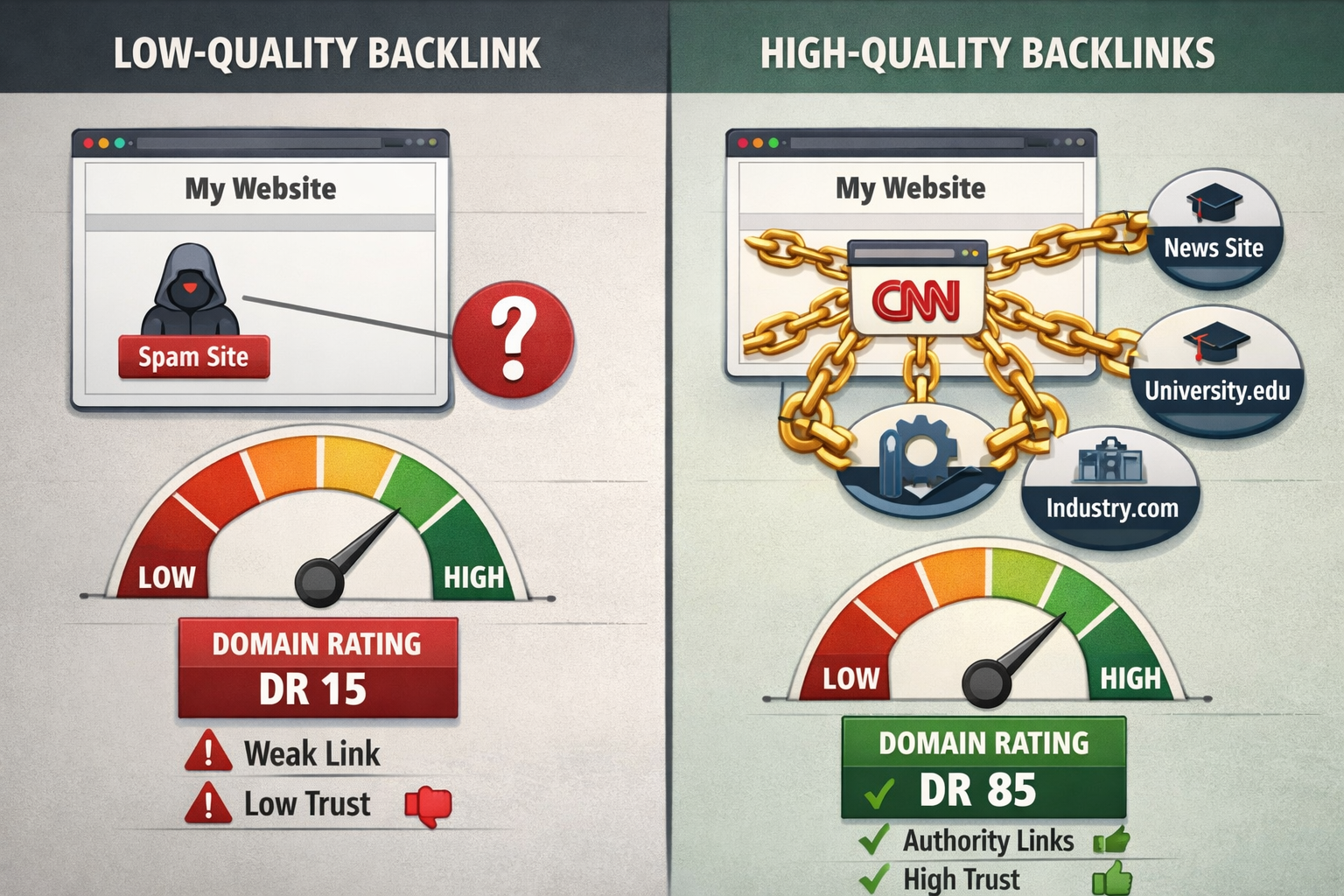
Quality content and backlinks create a self-reinforcing cycle. Long-form content exceeding 2,000 words receives 77.2% more backlinks than shorter articles[1][4], but those backlinks also help the content rank higher, attracting even more links over time.
Why comprehensive content attracts backlinks:
- Reference value: Other writers link to detailed resources that support their own content
- Data and research: Original statistics, case studies, and insights become citation-worthy
- Problem-solving depth: Thorough guides answer multiple related questions, increasing linkability
- Visual elements: Infographics, charts, and diagrams get shared and linked
The content-backlink relationship works both ways. While great content attracts links naturally, strategic backlink building also amplifies mediocre content’s visibility. However, combining both approaches delivers optimal results.
Common mistakes to avoid:
- Creating thin content and expecting backlinks to compensate for quality gaps
- Publishing comprehensive content but doing zero outreach or promotion
- Focusing exclusively on link building while neglecting content improvement
For practical examples of how quality backlinks impact real websites, review this detailed backlink case study showing measurable ranking improvements.
Different Types of Backlinks and Their SEO Value
Not all backlinks provide equal SEO value. Understanding the hierarchy helps prioritize link building efforts for maximum impact.
| Backlink Type | SEO Value | Difficulty to Acquire | Best Use Case |
|---|---|---|---|
| Editorial links | Highest | Very High | Building authority, major ranking boosts |
| Guest post links | High | Medium-High | Consistent link acquisition, niche relevance |
| Resource page links | High | Medium | Evergreen link building, educational content |
| Broken link replacements | Medium-High | Medium | Reclaiming lost links, competitor analysis |
| Directory links | Low-Medium | Low | Basic citations, local SEO |
| Forum/comment links | Low | Very Low | Referral traffic only (usually nofollow) |
| Reciprocal links | Low-Medium | Low | Mutual benefit (use sparingly) |
Editorial links come from journalists, bloggers, or content creators who reference your content naturally within their articles. These carry the most weight because they’re genuinely earned endorsements.
Guest post links allow you to contribute content to other websites with a backlink to your site. While valuable, they require substantial effort and quality content. Services like guest post backlinks can streamline this process.
Resource page links appear on curated lists of helpful resources within a specific topic. Once acquired, they often remain active for years.
Interestingly, reciprocal linking appears in 43.7% of top-ranking pages[4][5], suggesting mutual linking relationships remain tactically relevant when used naturally and sparingly.
Choose this strategy if: You’re building a new site—start with easier wins (resource pages, relevant directories) while simultaneously pursuing high-value editorial opportunities for long-term growth.
Common Backlink Building Mistakes That Hurt SEO
Understanding why backlinks are important for SEO includes knowing what not to do. Poor link building practices can trigger penalties or waste resources without meaningful results.
Critical mistakes to avoid:
- Buying low-quality bulk backlinks: Packages promising “10,000 backlinks for $50” typically come from spam sites and can trigger Google penalties
- Ignoring relevance: A backlink from a high-authority site in an unrelated industry provides minimal value
- Over-optimized anchor text: Using exact-match keywords in every backlink looks manipulative; vary anchor text naturally
- Neglecting link velocity: Acquiring 100 backlinks overnight after months of zero activity raises red flags
- Focusing only on homepage links: Deep links to specific content pages often provide better ranking value
- Ignoring toxic backlinks: Regularly audit your backlink profile and disavow spammy links
Red flag pattern: If a backlink opportunity seems too easy or promises guaranteed rankings, it’s likely low-quality. Quality link building requires genuine relationship building, valuable content, or strategic outreach.
Recovery approach: If you’ve acquired questionable backlinks, use Google Search Console’s disavow tool to distance your site from toxic links. Focus future efforts on quality over quantity.
For those seeking legitimate link building, explore multi-tier backlink strategies that create natural-looking link profiles through layered approaches.
How to Start Building Quality Backlinks in 2026
Strategic backlink acquisition requires a systematic approach that balances effort, cost, and results. Start with these proven methods that deliver measurable outcomes.
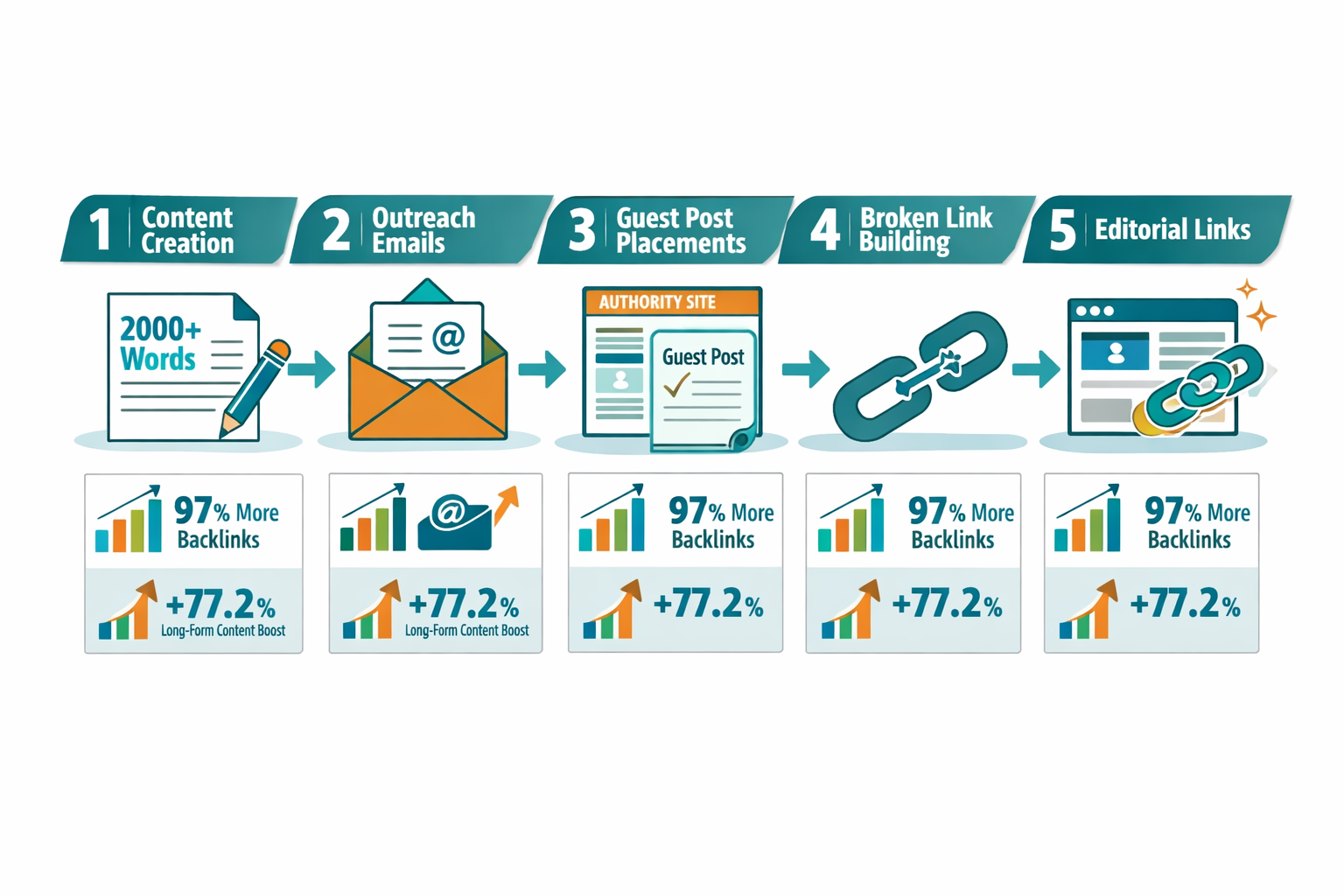
Step-by-step backlink building process:
- Audit your current backlink profile
- Use tools like Ahrefs, SEMrush, or Google Search Console
- Identify your strongest existing backlinks
- Note gaps where competitors have links you don’t
- Create linkable assets
- Develop comprehensive guides (2,000+ words for 77.2% more backlinks)[1][4]
- Produce original research, statistics, or case studies
- Design shareable infographics or tools
- Execute strategic outreach
- Identify websites that link to similar content
- Craft personalized pitches explaining mutual value
- Follow up professionally without being pushy
- Leverage broken link building
- Find broken links on relevant websites
- Offer your content as a replacement
- Provide value to the site owner while gaining a link
- Pursue guest posting opportunities
- Target reputable sites in your niche
- Pitch unique, valuable content ideas
- Include natural, contextual links to your site
- Build relationships, not just links
- Engage with industry influencers on social media
- Contribute to discussions and communities
- Natural links often follow genuine relationships
Timeline expectations: Quality backlink building takes 3-6 months to show measurable ranking improvements. Expect to acquire 5-20 quality backlinks monthly with consistent effort, depending on your niche competitiveness.
For businesses needing faster results, professional services offering article backlinks or EDU/GOV backlinks can accelerate the process while maintaining quality standards.
Measuring Backlink Impact on Your SEO Performance
Tracking backlink effectiveness ensures your link building efforts generate actual results rather than just vanity metrics.
Key performance indicators to monitor:
- Referring domains: Total number of unique websites linking to you (more important than total backlink count)[5]
- Domain authority/rating: Third-party metrics (Ahrefs DR, Moz DA) indicating overall site strength
- Ranking improvements: Position changes for target keywords after acquiring backlinks
- Organic traffic growth: Increases in search-driven visitors correlating with new backlinks
- Link quality distribution: Ratio of high-authority to low-authority backlinks
Measurement timeline:
- Week 1-4: Backlinks get discovered and indexed
- Week 4-12: Initial ranking movements begin
- Month 3-6: Full impact becomes measurable
Benchmark expectations: A single quality backlink contributes approximately 1.5 ranking positions on average[1][2]. However, high-authority backlinks from major publications can jump you 5-10+ positions for competitive keywords.
Warning sign: If you’re acquiring backlinks but seeing no ranking improvements after 3 months, audit for these issues:
- Links from irrelevant or low-authority sources
- Over-optimized anchor text triggering filters
- Technical SEO problems preventing overall site performance
- Targeting keywords too competitive for your current authority level
Regular monitoring through Google Search Console, Ahrefs, or SEMrush helps identify which backlinks drive the most value, allowing you to double down on successful strategies.
FAQ
How many backlinks do I need to rank on the first page?
There’s no magic number, but top-ranking pages average around 220 backlinks, while positions 2-10 have significantly fewer[1][2]. Focus on acquiring quality backlinks from diverse referring domains rather than hitting a specific count. In low-competition niches, 10-20 quality backlinks might suffice, while competitive industries may require hundreds.
Are backlinks still important for SEO in 2026?
Yes, backlinks remain one of Google’s top-three ranking signals and are explicitly confirmed as a primary ranking factor[3]. With AI-generated content comprising 17.3% of Google results, backlinks serve as crucial trust signals that help search engines distinguish authoritative content from low-quality material[1].
What’s the difference between dofollow and nofollow backlinks?
Dofollow backlinks pass ranking authority (link equity) to your site and directly impact SEO. Nofollow backlinks include a tag telling search engines not to pass authority, but they still drive referral traffic and brand visibility. Both have value in a natural backlink profile.
How long does it take for backlinks to improve rankings?
Most backlinks show initial impact within 4-12 weeks after Google discovers and processes them. Full ranking benefits typically materialize over 3-6 months as search algorithms incorporate the new authority signals into their calculations.
Can backlinks hurt my SEO?
Yes, low-quality backlinks from spam sites, link farms, or irrelevant sources can trigger Google penalties or algorithmic devaluation. Regularly audit your backlink profile and use Google’s disavow tool to distance your site from toxic links you didn’t intentionally acquire.
What makes a backlink “high-quality”?
High-quality backlinks come from authoritative websites relevant to your niche, appear within editorial content (not footers or sidebars), use natural anchor text, and are surrounded by contextually related content. Authority, relevance, and placement all contribute to backlink quality.
Should I focus on backlinks or content first?
Both work together synergistically. Start with solid content that provides genuine value, then build backlinks to amplify its visibility. Long-form content exceeding 2,000 words attracts 77.2% more backlinks naturally[1][4], so quality content makes link building significantly easier.
How do I get my first backlinks for a new website?
Start with low-hanging fruit: relevant business directories, industry resource pages, local citations, and guest posting on smaller niche blogs. Create valuable content worth linking to, then reach out to websites that have linked to similar content, offering your resource as an additional reference.
Do internal links count as backlinks?
No, backlinks specifically refer to links from external websites. Internal links (links between pages on your own site) are important for SEO but serve different purposes: site structure, user navigation, and distributing page authority throughout your domain.
What’s the best way to find backlink opportunities?
Analyze competitor backlink profiles using tools like Ahrefs or SEMrush to see where they’re getting links. Look for broken links on relevant websites you could replace, identify resource pages in your niche, and monitor brand mentions that don’t include links (then request the link addition).
Are reciprocal links bad for SEO?
Not necessarily. Reciprocal linking appears in 43.7% of top-ranking pages[4][5], suggesting mutual linking relationships remain acceptable when natural and relevant. Problems arise when reciprocal linking becomes your primary strategy or involves unrelated websites purely for SEO manipulation.
How much should I spend on backlink building?
Budget varies widely based on strategy. DIY outreach costs mainly time (10-20 hours monthly). Professional guest posts range from $100-$500+ per placement. Comprehensive SEO backlink services typically cost $500-$5,000+ monthly depending on competitiveness and goals. Expect to invest 3-6 months before seeing substantial returns.
Conclusion
Understanding why backlinks are important for SEO transforms from theoretical knowledge into practical advantage when you implement strategic link building. The data makes the case compelling: top-ranking pages average 3.8x more backlinks than lower positions[1][2], 94-95% of pages without backlinks receive virtually no traffic[1][3], and each quality backlink contributes measurable ranking improvements averaging 1.5 positions[1][2].
The path forward requires balancing three priorities: creating genuinely valuable content worth linking to, systematically acquiring quality backlinks from relevant authoritative sources, and avoiding shortcuts that promise quick wins but deliver penalties instead.
Your next steps:
- Audit your current backlink profile using Google Search Console or specialized tools to understand your starting point
- Identify 5-10 competitor backlinks you could realistically acquire through outreach or content creation
- Create one comprehensive linkable asset (2,000+ words) that provides exceptional value in your niche
- Execute systematic outreach to 10-20 relevant websites monthly, offering genuine value in exchange for consideration
- Monitor results quarterly to identify which backlink sources drive the most ranking and traffic improvements
Remember that backlink building is a marathon, not a sprint. Consistent effort over 6-12 months builds the authority that translates to sustainable rankings, increased traffic, and better business outcomes. The websites dominating search results in 2026 aren’t there by accident—they’ve invested in building the backlink profiles that search engines reward with visibility.
Start building your backlink foundation today, and you’ll be competing for those coveted first-page positions tomorrow.
References
[1] Seo Statistics – https://www.incremys.com/en/resources/blog/seo-statistics
[2] Backlinks Seo Importance 442529 – https://searchengineland.com/backlinks-seo-importance-442529
[3] Backlinks – https://www.rankability.com/ranking-factors/google/backlinks/
[4] Seo Stats – https://backlinko.com/seo-stats
[5] Link Building Statistics 2026 – https://heroicrankings.com/seo/linkbuilding/link-building-statistics-2026/
[7] Link Building Statistics – https://wytlabs.com/blog/link-building-statistics/
Tags
backlinks, SEO, link building, search engine optimization, domain authority, Google rankings, backlink strategy, organic traffic, SEO 2026, link equity, referring domains, search visibility
🔗 Backlink Impact Calculator
Calculate potential ranking improvements and traffic increases from backlink acquisition