Last updated: April 19, 2026
Quick Answer
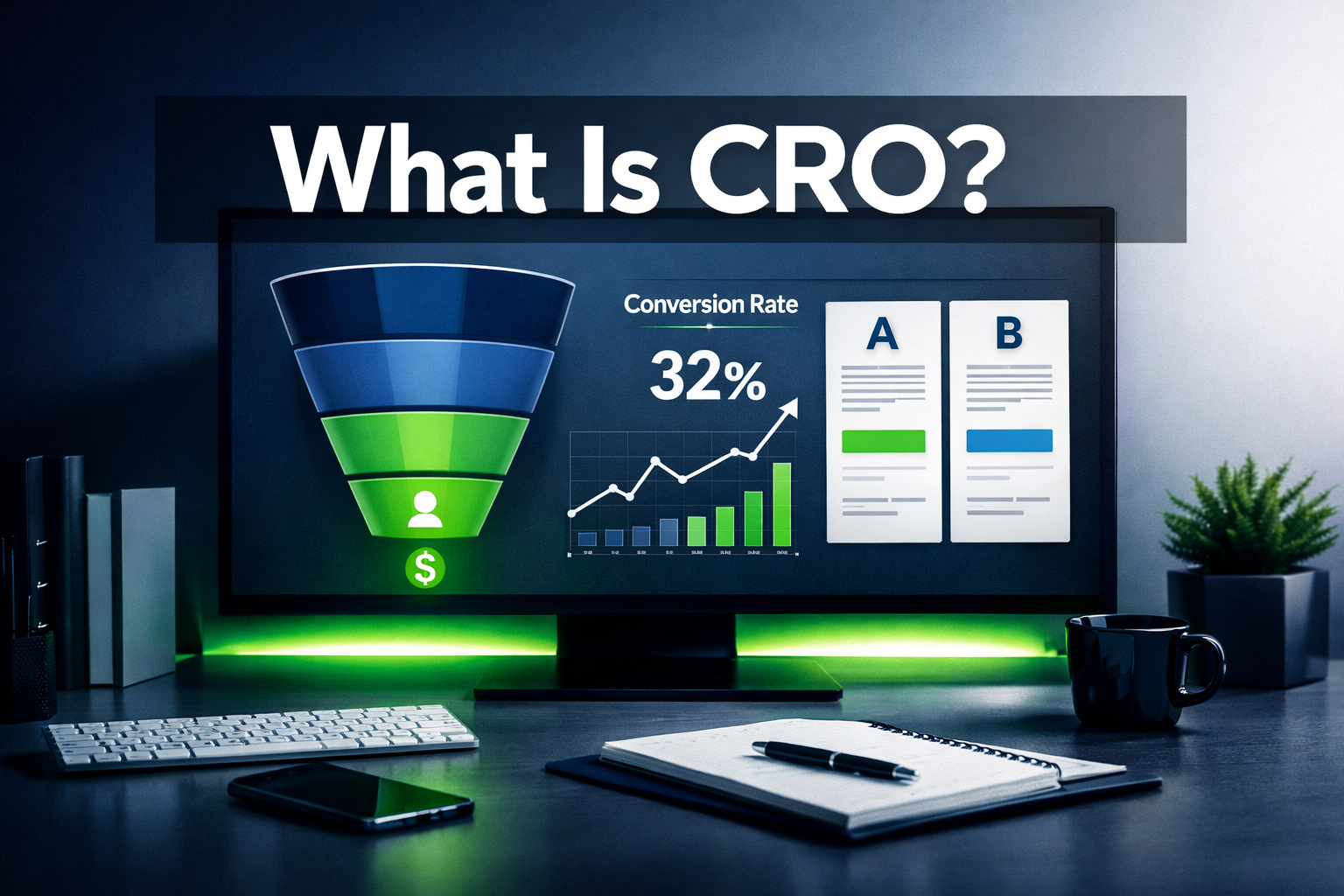
CRO (Conversion Rate Optimization) is the systematic process of increasing the percentage of website visitors who complete a desired action, such as making a purchase, signing up for a newsletter, or filling out a contact form. It combines data analysis, user behavior research, and structured testing to remove friction from the user journey. CRO does not require more traffic — it makes existing traffic work harder.
Key Takeaways 🎯
- CRO stands for Conversion Rate Optimization — improving the percentage of visitors who take a target action on your site.
- Conversion rate is calculated as: (Conversions ÷ Total Visitors) × 100.
- CRO applies to any goal: purchases, sign-ups, downloads, calls, or form submissions.
- The core process involves research, hypothesis, testing (usually A/B or multivariate), and iteration.
- CRO and SEO work together — better content and clearer pages improve both rankings and conversions.
- Common CRO tools include heatmaps, session recordings, user surveys, and A/B testing platforms.
- Even small conversion rate improvements can produce significant revenue gains without increasing ad spend.
- CRO is not a one-time fix — it’s an ongoing cycle of testing and learning.
What Is CRO and Why Does It Matter?
CRO, or Conversion Rate Optimization, is the practice of improving a website or landing page so that more visitors complete a specific goal. Instead of spending more money to drive traffic, CRO focuses on getting better results from the visitors already arriving.
For context: if a website receives 10,000 visitors per month and 200 of them buy something, the conversion rate is 2%. A CRO program aims to raise that number — even moving from 2% to 3% represents a 50% increase in revenue without a single extra visitor.
Why it matters in 2026:
- Digital advertising costs continue to rise, making traffic acquisition more expensive.
- User expectations for fast, clear, and frictionless experiences are higher than ever.
- Businesses that test and iterate consistently outperform those that rely on gut instinct alone.
“Getting traffic is only half the job. What you do with that traffic determines whether your marketing budget is an investment or an expense.”
CRO matters for any business with a digital presence — from e-commerce stores and SaaS platforms to local service providers and content publishers. Understanding what is SEO content is a natural complement, since well-structured content directly supports conversion goals.
How Is Conversion Rate Calculated?
The formula is straightforward:
Conversion Rate (%) = (Number of Conversions ÷ Total Visitors) × 100
| Metric | Example Value |
|---|---|
| Monthly visitors | 20,000 |
| Completed purchases | 400 |
| Conversion rate | 2.0% |
| After CRO (target) | 3.0% |
| Revenue increase (est.) | +50% (same traffic) |
What counts as a “conversion” depends entirely on the business goal:
- E-commerce: completed purchase
- SaaS: free trial sign-up or demo request
- Lead generation: form submission or phone call
- Content site: email newsletter subscription
- Local business: direction request or click-to-call
Common mistake: Tracking only macro-conversions (purchases) and ignoring micro-conversions (add-to-cart, wishlist adds, email sign-ups). Micro-conversions signal intent and reveal where users drop off in the funnel.
What Is CRO’s Core Process? (Step-by-Step)
CRO is not guesswork. It follows a repeatable research-and-testing cycle. Here is how a structured CRO process works:
Step 1: Research and Data Collection
Gather both quantitative data (analytics, heatmaps, scroll maps) and qualitative data (user surveys, session recordings, customer interviews). Identify which pages have high traffic but low conversions — these are your highest-priority targets.
Step 2: Identify Conversion Barriers
Look for friction points: confusing navigation, slow load times, unclear calls-to-action, trust gaps (missing reviews or security badges), or forms with too many fields.
Step 3: Form a Hypothesis
A good hypothesis follows this structure: “If we [change X], then [metric Y] will improve because [reason Z].” For example: “If we reduce the checkout form from 8 fields to 4, cart abandonment will decrease because fewer required steps reduce friction.”
Step 4: Design and Run a Test
- A/B testing: Show version A (control) to 50% of visitors and version B (variation) to the other 50%. Measure which performs better.
- Multivariate testing: Test multiple elements simultaneously. Best used when traffic volumes are high.
Step 5: Analyze Results
Wait for statistical significance before drawing conclusions. A result is only meaningful when the sample size is large enough to rule out random chance. Most CRO practitioners aim for 95% statistical confidence.
Step 6: Implement and Repeat
Roll out winning variations. Then start the cycle again — there is always another hypothesis to test.
What Elements Does CRO Focus On?
CRO can touch almost any element of a web page. The most commonly tested areas include:
Page elements tested in CRO:
- Headlines and subheadings — clarity, relevance, and emotional pull
- Call-to-action (CTA) buttons — wording, color, size, and placement
- Page layout and visual hierarchy — where the eye travels first
- Images and video — product photos, explainer videos, social proof imagery
- Forms — number of fields, labels, error messages
- Trust signals — reviews, testimonials, security badges, guarantees
- Page speed — load time directly affects bounce rate and conversions
- Pricing presentation — anchoring, plan comparisons, free trial offers
- Navigation and internal linking — helping users find what they need faster
A strong content marketing strategy for SEO also feeds CRO by ensuring that the content visitors land on matches their intent and answers their questions clearly.
CRO vs. SEO: What’s the Difference?
CRO and SEO are separate disciplines but they work best together. SEO drives traffic to a site; CRO converts that traffic into customers or leads.
| Dimension | SEO | CRO |
|---|---|---|
| Primary goal | Increase organic traffic | Increase conversion rate |
| Focus area | Search engines and rankings | User behavior on-site |
| Key activities | Keywords, backlinks, content | Testing, UX, persuasion |
| Timeframe | Weeks to months | Days to weeks (per test) |
| Main tools | Search consoles, rank trackers | Heatmaps, A/B testing tools |
They overlap in important ways:
- Faster pages improve both Google rankings and user experience.
- Clear, well-structured content (good for SEO) also reduces confusion and improves conversions.
- Reducing bounce rate (a CRO goal) sends positive engagement signals to search engines.
Understanding how backlinks work in SEO is relevant here because authority and trust built through SEO directly support the credibility signals that CRO relies on.
What Tools Are Used for CRO?
The right tools depend on budget and team size, but most CRO programs use a combination of:
Analytics and behavior tools:
- Google Analytics 4 (funnel analysis, goal tracking)
- Hotjar or Microsoft Clarity (heatmaps, session recordings)
- Crazy Egg (scroll maps, click tracking)
A/B and multivariate testing:
- Google Optimize alternatives (VWO, Optimizely, AB Tasty)
- Convert.com (enterprise-level testing)
User research:
- Typeform or SurveyMonkey (on-site surveys)
- UserTesting.com (moderated and unmoderated user sessions)
Choose a tool based on:
- Traffic volume (low-traffic sites need simpler tools with faster test cycles)
- Team technical skill (some platforms require developer support)
- Budget (free tools like Microsoft Clarity are surprisingly capable for smaller sites)
What Is CRO’s Relationship with User Experience (UX)?
CRO and UX design share the same fundamental goal: make it easier for users to accomplish what they came to do. CRO uses data and testing to validate UX decisions rather than relying on design intuition alone.
Where UX and CRO intersect:
- Page speed: Slow load times frustrate users and kill conversions. According to Google’s research (published 2018, still widely cited), pages that load in under 3 seconds have significantly lower bounce rates than slower pages.
- Mobile experience: With mobile traffic representing a majority of web visits for most industries, a poor mobile layout directly suppresses conversion rates.
- Accessibility: Forms and CTAs that are easy to use for all users, including those with disabilities, also tend to convert better for everyone.
A well-executed SEO content audit often surfaces UX problems — thin content, confusing page structures, or mismatched intent — that CRO testing can then address.
Common CRO Mistakes to Avoid
Even experienced teams make these errors:
- Testing too many things at once — makes it impossible to know what caused the change.
- Ending tests too early — a result that looks significant after 3 days may reverse by day 14.
- Ignoring mobile users — running desktop-only tests misses a large share of actual traffic.
- Optimizing low-traffic pages first — tests on pages with few visitors take too long to reach significance.
- Copying competitor tactics without testing — what works for another site may not work for yours.
- Treating CRO as a one-time project — user behavior changes, and so should your tests.
Interactive CRO Calculator
Your Results
FAQ: What Is CRO and How Does It Work?
Q: What does CRO stand for?
CRO stands for Conversion Rate Optimization. It is the process of increasing the percentage of website visitors who complete a desired action, such as buying a product or submitting a form.
Q: What is a good conversion rate?
Conversion rates vary widely by industry. E-commerce sites typically average between 1% and 4%, while lead generation pages can range from 5% to 15%. Rather than chasing an industry benchmark, focus on consistently improving your own baseline through testing.
Q: How long does a CRO test take?
Most A/B tests need at least two weeks to account for weekly traffic patterns, and enough conversions to reach statistical significance. For low-traffic sites, tests may need four to eight weeks. Ending a test early is one of the most common CRO mistakes.
Q: Is CRO only for e-commerce?
No. CRO applies to any website with a goal: SaaS platforms, local businesses, B2B lead generation sites, content publishers, and nonprofits all benefit from conversion rate optimization.
Q: What is the difference between CRO and UX?
UX (User Experience) focuses on designing intuitive, enjoyable experiences. CRO uses data and testing to validate whether those design decisions actually improve measurable outcomes. They are complementary — CRO gives UX decisions a feedback loop.
Q: Do I need a lot of traffic to run CRO?
Higher traffic makes tests reach statistical significance faster. Low-traffic sites (under 1,000 monthly visitors) should focus on qualitative research — user surveys and session recordings — before running formal A/B tests.
Q: How does CRO relate to SEO?
SEO brings visitors to a site; CRO converts them. Improvements that help CRO — faster pages, clearer content, better structure — also tend to support SEO performance. They work best as a combined strategy. For deeper context, see this guide to SEO-driven content.
Q: What is the first step in starting a CRO program?
Start with data. Review your analytics to identify pages with high traffic but low conversion rates. Then use heatmaps and session recordings to understand why users are not converting before forming any hypotheses.
Q: Can CRO reduce my ad spend?
Yes, indirectly. If your conversion rate doubles, you need half the traffic to hit the same revenue target. This makes every pound or dollar spent on paid advertising more efficient.
Q: What is a CRO audit?
A CRO audit is a structured review of a website to identify conversion barriers. It typically includes analytics review, heatmap analysis, user journey mapping, and a prioritized list of test opportunities. It is often the starting point for any new CRO program.
Conclusion: Turning Visitors into Results
Understanding what is CRO is the first step — but the real value comes from applying it consistently. CRO is not a one-time project or a quick fix. It is a discipline that rewards curiosity, patience, and a willingness to let data override assumptions.
Actionable next steps for 2026:
- Set up goal tracking in Google Analytics 4 if you haven't already. You cannot optimize what you don't measure.
- Install a free heatmap tool (Microsoft Clarity is free and privacy-compliant) to see where users click, scroll, and drop off.
- Run a simple A/B test on your most important CTA button — change the wording and measure the difference over two weeks.
- Survey recent customers with one question: "What almost stopped you from completing your purchase?" The answers will surface friction you didn't know existed.
- Pair CRO with your content strategy — a content strategy for SEO that matches user intent will naturally support higher conversion rates.
- Review your mobile experience — test your key landing pages on a real mobile device, not just a desktop browser emulator.
CRO compounds over time. Each test teaches something about your audience, and each winning variation becomes the new baseline to beat. Businesses that build this habit in 2026 will consistently outperform those that don't — not because they have more traffic, but because they use it better.
References
- Ash, T., Page, R., & Ginty, M. (2012). Landing Page Optimization: The Definitive Guide to Testing and Tuning for Conversions. Wiley.
- Google/SOASTA Research. (2018). Find out how you stack up to new industry benchmarks for mobile page speed. Think with Google. https://www.thinkwithgoogle.com/marketing-strategies/app-and-mobile/mobile-page-speed-new-industry-benchmarks/
- Nielsen Norman Group. (2023). A/B Testing 101. https://www.nngroup.com/articles/ab-testing-and-ux/
- Econsultancy. (2023). Conversion Rate Optimization Report. https://econsultancy.com/